
David Contasta and Carol Franklin
Metropolitan Paradise: The Struggle for Nature in the City; Philadelphia's Wissahickon Valley 1620-2020
St. Josephâs University Press
Jack Williams
Easy Off, Easy On: Emerging Landscapes
University of Virginia Press
Caren Yglesias
The Complete House and Grounds: Learning from Andrew Jackson Downing's Domestic Architecture
The Center for American Places at Columbia College, Chicago
Lawrence Halprin
A Life Spent Changing Places: An Autobiography
University of Pennsylvania Press
This book is an autobiography by one of the world’s leading landscape architects, environmental planners, and urban design innovators.
John Dixon Hunt
The Venetian City Garden: Place, Typology, and Perception
Birkhäuser
This book is a history of the Venetian garden as a representation of the city’s unique cultural and environmental conditions.
Judith K. Major
The Evolution of a Landscape Critic: Mariana Griswold Van Rensselaer
University of Virginia Press
This book is the first full-length study of the artist, architect, critic, historian, and journalist Mariana Griswold Van Rensselaer’s writings on landscape gardening.
Janet Mendelsohn and Christopher Wilson, Editors
My Kind of American Landscape: J. B. Jackson Speaks
Center for American Places
This publication is made up of a DVD documentary, a book of essays, and a portfolio of images. It provides a composite portrait of the teachings, writings, drawings, and photographs of the cultural geographer John Brinckerhoff Jackson.
Dorothée Imbert
Between Garden and City: Landscape Modernism and Jean Canneel-Claes
University of Pittsburgh Press
This book-in-progress chronicles the work and life of Belgian landscape architect Jean Canneel-Claes (1909-1989), a somewhat overlooked but significant figure for the early period of European modernism. Imbert restores Canneel-Claes as a major figure in the transformation of landscape architecture into a modern discipline. She presents his own transition from garden design to urban planning as exemplifying the development of the field itself. In tracing the trajectory of his work, she opens new possibilities for considering modernism’s approach to gardens and nature, as well as landscape design’s relationship to modern architecture and urban design.
Thaisa Way
Unbounded Practices: Women, Landscape Architecture, and Early Twentieth Century Design
University of Virginia Press
This book-in-progress describes landscape design in the United States starting in 1893, the year of Olmsted’s landscape for the Chicago World’s Fair and the publication of Marianna Van Renssalaer’s book, Art out of Doors. Both achievements were significant landmarks in the establishment of the practice as a profession. Two constellations of women frame the narrative, the first composed of six successful women (Beatrix Jones Farrand, Marian Cruger Coffin, Annette Hoyt Flanders, Ellen Biddle Shipman, Martha Brookes Hutcheson, and Marjorie Sewell Cautley) whose practices are considered within the context of a second constellation embracing hundreds of women who practiced across the nation during the early twentieth century. The narrative draws to a temporal close in mid-century when the practice and profession moved into a new phase of growth and maturation. Way’s narrative weaves these stories together: the history of the profession and the women who helped shape it.
Sarah Allaback
Marjorie Cautley, Landscape Architect
Library of American Landscape History, Volume in the LALH series Designing the American Park
During the interwar years, Marjorie Sewell Cautley (1891–1954) designed state parks and landscapes for urban housing developments, wrote for American City, and taught in MIT’s new city-planning department. Marjorie Sewell Cautley, Landscape Architect documents her wide-ranging achievements in an era of rapid modernization and her professional career within the overlapping worlds of forestry, government consulting, and city planning.
Sarah Allaback, Ph.D., is the senior manuscript editor at the Library of American Landscape History and a coeditor of the LALH series Masters of Modern Landscape Design. She has worked previously as a historian and editor for the Historic American Buildings Survey and the Historic American Engineering Record, as a consultant for the National Park Service, and as the publications manager at Monticello.
William K. Wyckoff and Kyle Byrand, editors
Designs upon Nature: The First Cultural Landscape History of Yellowstone National Park
In 1872 Yellowstone became America’s and the world’s first national park, preserving some of Earth’s most spectacular natural scenery. Although more than 950 books have been published on its natural wonders, until now no one book has treated its entire history and cultural landscape nor told the story of how it became a laboratory for an emerging National Park Service architectural style.
William Wyckoff, Ph.D., is a geography professor at Montana State University who specializes in the cultural and historical geography of North America and the American West. His research interests also include world regional geography and the history of geographical thought.
Karl Byrand has a Ph.D. in geography from the University of Maryland, College Park, and an M.S. in earth sciences from Montana State University-Bozeman. He chaired the department of geography and geology at the University of Wisconsin-Sheboygan and is now a professor emeritus in the University of Wisconsin System.
Jane Amidon
Dan Kiley
Library of American Landscape History’s Modern Landscape Design series, Volume Five
Jane Amidon, professor of Landscape Architecture at Northeastern University, teaches studio, lecture, and seminar courses focused on the ideas, histories, and design strategies of changing cities.
Elizabeth Butler
Spirited Stone: Lessons from Kubota’s Garden
Chin Music Press
Bruce Rutledge of Chin Music Press and an editorial team from Kubota Garden Foundation are overseeing this compendium of contributions by a group of scholars, novelists, poets, and garden enthusiasts on the legacy of nurseryman Fujitaro Kubota, who transformed a clearcut riparian forest in south Seattle into a beautiful Japanese garden that is now a public park.
Helen L. Horowitz
Traces of J. B. Jackson, The Man Who Taught Us to See Everyday America
University of Virginia Press
Helen Lefkowitz Horowitz, a Smith College professor emerita, is the author of books ranging from architecture to women’s studies.
Pennsylvania Academy of the Fine Arts
From the Schuylkill to the Hudson: Landscapes of the Early American Republic
Exhibition Catalogue
This handsome volume will accompany an exhibition organized by Anna O. Marley, curator of historical American art at the academy and director of the Center for the Study of the American Artist.
Ethan Carr
The Greatest Beach: A History of the Cape Cod National Seashore
University of Georgia Press
Ethan Carr is a professor of landscape architecture at the University of Massachusetts, Amherst. He is a landscape historian and preservationist specializing in public landscapes. He has written two award-winning books, Wilderness by Design (1998) and Mission 66: Modernism and the National Park Dilemma (2007) that describe the twentieth-century history of planning and design in the U.S. national park system as the context for considering its future management. He was the volume editor for The Early Boston Years, 1882-1890 of the Papers of Frederick Law Olmsted (2013).
Sara Cedar Miller
Before Central Park
Columbia University Press
Sara Cedar Miller was the official photographer for the Central Park Conservancy and from 1984 until 2017 and its designated historian after 1989. She has written and photographed Central Park, An American Masterpiece, published in 2003 and three other books on the Park. Her current book, Before Central Park, will be published in 2020 by Columbia University Press.
Reuben M. Rainey and J.C. Miller
Robert Royston
University of Georgia Press
J.C Miller, ASLA is a licensed landscape architect and writer with a deep interest in the post war California landscape. A partner at Vallier Design Associates, a landscape architecture and planning practice located in historic Point Richmond, California, he is also the former Director for the Landscape Architecture Program at UC Berkeley Extension.
Reuben M. Rainey is William Stone Weedon Professor Emeritus in the School of Architecture at the University of Virginia. He is Co-Director of the School's Center for Design and Health and a historian of American landscape architecture.
Alexander Robinson
The Spoils of Dust: Reinventing the Lake that Made Los Angeles
Applied Research and Design Publishing
Alexander Robinson is an Assistant Professor in the Landscape Architecture & Urbanism program at the University of Southern California. His first book, Living Systems: Innovative Materials in Landscape Architecture (co-authored with Liat Margolis) is a treatise on performance landscapes systems. His recent work has focused on the design of landscape infrastructures, including the Los Angeles River and Owens Lake. In 2015, he was awarded the American Academy in Rome, Prince Charitable Trust Rome Prize.
Stephen Whiteman
Constructing Kangxi: Landscape, Image and Ideology in Qing China
University of Washington Press
Stephen Whiteman is Senior Lecturer in Art History at The University of Sydney. An historian of early modern Chinese landscape and visual culture, he is a former Junior Fellow at Dumbarton Oaks and current Secretary of the Society of Architectural Historians Landscape History Chapter. He is co-author of Thirty-Six Views: The Kangxi Emperor's Mountain Estate in Poetry and Prints (Dumbarton Oaks/HUP, 2016), which received the John Brinckerhoff Jackson Book Prize in 2017.
Margarita Blanco
Designing Paradise: Diego Suarez, America’s First Hispanic Landscape Architect
ORO Press
Margarita Blanco is a landscape architect and the co-founder and director of ArquitectonicaGEO, a landscape design firm in Miami, Florida. She is a PhD candidate in landscape architecture program at the University of Florida. Designing Paradise is her first book.
Sonja Duempelmann
Seeing Trees: Street Trees in New York City and Berlin
Yale University Press
Sonja Dümpelmann, Associate Professor of Landscape Architecture at Harvard University, is the coeditor, with Dorothee Brantz, of Greening the City: Urban Landscapes in the Twentieth Century.
Mariana Mogilevich
The Invention of Public Space: Design and Politics in Lindsay’s New York
University of Minnesota Press
Mariana Mogilevich is a historian of architecture and urbanism whose research focuses on the design and politics of the public realm. Her current work includes the forthcoming book The Invention of Public Space: Design and Politics in Lindsay’s New York, and a study of the production of waste and the production of space in New Jersey. A project to revisit interpretation at Paterson Great Falls National Historic Site was winner of the Van Alen Institute and National Parks Service competition National Parks Now. Her writing has appeared in journals including Praxis and Future Anterior and the edited volumes Use Matters: An Alternative History of Architecture, and Summer in the City. Mariana was an inaugural Princeton-Mellon Fellow in Architecture, Urbanism, and the Humanities at Princeton University. She received a PhD in architectural history from Harvard University.
Catherine Seavitt Nordenson
Depositions: Cultura and the Counsel of Roberto Burle Marx
University of Texas Press
Catherine Seavitt is an Associate Professor of Landscape Architecture at CUNY’s City College of New York and principal of Catherine Seavitt Studio. Her research focuses on design adaptation to sea level rise in urban coastal environments and explores novel landscape restoration practices given the dynamics of climate change. Seavitt co-authored the book On the Water: Palisade Bay, a climate adaptation proposal for the New York / New Jersey Upper Harbor; this study, examining the use of “soft” infrastructural systems to mitigate the impacts of storm surge and flooding, was the foundation of the 2010 exhibition Rising Currents at the Museum of Modern Art.
John Dixon Hunt
John Evelyn: A Life of Domesticity
Reaktion Books
John Dixon Hunt is Emeritus Professor of the History and Theory of Landscape at the University of Pennsylvania and a recipient of the Foundation for Landscape Studies’ Lifetime Achievement Award. His current research centers on the roles of history and typology in landscape architecture and garden design.
Elizabeth Kryder-Reid
California Mission Landscapes: Race, Memory, and the Politics of Heritage
University of Minnesota
Dr. Elizabeth Kryder-Reid is Professor of Anthropology and Museum Studies and director of the Cultural Heritage Research Center in the School of Liberal Arts at Indiana University-Purdue University Indianapolis. She is a coauthor of Keywords in American Landscape Design (Yale University Press, 2010) and winner of the Society of Architectural Historian Landscape History Essay Prize (2012).
Dean Cardasis
James Rose
Library of American Landscape History
Dean Cardasis, FASLA, is a professor of landscape architecture at Rutgers, the State University of New Jersey, and director of the James Rose Center for Landscape Architectural Research and Design in Ridgewood, New Jersey.
Mohammad Gharipour
Gardens of Renaissance Europe and the Islamic Empires: Encounters and Connections
Pennsylvania State University Press
Mohammad Gharipour is an associate professor in the School of Architecture and Planning at Morgan State University. He is the director and founding editor of the International Journal of Islamic Architecture and the author of Persian Gardens and Pavilions: Reflections in Poetry, Art and History (I. B. Tauris, 2013).
Elizabeth Milroy
The Grid and the River: Philadelphia's Green Places, 1682-1876
Penn State Press
Elizabeth Milroy is the Zoë and Dean Pappas Curator of Education for Public Programs at the Philadelphia Museum of Art. She is the author of The Grid and the River: Philadelphia's Green Places, 1682-1876, forthcoming from Penn State Press in 2016.
Giles Clement
“The Planetary Garden,” and Other Writings
University of Pennsylvania Press
Lake Douglas
Steward of the Land: The Writings of Nineteenth-Century Horticulturalist Thomas Affleck
LSU Press
Carol Grove and Cydney Millstein
Hare and Hare, Landscape Architects
Library of American Landscape History
Anna O. Marley
The Artist’s Garden: American Impressionism and the Garden Movement, 1887-1920
University of Pennsylvania Press
Thaisa Way
Richard Haag, Landscape Architect: From Modern Space to Urban Ecological Design
University of Washington Press
Jack Williams
Easy On, Easy Off
University of Virginia Press
Sonia Dümpelmann
Flights of Imagination: Powered Aviation and the Art and Science of Landscape Design and Planning
University of Virginia Press
Georges Farhat
The French Formal Garden: Garden Types for Contemporary Architecture
Birkhäuser
Wybe Kuitert
Gardens and Landscapes in Japan, 1650–1950
University of Pennsylvania Press
Mark Laird
The Natural History of the Eighteenth Century Garden
Yale University Press
Micheline Nilsen
The Working Man’s Green Space: Allotments and Community Gardens in Britain, France, and Germany 1870–1919
University of Virginia Press
William E. O’Brien
Landscape of Exclusion: State Parks and Jim Crow in the American South
Library of American Landscape History
Elizabeth Hope Cushing
Arthur A. Schurcliff (1870-1957) and the Road to Colonial Williamsburg
Library of American Landscape History
Alison Hirsch
City Choreographer: Lawrence Halprin and Public Performance in Urban Renewal America
University of Minnesota Press
Karen M’Closkey
Unearthed: The Landscapes of Hargreaves Associates
University of Pennsylvania Press
Emily Pugh
Architecture and the Cold War: The Berlin Wall and the Construction of East and West Berlin
University of Pittsburgh Press
William Tronzo
Petrarch’s Two Gardens
Italica Press
Suzanne L. Turner
The Garden Diary of Martha Turnbull, Mistress of Rosedown Plantation
Louisiana State University Press
Thomas E. Beck, Editor and translator
La Villa by Bartolomeo Taegio
University of Pennsylvania Press
Caroline Constant
Landscapes of Modern Architecture
University of Minnesota Press
Lake Douglas
Public Spaces, Private Gardens: A History of Designed Landscapes in New Orleans
Louisiana State University Press
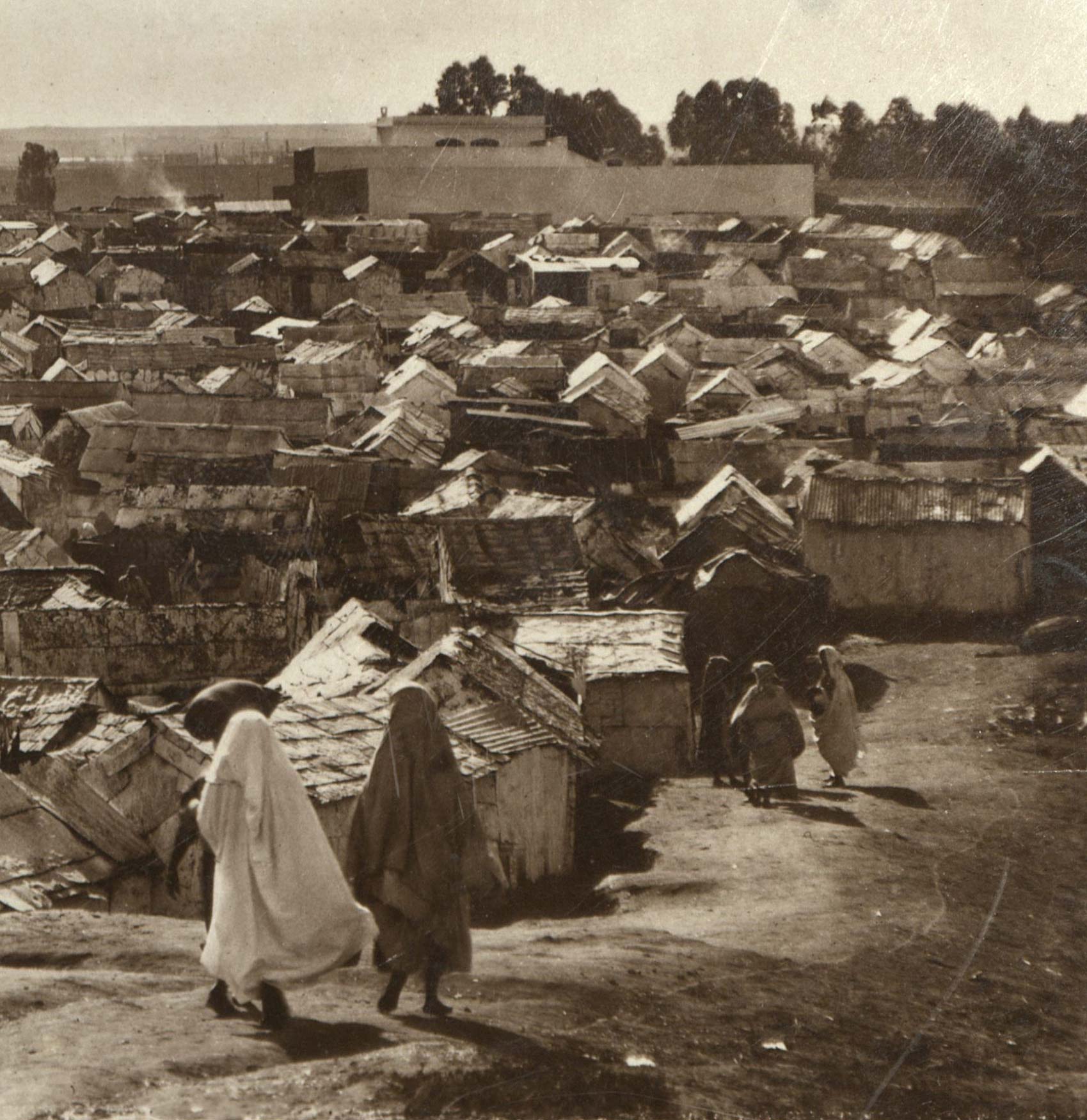
SHEILA CRANE
City in the Shadow of Shantytown. A Critical History of Bidonville.
University of Pittsburgh Press, forthcoming
In this book, author Sheila Crane expands our understanding Moroccan and Algerian shantytowns located on the periphery of French colonial cities. Through the careful examination of archival sources, Crane analyzes these shantytowns as a complex form of landscape urbanity challenging the tropes through which most urban scholars have discussed informality as a “spatial manifestation of poverty or marginalization”.
The title is part of the University of Pittsburgh Press' Culture, Politics, and Built Environment series (edited by Dianne Harris, dean of the College of Arts and Sciences at the University of Washington). Books in this series address the intersecting relationships between the built environment and a range of cultural forces, exploring the ways buildings, cities, and landscapes impact—and are in turn shaped by—the formulation and function of deep social, economic, and political structures. The scope of the series is international and open to multidisciplinary work, but it is primarily focused on publishing spatial histories that have the potential to influence many other kinds of historical thought and writing.
Sheila Crane is the Chair of the Department of Architectural History at the University of Virginia where she has taught since 2007. The Society of Architectural Historians selected her first book Mediterranean Crossroads: Marseilles and Modern Architecture (2011) for the Spiro Kostof Award (2013). Crane is the recipient of numerous fellowships and awards for her scholarly work including the Mellon Fellowship in Urban Landscape Studies from Harvard University’s Dumbarton Oaks Research Institute (Garden and Landscape Studies Program), the Clark Fellowship from the Sterling and Francine Clark Art Institute, the Sidney J. Weinberg Foundation Fellowship in Architectural History and Preservation from Columbia University’s Italian Academy for Advanced Study in America, and the Visiting Scholarship from the Canadian Centre for Architecture.
YVONNE ELET
Urban Landscape in the Third Rome: Raphael's Villa and Mussolini's Forum
Edifer, 2023
The "Renaissance" gardens of Villa Madama, Raphael's late masterwork for the Medici popes, were actually completely recreated in the twentieth century, although little information about them has previously emerged. Based on abundant material from private archives, this book reveals an unknown story of the gardens' creation by an international cohort of designers and patrons. It further details how the restored villa came to be integrated into one of the most significant urban initiatives of the Fascist ventennio—the neighboring Foro Mussolini (current Foro Italico)—and linked with the seat of the Foreign Ministry in a verdant garden park. This novel account of the synergy among these coeval projects traces the interwar development of this symbolic entry zone to Rome, demonstrating the power of urban landscape for constructing political and cultural identity. This narrative integrates the histories of architecture, of gardens and landscape, of urban form, and of restoration with the storia del gusto and political history. It also introduces the villa's owners—a French engineer, then an Italian count and a flamboyant American heiress—interweaving stories of their lives with their restoration of this significant heritage site, set against the political backdrop of the Fascist ascendency. The richly textured narrative yields a new portrait of the villa as an international salon for soft diplomacy, and examines the mythologizing of Renaissance heritage by ideologues and propagandists establishing the Third Rome. Ultimately it is a tale of diachronic political theater in the palimpsestic gateway to Rome, at a crucial moment for the formation of Italian cultural identity and Roman urban form.
Yvonne Elet is Associate Professor of Art History at Vassar College, New York. A specialist in Italian early modern art and architecture, her research focuses on Renaissance villa culture; integrated designs for art, architecture, and landscape; early modern stucco; and intersections among art, literature, science, and natural philosophy. Her articles appear in the Journal of the Society of Architectural Historians and I Tatti Studies in the Italian Renaissance. She has received grants from the Center for Advanced Studies in the Visual Arts, the Getty Research Institute, and the American Council of Learned Societies. She has also been a Fellow at the Metropolitan Metropolitan Museum of Art and at the Frick Collection, New York, as well as a visiting scholar at the Max-Planck-Institut für Wissenschaftsgeschichte, Berlin.
JOSEPH HEATHCOTT
Global Queens: An Urban Mosaic
Fordham University Press, 2023
Remade by decades of immigration, Queens, New York, has emerged as an emblematic space of social mixing and encounters across multiple lines of difference. With its expansive subdivisions, tangled highways, and centerless form, it is also New York’s most enigmatic borough. It can feel alternately like a big city, a tight-knit village, a featureless industrial zone, or a sprawling suburban community. Through more than 200 contemporary photographs, Joseph Heathcott captures this multifaceted borough and one of the most diverse places in the United States.
Drawn from more than a decade of roaming around Queens and snapping photos, Heathcott conveys the juxtaposition of the ordinary and the extraordinary, the mundane and the surprising, and the staggering social diversity that best characterizes Queens. At the heart of the story are two separate but entwined histories: the rapid expansion of the borough’s built environment through the twentieth century, and the millions of people who have traveled from near and far to call Queens home. Newcomers have had to confront discrimination, white racial hostility, legal challenges, and language barriers. They have had to struggle to find adequate housing, places to worship, and jobs that pay enough to survive. And they have done all of this in the borough’s jumbled collection of neighborhoods, housing types, civic and religious institutions, factories and warehouses, commercial streets, and strip malls.
Heathcott makes primary use of documentary photography to bring these social and spatial realities of everyday life into relief. He also draws on demographic data, archival sources, planning documents, news stories, and reports. The result is a visual meditation on Queens that provides clues about an urban future where notions of citizenship and belonging are negotiated across multiple lines of difference, but where a sense of ”getting along”—however roughly textured and unfinished—has taken hold in the everyday life of the streets.
Joseph Heathcott is a writer, photographer, educator, and Chair of Urban and Environmental Studies at The New School. His work has appeared in a wide range of venues, including books, academic journals, magazines, exhibits, and juried art shows. His most recent books include Urban Infrastructure: Historical and Social Dimensions of an Interconnected World; The Routledge Handbook of Infrastructure Design: Global Perspectives from Architectural History; and Capturing the City: Photographs from the Streets of St. Louis, 1900–1930.
The David R. Coffin Publication Grant was not awarded in 2022.
Rolf Diamant and Ethan Carr
Olmsted and Yosemite: Civil War, Abolition, and the National Park Idea
Library of American Landscape History
Both Central Park in New York and Yosemite Valley in California became public parks during the tumultuous years before and during the Civil War. Rolf Diamant and Ethan Carr demonstrate how anti-slavery activism, war, and the remaking of the federal government gave rise to the American public park. The authors closely examine Frederick Law Olmsted’s 1865 Yosemite Report—the key document that expresses the aspirational vision of making great public parks keystone institutions of a renewed liberal democracy. Yosemite, the prototype of the national park system, embodied the “new birth of freedom” that inspired the nation during its greatest crisis. The park epitomized the duty of Republican government to act to enhance the lives and well-being of all of its citizens, and its creation was rooted in contemporary ideology of Union, abolition, and progress.
A consistent thread runs through the apparently disparate events of anti-slavery activism, the war effort, and the creation of urban and national parks: the life and work of Frederick Law Olmsted. His Yosemite Report (reprinted in this volume), provided the intellectual framework for a national park system. Olmsted’s influence lived on, when his son and namesake drafted the key portions of the 1916 legislation that created the National Park Service. The goals and purposes of national parks he described were based on the ideas and aspirations his father had expressed fifty years earlier.
But Olmsted’s role in national park history has been deemphasized since then. The early twentieth century was a period of “reconciliation” between North and South—and of Jim Crow restrictions and segregation. The National Park Service sought more neutral and anodyne narratives explaining the “national park idea.” Associating national parks with the ideology and politics of the Civil War and Reconstruction apparently did not serve the young agency seeking to build a national coalition of park supporters and their elected representatives some from the South). The official origins of the national parks were therefore mythologized as “campfire tales.” The first was the story of an 1870 campfire in Yellowstone—an event that never took place—during which a visiting group of scientists and businessmen were supposed to have spontaneously declared that the region should be made a national park. By the 1970s that account became factually insupportable, and the story was replaced by that of another campfire (this one at least did occur) in Yosemite in 1903, during which Theodore Roosevelt and John Muir discussed the future of public lands, generally, and of Yosemite Valley in particular. But while these two figures are giants in the history of American conservation, neither thought up the idea of national parks or the National Park Service.
This book offers a new interpretation of how the American park—urban and national—came to loom so large in the national imagination. It comes at an important time, following the centennial of the National Park Service, and during a period of reassessment of the tortured national legacy of racism.
Rolf Diamant of Woodstock is an adjunct associate professor in the University of Vermont’s History Department/Historic Preservation Program.
Ethan Carr is a professor of landscape architecture at the University of Massachusetts, Amherst. He is a landscape historian and preservationist specializing in public landscapes.
Catherine Seavitt Nordenson
The Miasmist: George E. Waring Jr. and the Sanitary Landscape
University of Texas Press
In 1867, nineteenth-century sanitary engineer George E. Waring, Jr. (1833–1898) published an influential manual entitled “Draining for Profit, Draining for Health,” reflecting the obsessions of his gilded age—wealth, health, and miasma. Even as the germ theory emerged, Waring supported the anti-contagionist miasma theory, positing that disease spread through the air as a poisonous vapor, emerging from damp soil. He applied his knowledge of farm drainage to an urban theory of public health, with a drainage plan for Central Park; a sewerage system for Memphis; a transformation of New York City’s Department of Street Cleaning; and a sanitation plan for Havana, Cuba. Waring’s battle against miasma was an endeavor to transform both the physical landscape and its inhabitants’ morality; his brilliant failure (in scientific terms) is worth reassessing in light of the public health and equity issues arising from today’s pandemic and climate crises.
Catherine Seavitt Nordenson is a professor and director of the graduate landscape architecture program at the Spitzer School of Architecture, City College of New York
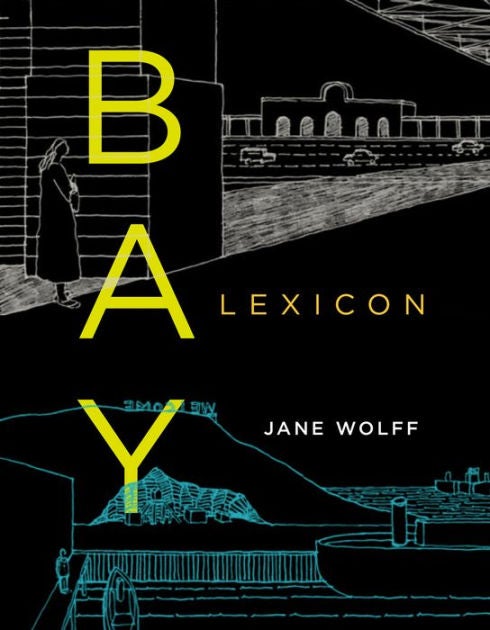
Jane Wolf
Bay Lexicon
McGill-Queen’s University Press
As human populations inhabiting cities have grown dramatically, we have lost the ability to understand and even to see the natural world around us. We lack the vocabulary to describe our surroundings, and this lack of understanding limits our ability as citizens to contribute to political decisions about the landscape of cities, especially at the edges where land meets water. Bay Lexicon, a field guide to San Francisco's shoreline, is a case study in establishing a working language for hybrid landscapes. Centred on a walk along the edge of the iconic San Francisco Bay, it documents, deciphers, and classifies the places and phenomena a person encounters—and the forces, histories, and interactions that underlie what is visible. In a unique synthesis of text and drawing, Jane Wolff applies analytical and representational tools based in design and documentary work to findings from the fields of geography, environmental and cultural history, public policy, urban ecology, and landscape studies. As our cities face increasing pressure caused by climate change, we will need to reimagine them in terms that do justice to their complexity. Bay Lexicon's methods for building landscape literacy are meant for translation, adaptation, and use far beyond San Francisco Bay. Through activist scholarship that cuts across disciplinary boundaries and levels of expertise, this book examines how the landscape at the water's edge works, documents its historical evolution, brings its citizens' values to light, and frames conversations about how and why it might change.
Jane Wolff is an associate professor at the University of Toronto’s Daniels Faculty of Architecture, Landscape, and Design and the author of Delta Primer: A Field Guide to the California Delta.
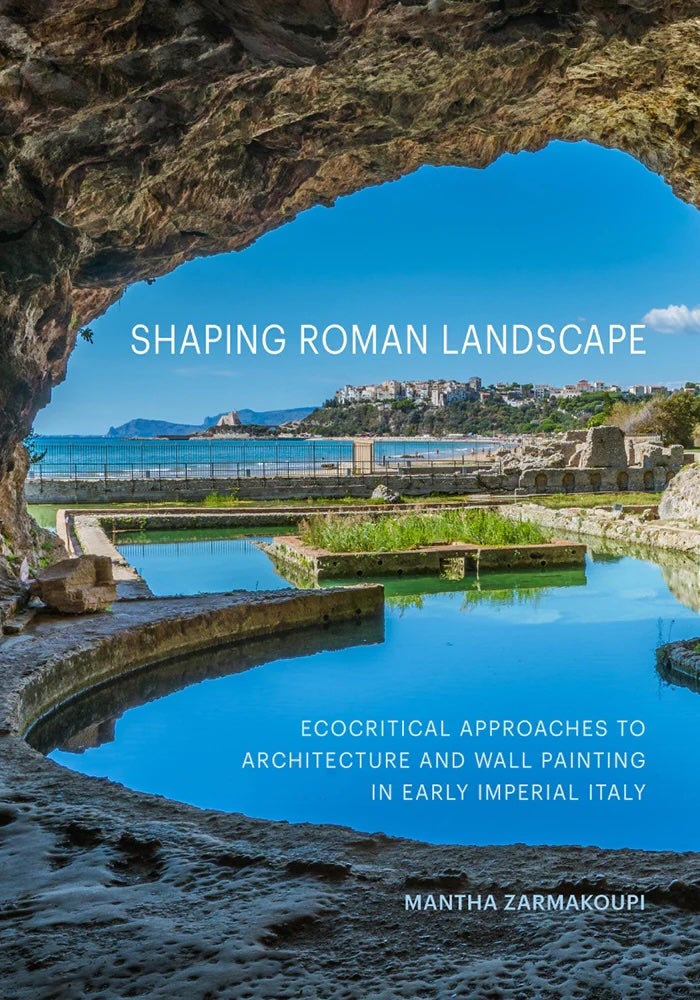
Mantha Zarmakoupi
Roman Landscape: Eco-critical Approaches to Early Imperial History
J. Paul Getty Museum Publications
Landscape emerged as a significant theme in the Roman Late Republican and Early Imperial periods. Writers described landscape in texts and treatises, its qualities were praised and sought out in everyday life, and contemporary perceptions of the natural and built environment, as well as ideas about nature and art, were intertwined with architectural and decorative trends.
This illustrated volume examines how representations of real and depicted landscapes, and the merging of both in visual space, contributed to the creation of novel languages of art and architecture. Drawing on a diverse body of archaeological, art historical, and literary evidence, this study applies an ecocritical lens that moves beyond the limits of traditional iconography. Chapters consider, for example, how garden designs and paintings appropriated the cultures and ecosystems brought under Roman control and the ways miniature landscape paintings chronicled the transformation of the Italian shoreline with colonnaded villas, pointing to the changing relationship of humans with nature. Making a timely and original contribution to current discourses on ecology and art and architectural history, Shaping Roman Landscape reveals how Roman ideas of landscape, and the decorative strategies at imperial domus and villa complexes that gave these ideas shape, were richly embedded with meanings of nature, culture, and labor.
Mantha Zarmakoupi is the Morris Russell and Josephine Chidsey Williams Assistant Professor in Roman Architecture and Urbanism in the Department of History of Art at the University of Pennsylvania.
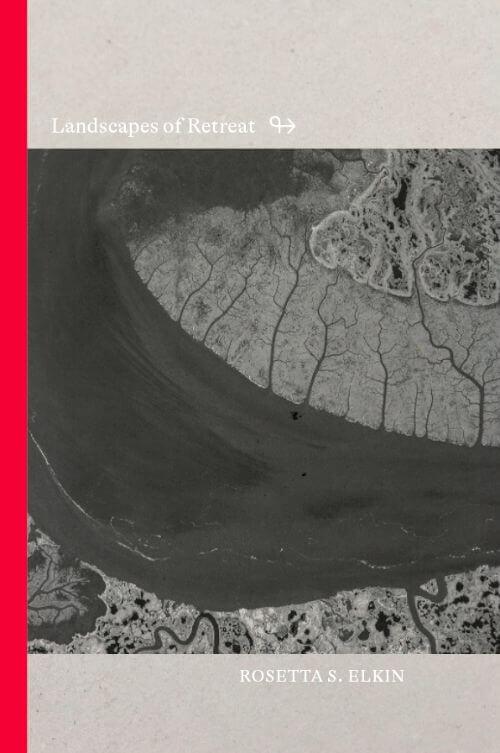
ROSETTA S. ELKIN
Landscapes of Retreat
K. Verlag, 2022
Landscapes of Retreat are portraits of climate adaptation. Retreat is found in the land that is left behind as settlement patterns shift due to a changing climate. The term landscape refers to the earth animated by the aliveness of creatures and organisms, and the term retreat suggests that human patterns are not fixed but might also be enlivened. Featuring in-depth field studies from Nijinomatsubara Forest/Japan, Maule River/Chile, Niugtaq Village/Alaska, Langtang Park/Nepal, and Gaspésie Peninsula/Québec, the stories in Landscapes of Retreat suggest that communities are more likely to adapt to change when the landscape is appreciated, so that retreat can be valued. The results cut across history, fieldwork, citizenship, and geography in order to rethink and rework “change” as a means toward shared climate futures.
Rosetta S. Elkin is Associate Professor and Academic Director of Landscape Architecture at Pratt Institute, Principal of Practice Landscape and Research Associate at the Arnold Arboretum of Harvard University.
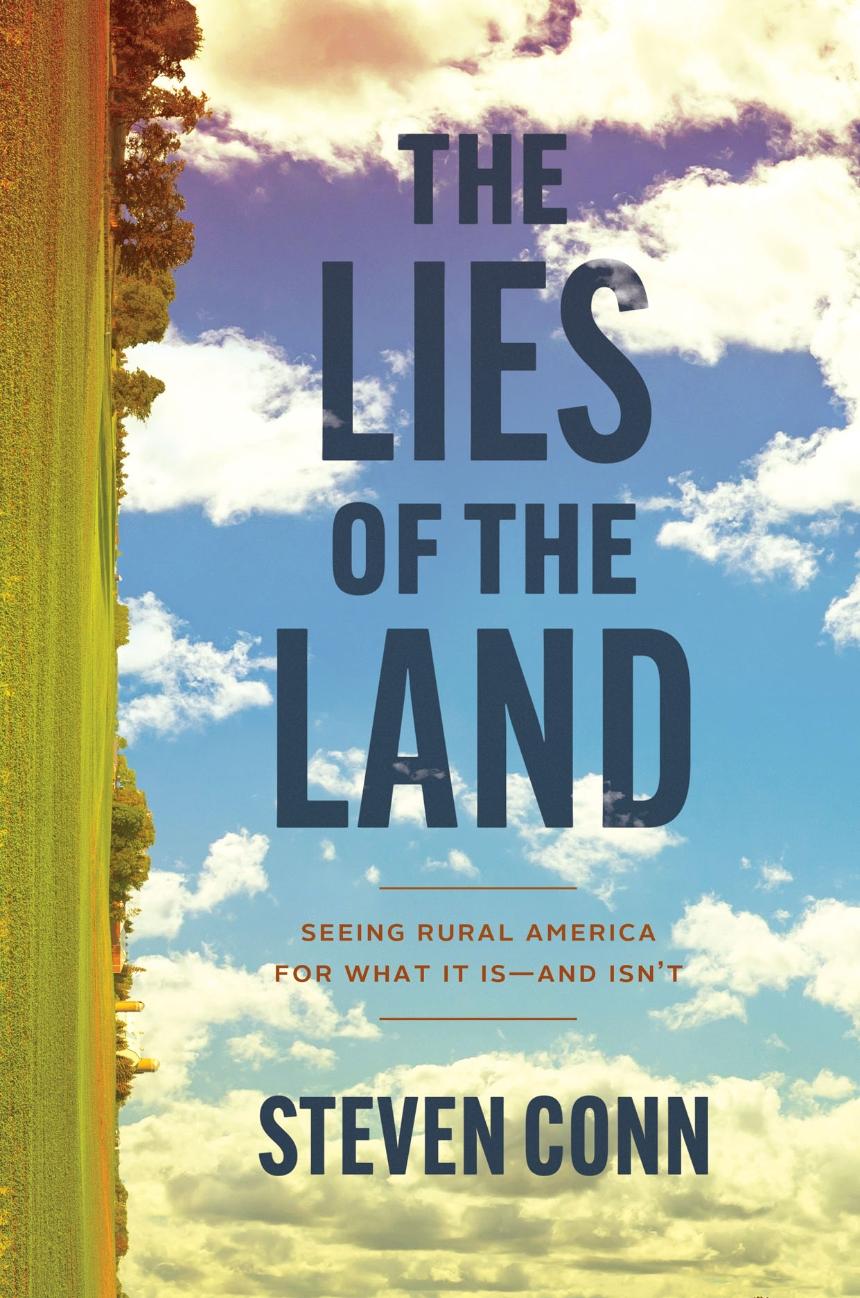
STEVEN CONN
The Lies of the Land: Seeing Rural American for What It Is – and Isn’t
The University of Chicago Press, 2023
It seems everyone has an opinion about rural America. Is it gripped in a tragic decline? Or is it on the cusp of a glorious revival? Is it the key to understanding America today? Steven Conn argues that we’re missing the real question: Is rural America even a thing? No, says Conn, who believes we see only what we want to see in the lands beyond the suburbs—fantasies about moral (or backward) communities, simpler (or repressive) living, and what it means to be authentically (or wrongheadedly) American. If we want to build a better future, Conn argues, we must accept that these visions don’t exist and never did.
In The Lies of the Land, Conn shows that rural America—so often characterized as in crisis or in danger of being left behind—has actually been at the center of modern American history, shaped by the same forces as everywhere else in the country: militarization, industrialization, corporatization, and suburbanization. Examining each of these forces in turn, Conn invites us to dispense with the lies and half-truths we’ve believed about rural America and to pursue better solutions to the very real challenges shared all across our nation.
Steven Conn is the W. E. Smith Professor of History at Miami University in Oxford, Ohio.
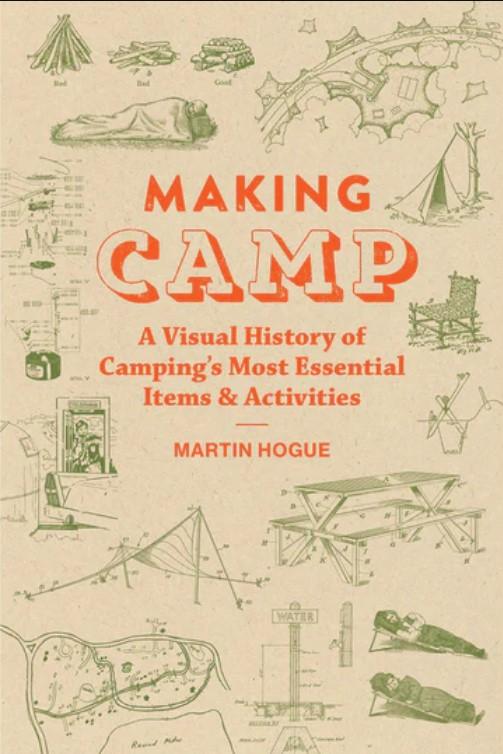
MARTIN HOGUE
Making Camp: A Visual history of Camping’s Most Essential Items and Activities
Princeton Architectural Press, 2023
There is a satisfying immediacy about the prospect of establishing an encampment for the night—clearing the site, erecting the tent, chopping wood, building a fire and cooking over the live flame—that suggests a meaningful connection to landscape, place, and the rugged life of backwoods adventurers. Each summer 40 million Americans take to the road in search of this powerful experience of nature. Serviced by extensive networks of infrastructure and populated with automobiles, trailers, $300,000 RVs, massive tents, thick mattresses, coolers, stoves and other forms of specialized gear, each of the nation’s 20,000 campgrounds and their 900,00 "lone" campsites functions as a stage upon which these cultural fantasies are performed, often in full view of a nearby audience of fellow enthusiasts.
Making Camp examines the evolution of this spatial setting by tracing the origins of its feature components: the campsite, the campfire, the picnic table, the map, the tent, the sleeping bag, as well as water delivery and trash collection systems. With so many of these elements in place as the visitor arrives, what few aspects of the craft remain that provide the camper the sense of agency that they are making their own camp? The book is supported by a rich collection of archival materials (photographs, paintings, film stills, diagrams, sketches, patents, technical drawings) that help illustrate the radical transformation of this mythical American ideal ever since the practice first took hold of the public imagination in the wilds of the Adirondacks 150 years ago.
Martin Hogue is a licensed architect and an associate professor in the Department of Landscape Architecture at Cornell University.
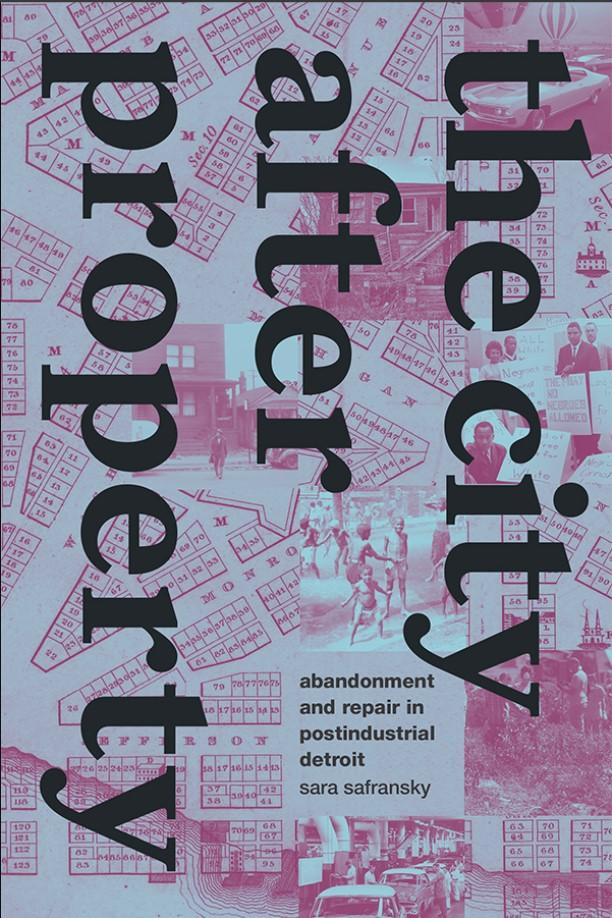
SARA SAFRANSKY
The City after Property: Abandonment and Repair in Postindustrial Detroit
Duke University Press, 2023
In The City after Property, Sara Safransky examines how postindustrial decline generates new forms of urban land politics. In the 2010s, Detroit government officials classified a staggering 150,000 lots—more than a third of the city—as “vacant” or “abandoned.” Analyzing subsequent efforts to shrink the Motor City’s footprint and budget, Safransky presents a new way of conceptualizing urban abandonment. She challenges popular myths that cast Detroit as empty along with narratives that reduce its historical decline to capital and white flight. In connecting contemporary debates over neoliberal urbanism to Cold War histories and the lasting political legacies of global movements for decolonization and Black liberation, she foregrounds how the making of—and challenges to—modern property regimes have shaped urban policy and politics. Drawing on critical geographical theory and community-based ethnography, Safransky shows how private property functions as a racialized construct, an ideology, and a moral force that shapes selves and worlds. By thinking the city “after property,” Safransky illuminates alternative ways of imagining and organizing urban life.
Sara Safransky is a geographer and Assistant Professor in the Department of Human and Organizational Development at Vanderbilt University.
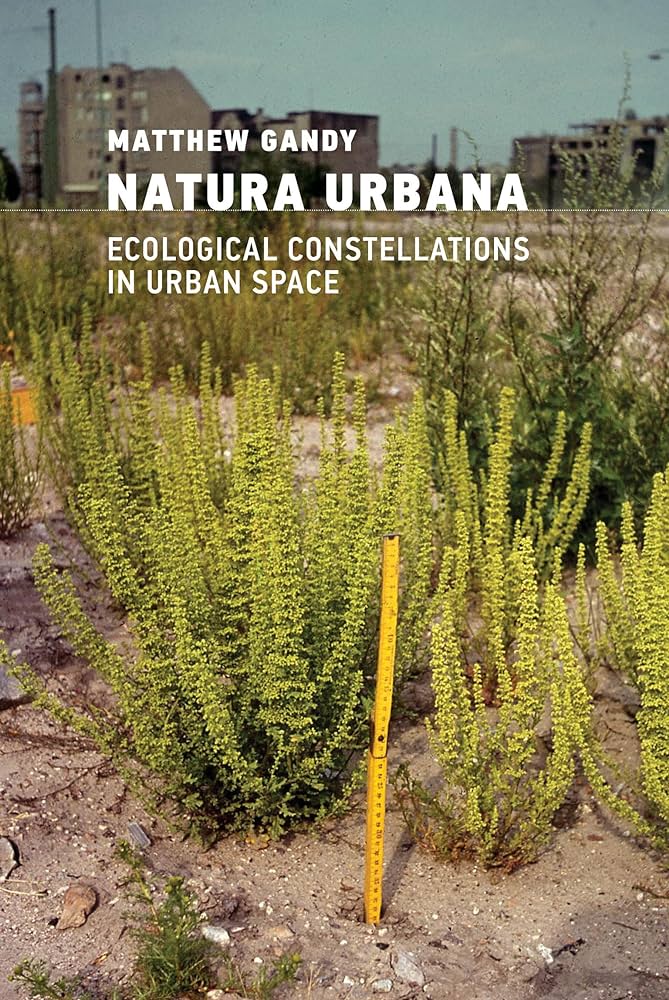
MATTHEW GANDY
Natura Urbana: Ecological Constellations in Urban Space
MIT Press, 2022
Postindustrial transitions and changing cultures of nature have produced an unprecedented degree of fascination with urban biodiversity. The “other nature” that flourishes in marginal urban spaces, at one remove from the controlled contours of metropolitan nature, is not the poor relation of rural flora and fauna. Indeed, these islands of biodiversity underline the porosity of the distinction between urban and rural. In Natura Urbana, Matthew Gandy explores urban nature as a multilayered material and symbolic entity, through the lens of urban ecology and the parallel study of diverse cultures of nature at a global scale.
Gandy examines the articulation of alternative, and in some cases counterhegemonic, sources of knowledge about urban nature produced by artists, writers, scientists, as well as curious citizens, including voices seldom heard in environmental discourse. The book is driven by Gandy's fascination with spontaneous forms of urban nature ranging from postindustrial wastelands brimming with life to the return of such predators as wolves and leopards on the urban fringe. Gandy develops a critical synthesis between different strands of urban ecology and considers whether "urban political ecology," broadly defined, might be imaginatively extended to take fuller account of both the historiography of the ecological sciences, and recent insights derived from feminist, posthuman, and postcolonial thought.
Matthew Gandy is Professor of Geography at the University of Cambridge and the author of Concrete and Clay and The Fabric of Space, both published by the MIT Press.
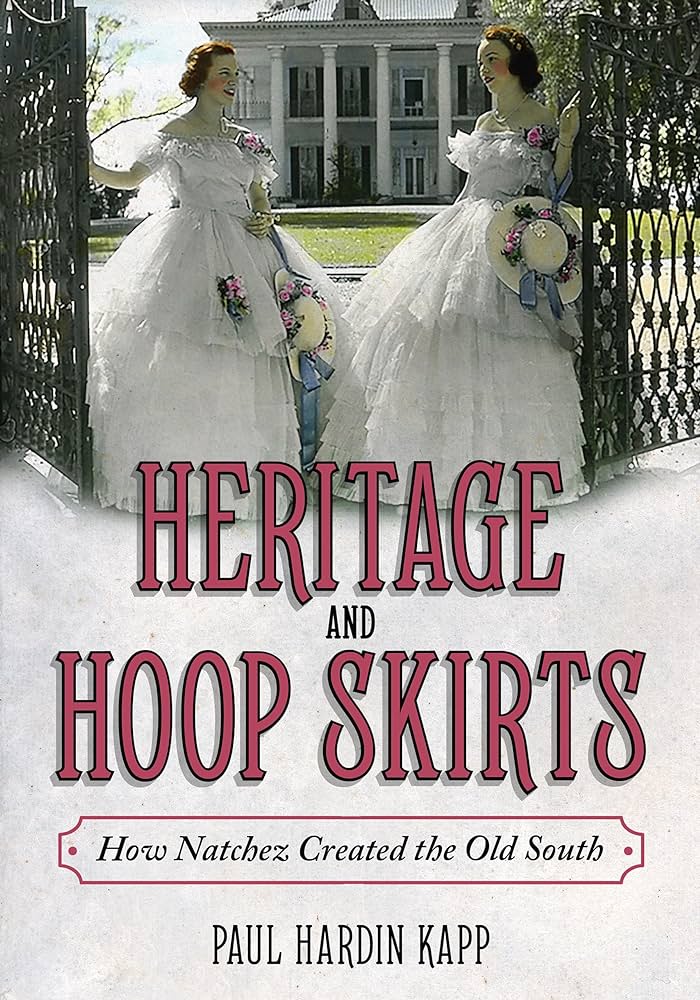
PAUL HARDIN KAPP
Heritage and Hoop Skirts: How Natchez Created the Old South
University Press of Mississippi, 2022
For over eighty years, tourists have flocked to Natchez, Mississippi, seeking the “Old South,” but what they encounter is invention: a pageant and rewrite of history first concocted during the Great Depression. In Heritage and Hoop Skirts: How Natchez Created the Old South, author Paul Hardin Kapp reveals how the women of the Natchez Garden Club saved their city, created one of the first cultural tourism economies in the United States, changed the Mississippi landscape through historic preservation, and fashioned elements of the Lost Cause into an industry.
Beginning with the first Natchez Spring Pilgrimage of Antebellum Homes in 1932, such women as Katherine Grafton Miller, Roane Fleming Byrnes, and Edith Wyatt Moore challenged the notion that smokestack industries were key to Natchez’s prosperity. These women developed a narrative of graceful living and aristocratic gentlepeople centered on grand but decaying mansions. In crafting this pageantry, they created a tourism magnet based on the antebellum architecture of Natchez. Through their determination and political guile, they enlisted New Deal programs, such as the WPA Writers’ Project and the Historic American Buildings Survey, to promote their version of the city.
Their work did save numerous historic buildings and employed both white and African American workers during the Depression. Still, the transformation of Natchez into a tourist draw came at a racial cost and further marginalized African American Natchezians. By attending to the history of preservation in Natchez, Kapp draws on a rich archive of images, architectural documents, and popular culture to explore how meaning is assigned to place and how meaning evolves over time. In showing how and why the Natchez buildings of the “Old South” were first preserved, commercialized, and transformed into a brand, this volume makes a much-needed contribution to ongoing debates over the meaning attached to cultural patrimony.
Paul Hardin Kapp is a professional and academic historic preservationist. He is associate professor of architecture at the School of Architecture and associate director of the Collaborative for Cultural Heritage and Policy, University of Illinois at Urbana-Champaign. He is author of The Architecture of William Nichols: Building the Antebellum South in North Carolina, Alabama, and Mississippi, published by University Press of Mississippi, and coeditor of SynergiCity: Reinventing the Postindustrial City. He is a National Endowment for the Humanities Fellow, a Senior Fulbright Scholar, a James Marston Fitch Mid-career Fellow, and a Franklin Fellow, US Department of State.
LAURA J MARTIN
Wild by Design: The Rise of Ecological Restoration
Harvard University Press, 2022
Environmental restoration is a global pursuit and a major political concern. Governments, nonprofits, private corporations, and other institutions spend billions of dollars each year to remove invasive species, build wetlands, and reintroduce species driven from their habitats. But restoration has not always been so intensively practiced. It began as the pastime of a few wildflower enthusiasts and the first practitioners of the new scientific discipline of ecology.
Restoration has been a touchstone of US environmentalism since the beginning of the twentieth century. Diverging from popular ideas about preservation, which romanticized nature as an Eden to be left untouched by human hands, and conservation, the managed use of natural resources, restoration emerged as a “third way.” Restorationists grappled with the deepest puzzles of human care for life on earth: How to intervene in nature for nature’s own sake? What are the natural baselines that humans should aim to restore? Is it possible to design nature without destroying wildness? Laura J. Martin shows how, over time, amateur and professional ecologists, interest groups, and government agencies coalesced around a mode of environmental management that sought to respect the world-making, and even the decision-making, of other species. At the same time, restoration science reshaped material environments in ways that powerfully influenced what we understand the wild to be.
In Wild by Design, restoration’s past provides vital knowledge for climate change policy. But Martin also offers something more—a meditation on what it means to be wild and a call for ecological restoration that is socially just.
Laura J. Martin is Assistant Professor of Environmental Studies at Williams College. She is a past fellow of the American Council of Learned Societies, the Stanford Humanities Center, and the Harvard University Center for the Environment. She has written for Scientific American, Slate, Environmental History, Environmental Humanities, Trends in Ecology and Evolution, and other publications.
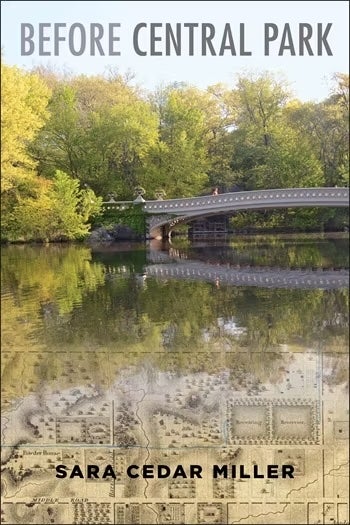
SARA CEDAR MILLER
Before Central Park
Columbia University Press, 2022
With more than eight hundred sprawling green acres in the middle of one of the world’s densest cities, Central Park is an urban masterpiece. Designed in the middle of the nineteenth century by the landscape architects Frederick Law Olmsted and Calvert Vaux, it is a model for city parks worldwide. But before it became Central Park, the land was the site of farms, businesses, churches, wars, and burial grounds—and home to many different kinds of New Yorkers.
This book is the authoritative account of the place that would become Central Park. From the first Dutch family to settle on the land through the political crusade to create America’s first major urban park, Sara Cedar Miller chronicles two and a half centuries of history. She tells the stories of Indigenous hunters, enslaved people and enslavers, American patriots and British loyalists, the Black landowners of Seneca Village, Irish pig farmers, tavern owners, Catholic sisters, Jewish protesters, and more. Miller unveils a British fortification and camp during the Revolutionary War, a suburban retreat from the yellow fever epidemics at the turn of the nineteenth century, and the properties that a group of free Black Americans used to secure their right to vote. Tales of political chicanery, real estate speculation, cons, and scams stand alongside democratic idealism, the striving of immigrants, and powerfully human lives. Before Central Park shows how much of the history of early America is still etched upon the landscapes of Central Park today.
Sara Cedar Miller is the historian emerita of the Central Park Conservancy, which she first joined as a photographer in 1984. Her books include Central Park: An American Masterpiece (2003), Strawberry Fields: Central Park’s Memorial to John Lennon (2011), and Seeing Central Park: The Official Guide (updated and expanded edition, 2020).
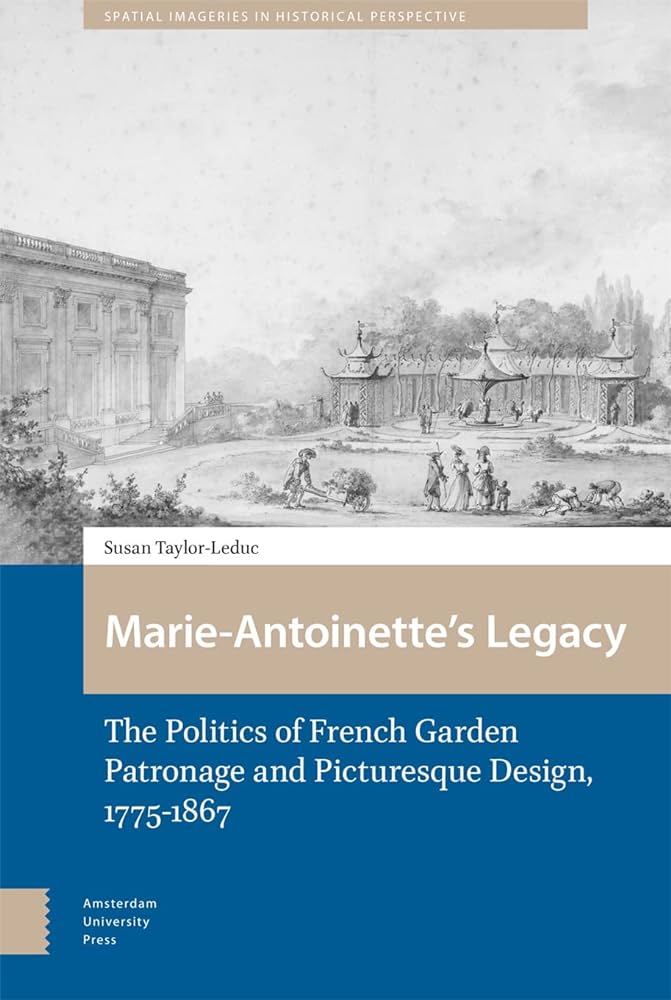
SUSAN TAYLOR-LEDUC
Marie-Antoinette’s Legacy: The Politics of French Garden Patronage and Picturesque Design, 1775-1867
Amsterdam University Press, 2022
Challenging the established historiography that frames the French picturesque garden movement as an international style, this book contends that the French picturesque gardens from 1775 until 1867 functioned as liminal zones at the epicenter of court patronage systems. Four French consorts—queen Marie-Antoinette and empresses Joséphine Bonaparte, Marie-Louise and Eugénie—constructed their gardens betwixt and between court ritual and personal agency, where they transgressed sociopolitical boundaries in order to perform gender and identity politics. Each patron endorsed embodied strolling, promoting an awareness of the sentient body in artfully contrived sensoria at the Petit Trianon and Malmaison, transforming these places into spaces of shared affectivity. The gardens became living legacies, where female agency, excluded from the garden history canon, created a forum for spatial politics. Beyond the garden gates, the spatial experience of the picturesque influenced the development of cultural fields dedicated to performances of subjectivity, including landscape design, cultural geography and the origination of landscape aesthetics in France.
Susan Taylor-Leduc earned both her masters and doctoral degrees from the University of Pennsylvania. Since 1992, she has worked as a teacher, curator and university administrator in Paris. She is currently affiliated with the Centre de Recherche du Château de Versailles.
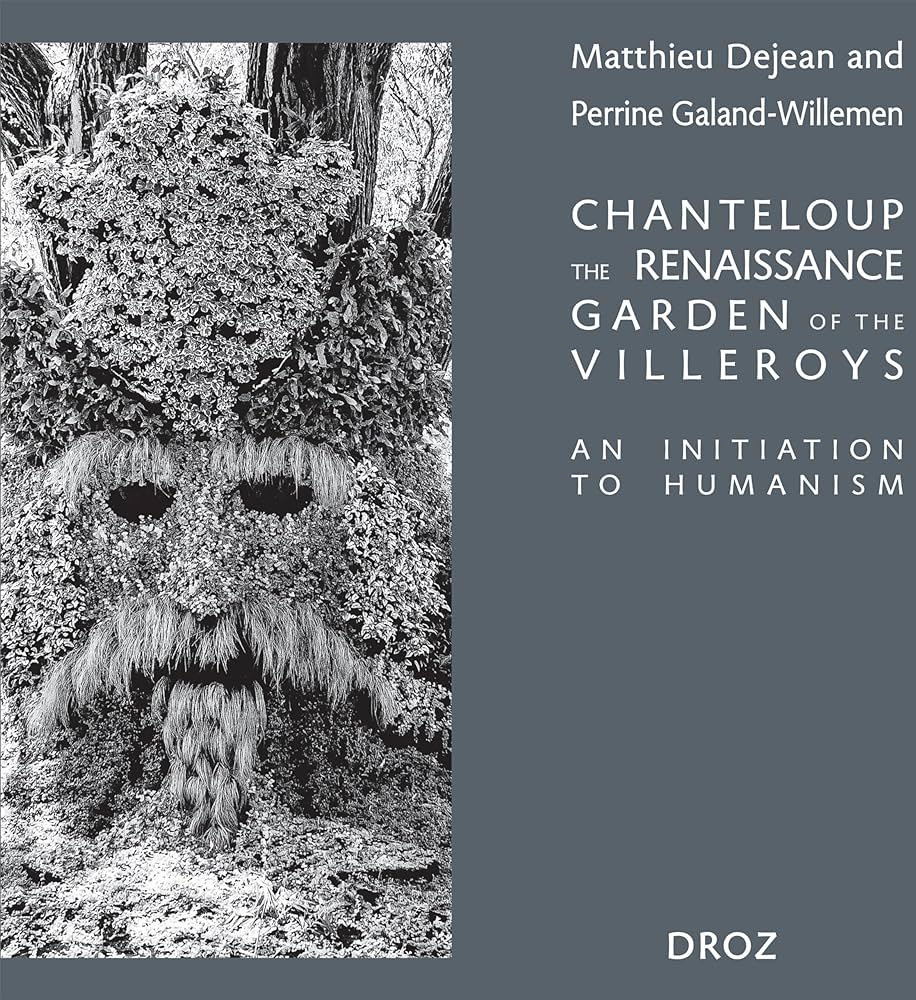
MATTHIEU DEJEAN AND PERRINE GALAND-WILLEMEN
Chanteloup: The Renaissance Garden of the Villeroys
Droz Publishing, 2022
The garden of the Chanteloup castle (Saint-Germain-lès-Arpajon), owned by the Villeroy-Neufville family, was one of the wonders of the French Renaissance, which could compete with the great Italian gardens of the time. Perrine Galand-Willemen and Matthieu Dejean revive this exceptional artistic creation in its historical and intellectual context. The authors have studied several travel guides and a long Latin poem entitled Cantilupum (Paris, 1587; 1588), which describes the meanders of the garden. Cantilupum was written by Madeleine de L'Aubespine-Villeroy (1546-1596), wife of Secretary of State Nicolas IV de Neufville-Villeroy, lady of honour of Catherine de' Medici, woman of letters whom Ronsard considered his “spiritual daughter”. The garden of Chanteloup housed an extraordinary set of topiaries (carved shrubs), automata, statues, models and fountains, which recreated Roman civilization and offered an initiatory, stoic-Christian course to the walker.
Matthieu Dejean is an independent scholar who studies Renaissance Gardens, Fountains and Nymphaea, and Renaissance Art.
Perrine Galand-Willemen is a French Latinist whose work is focused on the influence and pedagogy of Latin poetics across Europe.

SARAH JENSEN CARR
The Topography of Wellness: How Health and Disease Shaped the American Landscape
UVA Press, 2021
The COVID-19 pandemic has reignited discussions of how architects, landscape designers, and urban planners can shape the environment in response to disease. This challenge is both a timely topic and one with an illuminating history. In The Topography of Wellness, Sara Jensen Carr offers a chronological narrative of how six epidemics transformed the American urban landscape, reflecting changing views of the power of design, pathology of disease, and the epidemiology of the environment. From the infectious diseases of cholera and tuberculosis, to so-called social diseases of idleness and crime, to the more complicated origins of today’s chronic diseases, each illness and its associated combat strategies has left its mark on our surroundings. While each solution succeeded in eliminating the disease on some level, sweeping environmental changes often came with significant social and physical consequences. Even more unexpectedly, some adaptations inadvertently incubated future epidemics. From the Industrial Revolution to present day, this book illuminates the constant evolution of our relationship to wellness and the environment by documenting the shifting grounds of illness and the urban landscape.
Preparation of this volume has been supported by Furthermore: a program of the J. M. Kaplan Fund. Sara Jensen Carr is Assistant Professor of Architecture, Urbanism, and Landscape at Northeastern University.

ANETTE FREYTAG
The Landscapes of Dieter Kienast
GTA Press/ETH Zurich, 2021
Dieter Kienast (1945–1998) is a key figure in European landscape architecture. Amidst a striking change in societal understandings of nature, he sought a synthesis between design and ecology in the 1970s. He designed spaces to make the dissolving opposition between city and countryside legible and to enable aesthetic experience to help cope with increasingly complex everyday life. As a designer, planner, researcher and university lecturer, Kienast introduced new challenges into the discussion of those fields. Critique of urban planning, processes of participation and the significance of spontaneous urban vegetation played just as much a role in these discussions as did art, literature, architecture and the popularity of postmodernism.
Anette Freytag’s award-winning book, which offers the first and comprehensive critical examination of Dieter Kienast, is now available to an international audience in this English edition. It not only vividly deconstructs how design, theory and representation are interwoven in Kienast’s work, but also sheds light on a specific period of landscape architecture.
Anette Freytag is an award-winning scholar, educator and critic and a Professor of the History and Theory of Landscape Architecture at Rutgers University.

CLARE HICKMAN
The Doctor’s Garden: Medicine, Science, and Horticulture in Britain
Yale University Press, 2021
As Britain grew into an ever-expanding empire during the late eighteenth and early nineteenth centuries, new and exotic botanical specimens began to arrive within the nation’s public and private spaces. Gardens became sites not just of leisure, sport, and aesthetic enjoyment, but also of scientific inquiry and knowledge dissemination. Medical practitioners used their botanical training to capitalize on the growing fashion for botanical collecting and agricultural experimentation in institutional, semipublic, and private gardens across Britain. This book highlights the role of these medical practitioners in the changing use of gardens in the late Georgian period, marked by a fluidity among the ideas of farm, laboratory, museum, and garden. Placing these activities within a wider framework of fashionable, scientific, and economic interests of the time, historian Clare Hickman argues that gardens shifted from predominately static places of enjoyment to key gathering places for improvement, knowledge sharing, and scientific exploration.
Clare Hickman is a senior lecturer in history at Newcastle University. She lives in Whitley Bay, United Kingdom.

VALENCIA LIBBY
The Northwest Gardens of Lord & Schryver
Oregon State University Press, 2021
Lord & Schryver, the first landscape architecture firm founded and operated by women in the Pacific Northwest, designed more than two hundred gardens in Oregon and Washington, including residential, civic, and institutional landscapes. Elizabeth Lord and Edith Schryver met as young women and in 1929 established their highly successful firm in Salem; their work is acknowledged as one of the milestones in the history of garden design in the Northwest and beyond. Theirs is the only Oregon firm recognized in Pioneers of Landscape Architecture, compiled by the National Park Service. The Cultural Landscape Foundation describes them as “consummate professionals in the broadest sense, as they worked to raise the profile of landscape architects by involving an audience beyond their clients. Their work represented a transition from a formal symmetrical style of garden design to one which responded in a distinctive way to the unique features of Northwest climate, soil, topography, and plant material.”
Gaiety Hollow, their purpose-built Salem home, garden, and studio, is now owned by the Lord & Schryver Conservancy and is open to the public. The conservancy has lovingly restored the gardens at Gaiety Hollow according to Lord & Schryver’s original plans. They have also restored and now maintain the gardens at Deepwood, a former residence that is now a public park.
Valencia Libby gardens and lectures in Maine. She has researched and taught extensively on women’s contributions to landscape design and horticulture. Libby was an associate professor of landscape architecture and horticulture at Temple University. In 2004 she served as the Fulbright Distinguished Chair in Landscape History in Portugal. She has authored numerous articles on landscape preservation and women’s history.

DAVID MONTEYNE
For the Temporary Accommodation of Settlers: Architecture and Immigrant Reception in Canada, 1870-1930
McGill-Queen’s University Press 2021
For immigrants making the transoceanic journey from Europe or Asia to North America, the experience of a new country began when they disembarked. In Canada the federal government built a network of buildings that provided newcomers with shelter, services, and state support. "Immigration sheds" such as Pier 21 in Halifax - where ocean liners would dock and global migrants arrived and were processed - had many counterparts across the country: new arrivals were accommodated or incarcerated at reception halls, quarantine stations, and immigrant detention hospitals.
For the Temporary Accommodation of Settlers reconstructs the experiences of people in these spaces - both immigrants and government agents - to pose a question at the heart of architectural thinking: how is meaning produced in the built environments that we encounter? David Monteyne interprets official governmental intentions and policy goals embodied by the architecture of immigration but foregrounds the unofficial, informal practices of people who negotiated these spaces to satisfy basic needs, ensure the safety of their families, learn about land and job opportunities, and ultimately arrive at their destinations. The extent of this Canadian network, which peaked in the early twentieth century at over sixty different sites, and the range of building types that comprised it are unique among immigrant-receiving nations in this period.
In our era of pandemic quarantine and migrant detention facilities, For the Temporary Accommodation of Settlers offers new ways of seeing and thinking about the historical processes of immigration, challenging readers to consider government architecture and the experience of migrants across global networks.
David Monteyne is associate professor in the School of Architecture, Planning and Landscape at the University of Calgary.

REBECCA A. SENF
Making a Photographer: The Early Work of Ansel Adams
Yale University Press, 2020
One of the most influential photographers of his generation, Ansel Adams (1902–1984) is famous for his dramatic photographs of the American West. Although many of Adams’s images are now iconic, his early work has remained largely unknown. In this first monograph dedicated to the beginnings of Adams’s career, Rebecca A. Senf argues that these early photographs are crucial to understanding Adams’s artistic development and offer new insights into many aspects of the artist’s mature oeuvre.
Drawing on copious archival research, Senf traces the first three decades of Adams’s photographic practice—beginning with an amateur album made during his childhood and culminating with his Guggenheim-supported National Parks photography of the 1940s. Highlighting the artist’s persistence in forging a career path and his remarkable ability to learn from experience as he sharpened his image-making skills, this beautifully illustrated volume also looks at the significance of the artist’s environmentalism, including his involvement with the Sierra Club.
Published in association with the Center for Creative Photography at the University of Arizona. Rebecca A. Senf is chief curator at the Center for Creative Photography, University of Arizona.
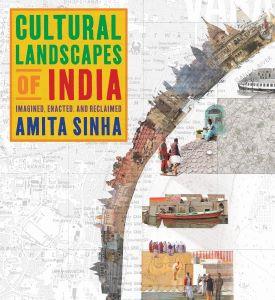
AMITA SINHA
Cultural Landscapes of India: Imagined, Enacted, and Reclaimed
University of Pittsburgh Press, 2020
Most people view cultural heritage sites as static places, frozen in time. In Cultural Landscapes in India, Amita Sinha subverts the idea of heritage as static and examines the ways that landscapes influence culture and that culture influences landscapes. The book centers around imagining, enacting, and reclaiming landscapes as subjects and settings of living cultural heritage. Drawing on case studies from different regions of India, Sinha offers new interpretations of links between land and culture using different ways of seeing—transcendental, romantic, and utilitarian. The idea of cultural landscape can be seen in ancient practices such as circumambulation and immersion in bodies of water that sustain engagement with natural elements. Pilgrim towns, medieval forts, religious sites, and contemporary memorial parks are sites of memory where myth and history converge. Engaging with these spaces allows us to reconstruct collective memory and reclaim not only historic landscapes, but ways of seeing, making, and remembering. In Cultural Landscapes in India makes the case for reclaiming iconic landscapes and rethinking conventional approaches to conservation that take into consideration performative landscape as heritage.
Amita Sinha taught in the Department of Landscape Architecture at the University of Illinois at Urbana Champaign from 1989-2018 and was a visiting professor in the Department of Architecture and Regional Planning, IIT Kharagpur in India. She is the author of Landscapes in India: Forms and Meanings, editor of Landscape Perception, and co-editor of Cultural Landscapes of South Asia: Studies in Heritage Conservation and Management.
MICHAEL VAN VALKENBURGH
Designing a Garden: Monk's Garden at the Isabella Stewart Gardner Museum
The Monacelli Press, 2019
In Designing a Garden, Van Valkenburgh presents the design of the Monk's Garden at the Isabella Stewart Gardner Museum, an intimate, walled garden that Laurie Olin has described as "a masterpiece, and not a minor one."
The book documents the evolution of the garden's design, which is based on the concept of meandering paths through a dreamlike woodland to create a contemplative space. Sketches and models show how the idea was worked out, and lush photographs reveal the completed garden through the seasons.
Van Valkenburgh's text explores the origins of his love of landscape and plants in his family farm in Upstate New York and how this has influenced his intuitions as a designer. He shares the full background story of the Monk's Garden, focusing on the experimental nature of design work as well as the challenges and satisfactions of the small scale and the historic and cultural context.
Designing a Garden provides a unique first-person account of the design process from the most prominent landscape architects in the country.
Michael Van Valkenburgh is the founder of Michael Van Valkenburgh Associates (MVVA) and formerly the Charles Eliot Professor in Practice of Landscape Architecture at the Graduate School of Design at Harvard University. Based in New York and Cambridge, Massachusetts, his firm is widely acknowledged as a leader in the discipline of landscape architecture. MVVA's design for Brooklyn Bridge Park earned the firm the Municipal Art Society's 2010 Brendan Gill Prize, given each year to the creator of a work of art that best captures the spirit and energy of New York City. Other notable projects include Teardrop Park in New York, waterfront parks in Toronto, Dallas, Tulsa, and Detroit, new gardens at the Menil Collection in Houston, and the landscape surrounding the Barack Obama Presidential Center in Chicago's Jackson Park.
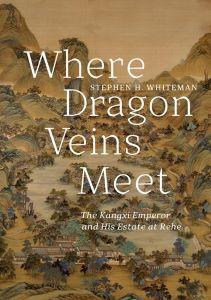
STEPHEN H. WHITEMAN
Where Dragon Veins Meet: The Kangxi Emperor and His Estate at Rehe
University of Washington Press, 2020
In 1702, the second emperor of the Qing dynasty ordered construction of a new summer palace in Rehe (now Chengde, Hebei) to support his annual tours north among the court’s Inner Mongolian allies. The Mountain Estate to Escape the Heat (Bishu Shanzhuang) was strategically located at the node of mountain “veins” through which the Qing empire’s geomantic energy was said to flow. At this site, from late spring through early autumn, the Kangxi emperor presided over rituals of intimacy and exchange that celebrated his rule: garden tours, banquets, entertainments, and gift giving
Stephen Whiteman draws on resources and methods from art and architectural history, garden and landscape history, early modern global history, and historical geography to reconstruct the Mountain Estate as it evolved under Kangxi, illustrating the importance of landscape as a medium for ideological expression during the early Qing and in the early modern world more broadly. Examination of paintings, prints, historical maps, newly created maps informed by GIS-based research, and personal accounts reveals the significance of geographic space and its representation in the negotiation of Qing imperial ideology. The first monograph in any language to focus solely on the art and architecture of the Kangxi court, Where Dragon Veins Meet illuminates the court’s production and deployment of landscape as a reflection of contemporary concerns and offers new insight into the sources and forms of Qing power through material expressions.
Stephen H. Whiteman is senior lecturer in the art and architecture of China at the Courtauld Institute of Art, University of London.
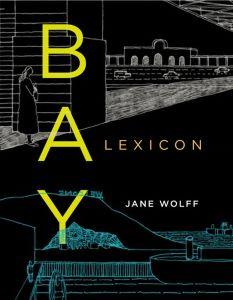
JANE WOLFF
Bay Lexicon
McGill-University Press, 2021
As human populations inhabiting cities have grown dramatically, we have lost the ability to understand and even to see the natural world around us. We lack the vocabulary to describe our surroundings, and this lack of understanding limits our ability as citizens to contribute to political decisions about the landscape of cities, especially at the edges where land meets water.
Bay Lexicon, a field guide to San Francisco's shoreline, is a case study in establishing a working language for hybrid landscapes. Centred on a walk along the edge of the iconic San Francisco Bay, it documents, deciphers, and classifies the places and phenomena a person encounters - and the forces, histories, and interactions that underlie what is visible. In a unique synthesis of text and drawing, Jane Wolff applies analytical and representational tools based in design and documentary work to findings from the fields of geography, environmental and cultural history, public policy, urban ecology, and landscape studies. As our cities face increasing pressure caused by climate change, we will need to reimagine them in terms that do justice to their complexity. Bay Lexicon‘s methods for building landscape literacy are meant for translation, adaptation, and use far beyond San Francisco Bay.
Through activist scholarship that cuts across disciplinary boundaries and levels of expertise, this book examines how the landscape at the water's edge works, documents its historical evolution, brings its citizens' values to light, and frames conversations about how and why it might change.
Jane Wolff is associate professor at the University of Toronto's Daniels Faculty of Architecture, Landscape, and Design.
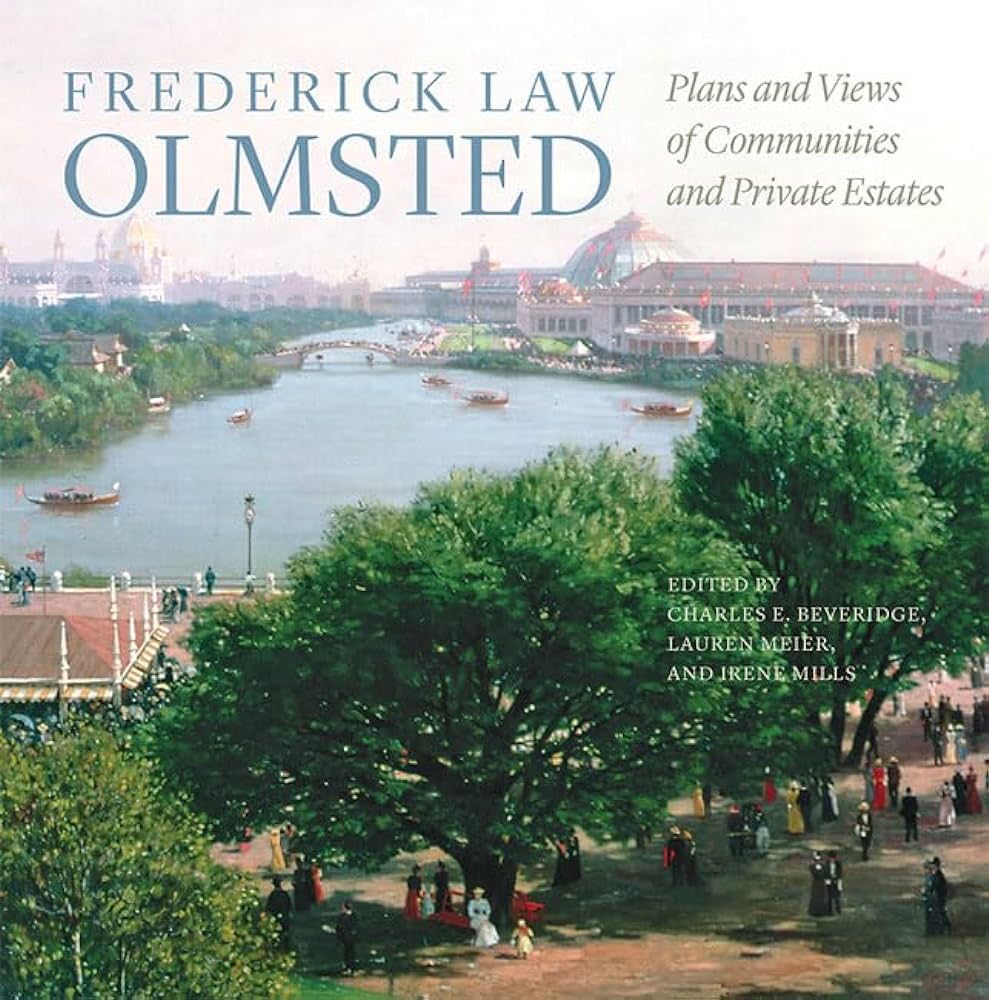
Charles E. Beveridge, Lauren Meier, and Irene Mills, editors
Frederick Law Olmsted: Plans and Views of Communities and Private Estates
Johns Hopkins University Press, 2020
Full of original plans and historic photographs, this beautifully illustrated collection is the first comprehensive presentation of Olmsted’s design concepts for communities and private estates. Master landscape architect Frederick Law Olmsted (1822–1903) is renowned for his public parks, but few know the extent of his accomplishment in meeting other needs of society.
Lavishly illustrated with over 500 images, this book presents Olmsted’s design commissions for a wide range of projects. The rich collection of studies, lithographs, paintings, and historical photographs depicts Olmsted’s planning for residential communities, regional and town plans, academic campuses, grounds of public buildings, zoos, arboreta, and cemeteries. Focusing on living spaces designed to promote physical and mental well-being, the book showcases more than seventy of Olmsted’s designs, including the community of Riverside, IL; the Stanford University campus; the U.S. Capitol grounds; the World’s Columbian Exposition of 1893; the National Zoo; and George W. Vanderbilt’s Biltmore estate.
Illuminating Olmsted’s design theory, this volume displays the beautiful plans and reveals the significance of each commission within his entire body of work. Readers concerned with the quality of the environment in which we live and work, as well as architects, landscape architects, urban planners, historians, and preservationists, will find stimulating insights in Plans and Views of Communities and Private Estates.
Charles E. Beveridge is the leading U.S. authority on Olmsted and the series editor of The Papers of Frederick Law Olmsted.
Lauren Meier is a landscape preservationist and a coeditor of The Master List of Design Projects of the Olmsted Firm, 1857–1979.
Irene Mills is a landscape designer. Beveridge, Meier, and Mills are the coeditors of Frederick Law Olmsted: Plans and Views of Public Parks.
Joan Busquets, Dingliang Yang, and Michael Keller
Urban Grids: Handbook on Regular City Design
ORO Editions, 2018
Urban Grids: Handbook for Regular City Design is the result of a five-year design research project undertaken at the Harvard Graduate School of Design. The research that is the foundation for this publication emphasizes the value of open forms for city design, a publication that specifically insists that the grid has the unique capacity to absorb and channel urban transformation flexibly and productively. Urban Grids analyzes cities and urban projects that utilize the grid as the main structural device for allowing rational development and goes further to propose speculative design projects capable of suggesting new urban paradigms drawn from the grid as a design tool.
Joan Busquets, an urban planner and architect, is the first Martin Bucksbaum Professor in Practice of Urban Planning and Design at the Harvard Graduate School of Design.
Dingliang Yang is an Instructor in Urban Planning and Design at the Harvard University Graduate School of Design.
Michael Keller is a landscape and architectural designer and a recent graduate from the Harvard University Graduate School of Design.
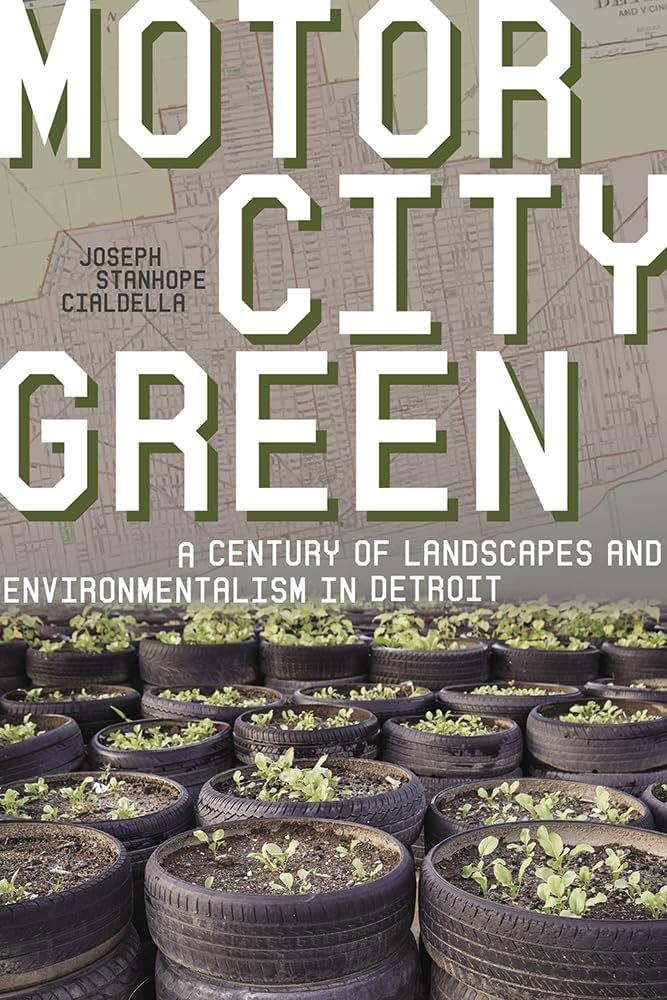
Joseph S. Cialdella
Motor City Green: A Century of Landscapes and Environmentalism in Detroit
University of Pittsburgh Press, 2020
Motor City Green is a history of green spaces in metropolitan Detroit from the late nineteenth to the early twenty-first century. The book focuses primarily on the history of gardens and parks in the city of Detroit and its suburbs in southeast Michigan. Cialdella argues that Detroit residents used green space to address problems created by the city’s industrial rise and decline, and racial segregation and economic inequality. As the city’s social landscape became increasingly uncontrollable, Detroiters turned to parks, gardens, yards, and other outdoor spaces to relieve the negative social and environmental consequences of industrial capitalism. Motor City Green looks to the past to demonstrate how today’s urban gardens in Detroit evolved from, but are also distinct from, other urban gardens and green spaces in the city’s past.
Joseph S. Cialdella is the program manager for public scholarship at the University of Michigan.
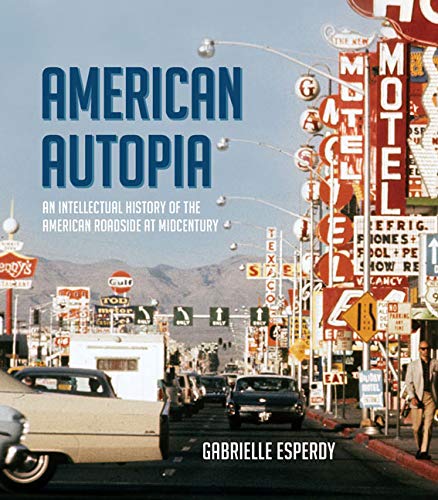
Gabrielle Esperdy
American Autopia: An Intellectual History of the American Roadside at Midcentury
University of Virginia Press, 2019
Early to mid-twentieth-century America was the heyday of a car culture that has been called an “automobile utopia.” In American Autopia, Gabrielle Esperdy examines how the automobile influenced architectural and urban discourse in the United States from the earliest days of the auto industry to the aftermath of the 1970s oil crisis. Paying particular attention to developments after World War II, Esperdy creates a narrative that extends from U.S. Routes 1 and 66 to the Las Vegas Strip to California freeways, with stops at gas stations, diners, main drags, shopping centers, and parking lots along the way.
Drawing on work published in the popular and professional press, and generously illustrated with evocative images, the book shows how figures as diverse as designer Victor Gruen, geographer Jean Gottmann, theorist Denise Scott Brown, critic J.B. Jackson, and historian Reyner Banham constructed “autopia” as a place and an idea. The result is an intellectual history and interpretive roadmap to the United States of the Automobile.
Gabrielle Esperdy is an Associate Professor of Architecture and Design at the New Jersey Institute of Technology and author of Modernizing Main Street: Architecture and Consumer Culture in the New Deal.
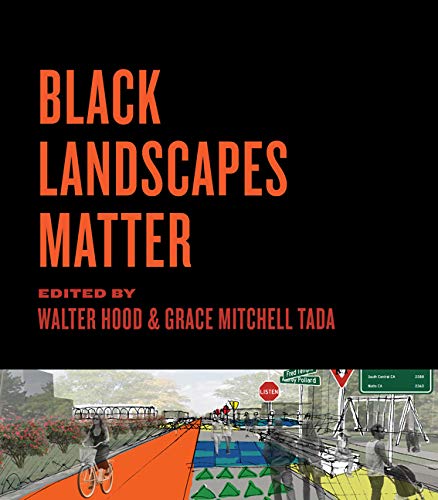
Walter Hood and Grace Mitchell Tada, editors
Black Landscapes Matter
University of Virginia Press, 2020
The question “Do black landscapes matter?” cuts deep to the core of American history. From the plantations of slavery to contemporary segregated cities, from freedman villages to northern migrations for freedom, the nation’s landscape bears the detritus of diverse origins. Black landscapes matter because they tell the truth. In this vital new collection, acclaimed landscape designer and public artist Walter Hood assembles a group of notable landscape architecture and planning professionals and scholars to probe how race, memory, and meaning intersect in the American landscape.
Essayists examine a variety of U.S. places – ranging from New Orleans and Charlotte to Milwaukee and Detroit – exposing racism endemic in the built environment and acknowledging the widespread erasure of black geographies and cultural landscapes. Through a combination of case studies, critiques, and calls to action, contributors reveal the deficient, normative portrayals of landscape that affect communities of color and question how public design and preservation efforts can support people in these places. In a culture in which historical omissions and specious narratives routinely provoke disinvestment in minority communities, creative solutions by designers, planners, artists, and residents are necessary to activate them in novel ways. Black people have built and shaped the American landscape in ways that can never be fully known. Black Landscapes Matter is a timely and necessary reminder that without recognizing and reconciling these histories and spaces, America’s past and future cannot be understood.
Walter Hood is a MacArthur Fellow and Professor of Landscape Architecture and Environmental Planning and Urban Design at the University of California, Berkeley, and principal of Hood Design Studio in Oakland, California.
Grace Mitchell Tada is an independent scholar, writer, and journalist.
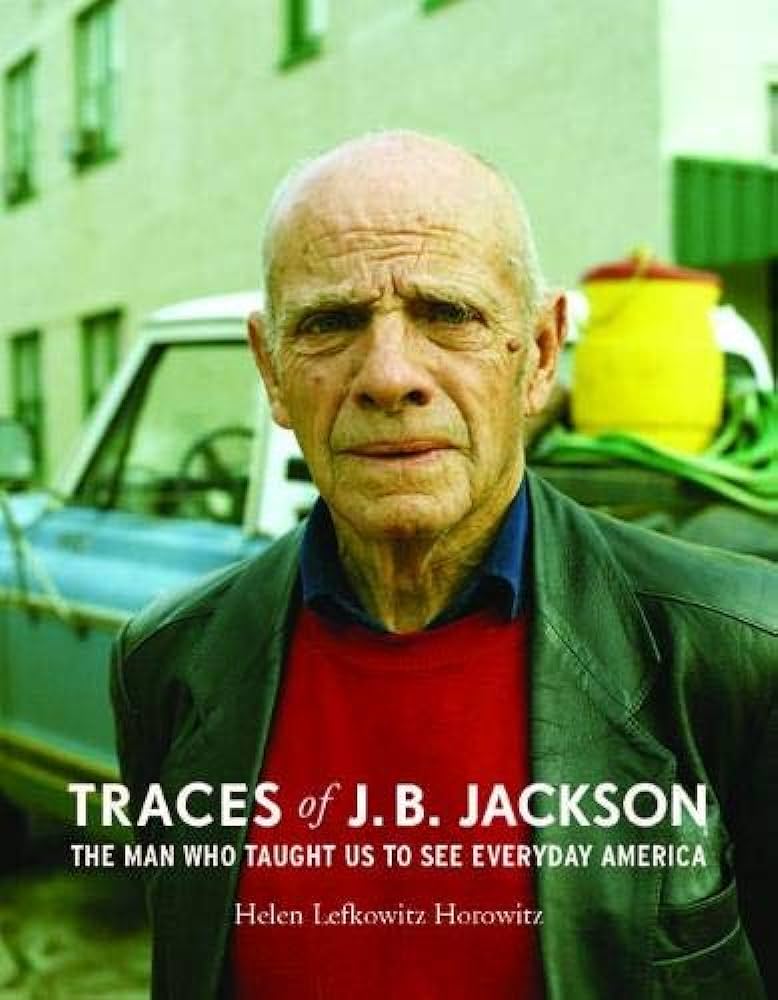
Helen L. Horowitz
Traces of J. B. Jackson: The Man Who Taught Us to See Everyday America
University of Virginia Press, 2020
J. B. Jackson transformed forever how Americans understand their landscape, a concept he defined as land shaped by human presence. In the first major biography of the greatest pioneer in landscape studies, Helen Horowitz shares with us a man who focused on what he regarded as the essential American landscape, the everyday places of the countryside and city, exploring them as texts that reveal important truths about society and culture, present and past. In Jackson’s words, landscape is “history made visible.”
After a varied life of traveling, writing, sketching, ranch labor, and significant service in army intelligence in World War II, Jackson moved to New Mexico and single-handedly created the magazine Landscape. As it grew under his direction throughout the 1950s and 1960s, Landscape attracted a wide range of contributors. Jackson became a man in demand as a lecturer and, beginning in the late 1960s, he established the field of landscape studies at Berkeley, Harvard, and elsewhere, mentoring many who later became important architects, planners, and scholars. Horowitz brings this singular person to life, revealing how Jackson changed our perception of the landscape and, through friendship as well as his writings, profoundly influenced the lives of many, including her own.
Helen Lefkowitz Horowitz, Sydenham Clark Parsons Professor Emerita of History and American Studies at Smith College, is the editor of Landscape in Sight: J. B. Jackson’s America and author of the Pulitzer Prize-nominated Rereading Sex: Battles over Sexual Knowledge and Suppression in Nineteenth-Century America.
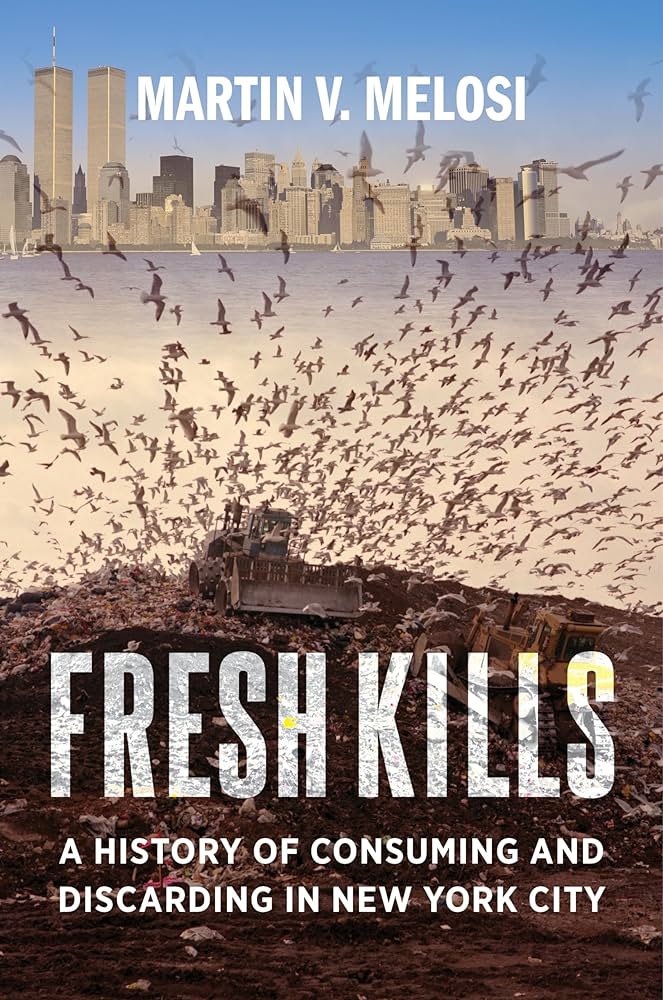
Martin V. Melosi
Fresh Kills: A History of Consuming and Discarding in New York City
Columbia University Press
Fresh Kills – a monumental 2,200-acre site on Staten Island – was once the world’s largest landfill. From 1948 to 2001, it was the main receptacle for New York City’s refuse. After the 9/11 attacks, it reopened briefly to receive human remains and rubble from the destroyed Twin Towers, turning a notorious disposal site into a cemetery. Today, a mammoth reclamation project is transforming the landfill site, constructing an expansive park three times the size of Central Park.
Martin V. Melosi provides a comprehensive chronicle of Fresh Kills that offers new insights into the growth and development of New York City and the relationship among consumption, waste, and disposal. He traces the metamorphoses of the landscape, following it from salt marsh to landfill to cemetery and looks ahead to the future park. By centering the problem of solid-waste disposal, Melosi highlights the unwanted consequences of mass consumption. He presents the Fresh Kills space as an embodiment of massive waste, linking consumption to the continuing presence of its discards. Melosi also uses the landfill as a lens for understanding Staten Island’s history and its relationship with greater New York City. The first book on the history of the iconic landfill, Fresh Kills unites environmental, political, and cultural history to offer a reflection on material culture, consumer practices, and perceptions of value and worthlessness.
Martin V. Melosi is Cullen Professor Emeritus of History and founding director of the Center for Public History at the University of Houston. His many books include The Sanitary City: Urban Infrastructure in America from Colonial Times to the Present (2000) and Atomic Age America (2013).
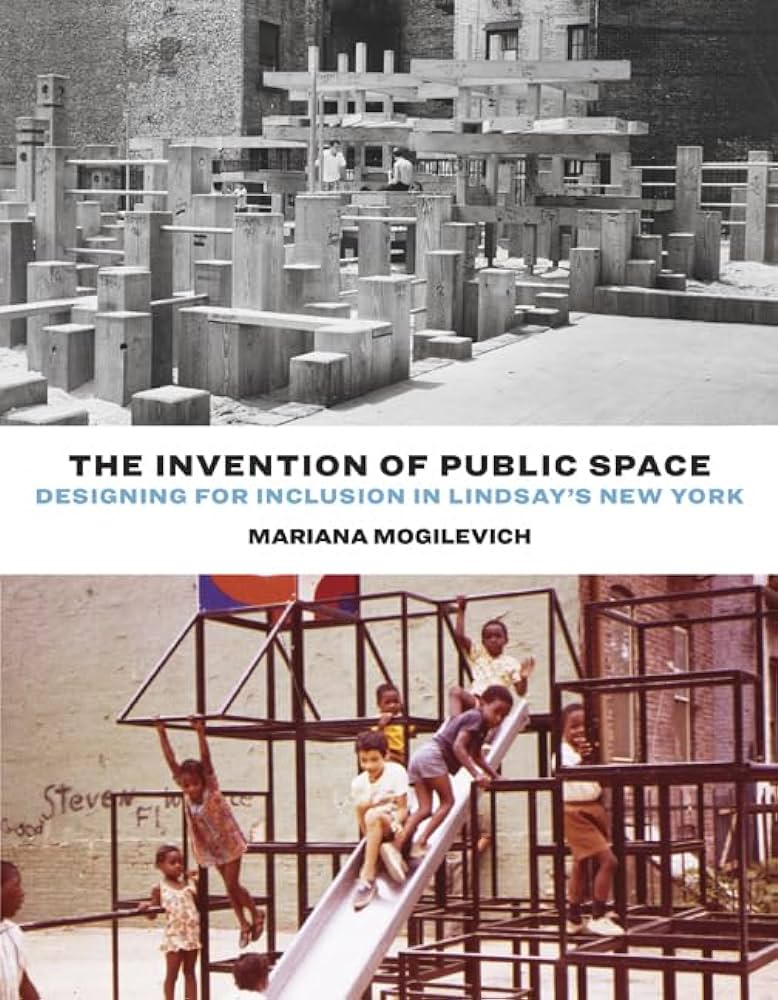
Mariana Mogilevich
The Invention of Public Space: Designing for Inclusion in Lindsay’s New York
University of Minnesota Press, 2020
As suburbanization, racial conflict, and the consequences of urban renewal threatened New York City with “urban crisis,” the administration of Mayor John V. Lindsay (1966–1973) experimented with a broad array of projects in open spaces to affirm the value of city life. Mariana Mogilevich provides a fascinating history of a watershed moment when designers, government administrators, and residents sought to remake the city in the image of a diverse, free, and democratic society.
New pedestrian malls, residential plazas, playgrounds in vacant lots, and parks on postindustrial waterfronts promised everyday spaces for play, social interaction, and participation in the life of the city. Whereas designers had long created urban spaces for a broad amorphous public, Mogilevich demonstrates how political pressures and the influence of the psychological sciences led them to a new conception of public space that included diverse publics and encouraged individual flourishing. Drawing on extensive archival research, site work, interviews, and the analysis of film and photographs, The Invention of Public Space considers familiar figures, such as William H. Whyte and Jane Jacobs, in a new light and foregrounds the important work of landscape architects Paul Friedberg and Lawrence Halprin and the architects of New York City’s Urban Design Group.
The Invention of Public Space brings together psychology, politics, and design to uncover a critical moment of transformation in our understanding of city life and reveals the emergence of a concept of public space that remains today a powerful, if unrealized, aspiration.
Mariana Mogilevich is a historian of architecture and urbanism and editor-in-chief of Urban Omnibus, the online publication of The Architectural League of New York.
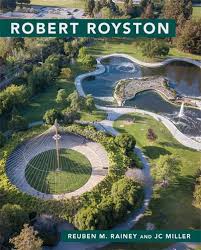
Reuben M. Rainey and JC Miller
Robert Royston
University of Georgia Press, 2020
Over nearly six decades of practice, Robert Royston (1918-2008) shaped the postwar Bay Area landscape with visionary designs for public spaces. Early in his career, Royston conceived of the “landscape matrix,” a system of interconnected parks, plazas, and parkways that he hoped could bring order and amenity to rapidly developing suburbs. The idea would inform his work on more than two thousand projects as diverse as school grounds, new towns, transit corridors, and housing tracts.
As an apprentice of Thomas Church, Royston gained experience with residential gardens that influenced his early designs for public parks. At a time when neighborhood parks were typically limited to playing fields and stock playground equipment, Royston created imaginative facilities for the American family, offering activities for people of all ages.
Royston, Hanamoto & Mayes, founded in 1958, grew to become one of the nation’s most influential corporate firms. With his collaborative approach, Royston designed landscapes that set a high standard of inclusivity and environmental awareness. In addition to the many beloved places he created, his perceptive humanism, which passed down to his students, is Royston’s enduring legacy.
Reuben Rainey, FASLA, professor emeritus at the University of Virginia and co-director of the Center for Design and Health at the University of Virginia, writes on on topics ranging from Renaissance landscape to modern “healing gardens.”
JC Miller is a partner at Vallier Design Associates in Point Richmond, California, and director of the Landscape Architecture Certificate Program at UC Berkeley Extension.
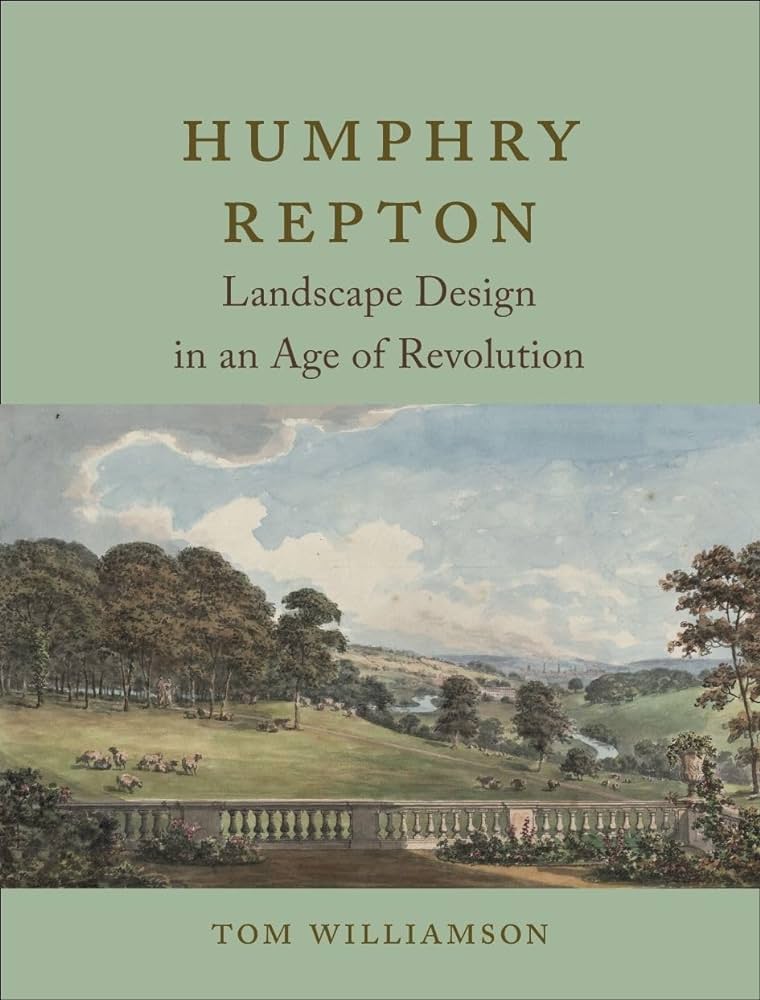
Tom Williamson
Humphry Repton: Landscape Design in an Age of Revolution
University of Chicago Press/Distributed for Reaktion Books Ltd., 2020
Humphry Repton (1752–1818) remains one of England’s most interesting and prolific garden and landscape designers. Renowned for his innovative design proposals and distinctive before-and-after images, captured in his famous “Red Books,” Repton’s astonishing career represents the link between the simple parklands of his predecessor Capability Brown and the more elaborate, structured, and formal landscapes of the Victorian age. This lavishly illustrated book, based on a wealth of new research, reinterprets Repton’s life, working methods, and designs, and examines why they proved so popular in a rapidly changing world.
Tom Williamson is professor of landscape history at the University of East Anglia.
Bill Hubbard, Jr.
American Boundaries: The Nation, the States, the Rectangular Survey
The University of Chicago Press, 2008
American Boundaries: The Nation, the States, the Rectangular Survey is the first book to chart the growth of the United States using the boundary as a political and cultural focus. The author explains how the original thirteen colonies and subsequently each state came to define its borders and assume its current shape. In addition, he explores how the country’s national boundaries were determined and how the policy came into being that yet-to-be settled lands within the federal domain would be held in trust for the common benefit. With the help of photographs, diagrams, and maps, Hubbard shows how this uncharted land was then surveyed and divided into mile-square sections (640 acres) forming a national grid beginning in Ohio and extending across the continent. He then outlines the settlement pattern of the country as the 640-acre sections were subdivided into 320-, 160-, 80-, and 40-acre parcels and sold to individual farmers and homesteaders.
John Dixon Hunt
The Venetian City Garden: Place, Typology, and Perception
Birkhäuser Verlag, 2009
In Venice, a city where the land has been claimed from the sea, gardens have sustained life, provided beauty, and greatly enriched human culture. Professor Hunt’s approach is typological. The gardens he discusses – all of which are distinguished by their predominantly small scale – fall into the categories of private versus public, useful versus beautiful, and open space within the context of a densely built environment. In The Venetian City Garden: Place, Typology, and Perception, he discusses both the social aspects and the design of nearly one hundred city gardens, squares, courtyards, public parks, and temporary gardens. These range from landscapes created two hundred years ago to the contemporary Paradise Garden designed by Gustafson Porter for the 2008 Biennale.
Thaïsa Way
Unbounded Practice: Women and Landscape Architecture in the Early Twentieth Century
University of Virginia, 2009
In Unbounded Practice: Women and Landscape Architecture in the Early Twentieth Century, Thaïsa Way narrates the role of women during the years in which landscape architecture came of age as a recognized profession. Through the history and analysis of the work of such practitioners as Beatrix Jones Farrand, Marian Cruger Coffin, Annette Hoyt Flanders, Ellen Biddle Shipman, Martha Brookes Hutcheson, and Marjorie Sewell Cautley, the author has made a valuable contribution to a hitherto little-known and under-appreciated area of landscape studies.
Special Recognition
Michel Conan
Volumes XXI–XXXI, Dumbarton Oaks Colloquiums on the History of Landscape Architecture
Dumbarton Oaks Research Library and Collections and Spacemaker Press
The Foundation for Landscape Studies offers special recognition to social scientist Michel Conan for his extraordinary contribution to landscape scholarship during his decade-long directorship of the Garden and Landscape Studies program at Dumbarton Oaks. Breadth of knowledge, expansiveness of intellect, a critical eye, linguistic prowess, and mentorship are evident in the eleven volumes of the Dumbarton Oaks Colloquium on the History of Landscape Architecture series published during his tenure. A permanent record of the annual symposia, these richly illustrated anthologies contain contributions drawn from the diverse fields of anthropology, architecture, landscape architecture, history, philosophy, botany, archeology, and religious studies. Conceived, organized, edited, and in part written by Conan, they form an enduring contribution to our understanding of the significance, complexity, and richness of meaning to be found in this important branch of academic inquiry.
Robin Karson
A Genius for Place: American Landscapes of the Country Place Era
University of Massachusetts Press, 2007
In this definitive and well illustrated volume on a formative period in the history of American landscape design, Robin Karson analyzes seven country places created by some of the nation's most talented landscape practitioners.
From the 1890s until the advent of the second World War, new industrial fortunes made it possible for wealthy Americans to commission mansions and grounds emulating Italian villas and French châteaux. The landscapes of this Gilded Age, or "Country Place Era," as it is also called, reveal the diverse influences of continental stylistic traditions, the English Arts-and-Crafts movement, and the lingering design precepts of Frederick Law Olmsted.
In the book’s chapters, the author traces a chronological progression from the naturalistic wild gardens of Warren Manning to the mysterious “Prairie-style” landscapes of Jens Jensen to the protomodernist gardens of Fletcher Steele. Other practitioners covered are Charles Platt, Ellen Biddle Shipman, Beatrix Farrand, Marian Coffin, and Lockwood de Forest Jr. The projects profiled follow a broad geographic arc from Stockbridge, Massachusetts, to Santa Barbara, California. All seven landscapes are now open to visitors.
Analyzing these designs in context with one another and against the backdrop of professional and cultural currents that shaped larger projects – parks, campuses, and planned communities – Karson creates a rich and comprehensive picture of the artistic achievements of the period. Striking black-and-white images by landscape photographer Carol Betsch capture the considerable beauty these country places retain, while hundreds of drawings, plans, and historical photographs enrich our understanding of the original designs and the lives of the initial owners.
Robin Karson is the founder and executive director of Library of American Landscape History. She holds a B.G.S. and an M.A. in the history of art and museum practice from the University of Michigan. Following an internship at the Mount Holyoke Museum of Art, she became a columnist for the Springfield Sunday Republican. She subsequently served as contributing editor to Garden Design and Landscape Architecture, writing frequently for those magazines on a wide range of topics. Her previous books are Fletcher Steele, Landscape Architect (author), The Muses of Gwinn (author), and Pioneers of American Landscape Design (coeditor).
Lucy Lawliss, Caroline Loughlin, and Lauren Meier
The Master List of Design Projects of the Olmsted Firm, 1857-1979
National Association for Olmsted Parks, 2008
This richly illustrated color edition of the Master List incorporates new research conducted over the past twenty years. Searchable by project type and geographic location, it is an inspiring and invaluable tool for landscape history scholars and landscape preservationists. Expanded from an earlier version to include over 6,000 projects, the Master List is the only publication to categorize all of the Olmsted firm’s design projects so that the scale, type, and geographic diversity of the work can be quickly and easily understood.
Lucy Lawliss, ASLA, is a cultural resources manager for the National Park Service and has written several award-winning historical landscape publications, including Olmsted in Georgia: The Residential Work of the Olmsted Firm 1895–1937. A board member of the National Association for Olmsted Parks, Lawliss served as the organization's co-chair from 2002–2005. She holds undergraduate and master's degrees in landscape architecture with a certificate in historic preservation from the University of Georgia and is a registered landscape architect.
Caroline Loughlin, a founding board member and previous president of Forest Park Forever, is the coauthor of Forest Park, a history of St. Louis’s premier park. She is a board member of the National Association for Olmsted Parks (NAOP), serves on the steering committee of the NAOP-sponsored Olmsted Research Guide Online, and is the treasurer of the Friends of Fairsted, the Frederick Law Olmsted National Historic Site in Brookline, Massachusetts. She is a volunteer at Mount Auburn Cemetery and a member of the steering committee for the cemetery’s Preservation Initiative.
Lauren Meier, ASLA, is a historic preservationist with Pressley Associates in Cambridge, Massachusetts, where she oversees a wide variety of historic landscape preservation projects. She was the founding coordinator of the National Park Service’s Historic Landscape Initiative in Washington, DC, and historical landscape architect for the agency’s Olmsted Center for Landscape Preservation. She holds a bachelor’s degree in botany from Pomona College and a master’s degree in landscape architecture from Harvard Graduate School of Design. Among her professional projects is the restoration of the landscape at Fairsted, Frederick Law Olmsted’s home and office in Brookline, Massachusetts, now a National Historic Site operated by the National Park Service. She is the author of numerous articles devoted to the preservation of historic plant material. She is a board member of the National Association for Olmsted Parks and a former chair of the research committee.
D. Fairchild Ruggles
Islamic Gardens and Landscapes
Penn Studies in Landscape Architecture, 2007
“In the course of my research,” writes D. Fairchild Ruggles, author of Islamic Gardens and Landscapes, “I devoured Arabic agricultural manuals from the tenth through the fourteenth centuries. I love gardening, and in these texts I was able to enter the minds of agriculturalists and botanists of a thousand years ago who likewise believed it was important and interesting to record all the known ways of propagating olive trees, the various uses of rosemary, and how best to fertilize a garden bed.”
Ruggles uses poetry, court documents, agronomy manuals, and early garden representations to immerse the reader in the world of the architects of the great gardens of the Islamic world, from medieval Morocco to contemporary India. Western admirers have long seen the Islamic garden as an earthly reflection of the paradise said to await the faithful. Such simplification, Ruggles contends, denies the sophistication and diversity of the art form. Just as Islamic culture is historically dense, sophisticated, and complex, so too is the history of its built landscapes. She follows the evolution of early Islamic agricultural efforts to their aristocratic apex in the formal gardens of the Alhambra in Spain and the Taj Mahal in Agra. This richly illustrated volume is a work of impressive scope sure to interest scholars and enthusiasts alike.
D. Fairchild Ruggles is a professor of landscape history at the University of Illinois at Urbana-Champaign and the author of Gardens, Landscape, and Vision in the Palaces of Islamic Spain. In her work, she examines landscape as a complex system in which agricultural practice, water management, and sites where local and exotic agricultural produce are traded are important aspects of culture. Ruggles holds a B.A. from Harvard-Radcliffe and an M.A. and Ph.D. from the University of Pennsylvania. Before coming to UIUC in 2001 as a Faculty Excellence hire, she taught at Cornell, Harvard, and Binghamton Universities.
Anne Whiston Spirn
Daring to Look: Dorothea Lange’s Photographs and Reports from the Field
University of Chicago Press, 2008
Near the end of her career, Dorothea Lange lamented, “No country has ever closely scrutinized itself visually. . . . I know what we could make of it if people only thought we could dare look at ourselves.” Lange did look, unflinchingly turning her lens on the despair, degradation, and greed unleashed by the Great Depression. Her photographs for the New Deal’s Farm Security Administration have become the defining images of that time, capturing a country and a people on the brink of cataclysmic change.
Lange viewed her photographs as part of sequenced narratives, contextualized and enriched by her descriptive captions – without which, she wrote, “half the value of fieldwork is lost.” Daring to Look presents never-before-published photos and captions from Lange’s fieldwork in California, the Pacific Northwest, and North Carolina during 1939. Lange’s images of squatter camps, benighted farmers, and stark landscapes are stunning, and her captions – ranging from simple explanations of settings to historical notes and biographical sketches—add unexpected depth, bringing her subjects and their struggles unforgettably to life, often in their own words.
When Lange was dismissed from the Farm Security Administration at the end of 1939, these photos and field notes were consigned to archives where they languished, rarely seen. With Daring to Look, Anne Whiston Spirn not only returns them to the public eye, but sets them in the context of Langeâs life, work, and struggle for critical recognition, firmly placing her in her rightful position at the forefront of American photography.
Anne Whiston Spirn, professor in the Department of Urban Studies and Planning and the Department of Architecture at MIT, is an author, photographer, landscape architect, and planner. Her previous books include the award-winning The Granite Garden: Urban Nature and Human Design (1984) and The Language of Landscape (1998). Currently she is finishing The Eye Is a Door, a book on photography and the art of seeing. "Knowing Where to Stand," an exhibition of her photographs, was on view at the MIT Museum in 2003–2004 and traveled to Vassar College in 2004. Since 1984 Spirn has worked on ecological planning and community design and development in inner-city neighborhoods. She directs the West Philadelphia Landscape Project, an internationally recognized program that has integrated teaching, research, and community service since 1987. Her next book project has grown out of this experience: Top-Down/Bottom-Up: Rebuilding the Landscape of Community.
Ethan Carr
Mission 66: Modernism and the National Park Dilemma
Library of American Landscape History with the University of Massachusetts Press, 2007
In the years following World War II, Americans visited the national parks in unprecedented numbers, yet Congress held funding at prewar levels and park conditions steadily declined. Elimination of the Civilian Conservation Corps and other New Deal programs further reduced the ability of the federal government to keep pace with the wear and tear on park facilities. To address the problem, in 1956 a ten-year, billion-dollar initiative titled "Mission 66" was launched, timed to be completed in 1966, the fiftieth anniversary of the National Park Service. The program covered more than one hundred visitor centers (a building type invented by Mission 66 planners), expanded campgrounds, innumerable comfort stations and other public facilities, new and wider roads, parking lots, maintenance buildings, and hundreds of employee residences. During this transformation, the park system also acquired new seashores, recreation areas, and historical parks; agency uniforms were modernized; and the arrowhead logo became a ubiquitous symbol. To a significant degree, the national park system and the National Park Service as we know them today are products of the Mission 66 era. Ethan Carr's book examines the significance of the Mission 66 program and explores the influence of mid-century modernism on landscape design and park planning. Environmental and park historians, architectural and landscape historians, and all who care about our national parks will enjoy this copiously illustrated history of a critical period in the development of the national park system.
Julie Czerniak and George Hargreaves
Large Parks
Princeton Architectural Press, 2007
The discipline of landscape architecture encompasses many typologies, from domestic gardens and neighborhood playgrounds to urban designs and state parks. Most critical studies of the discipline tend to approach it from a historical or contemporary perspective organized around criteria such as built versus unbuilt, urban versus peripheral, or competition-sponsored versus commission-based. Very few analyses have been undertaken from the seemingly obvious jumping-off point of size. In the eight essays that make up Large Parks, leading scholars and practitioners engage in depth the topic of large urban parks as complex cultural spaces, where issues of landscape discourse, ecological challenges, social history, urban relations, and place-making are writ large. From historic parks such as New York’s Central Park and Paris’s Bois de Boulogne to contemporary projects such as Toronto’s Downsview Park, Staten Island’s Fresh Kills, and California’s Orange County Great Park, Large Parks highlights the complexities and special considerations that go into designing these massive and culturally significant works.
Ada Segre
The Gardens at San Lorenzo in Piacenza, 1656-1665
Dumbarton Oaks Research Library and Collection, 2006
This two-volume set includes a photographic reproduction of an anonymous seventeenth-century Italian gardener’s notebook and a scholarly study, transcription, and translation of this valuable historical record. The notebook, which belongs to Dumbarton Oaks’s Rare Books Collection, is a record of the planting of three flower gardens at San Lorenzo. Three computer-generated re-creations of the garden’s planting beds are included with the reproduction. It is now believed that the gardens were created for Margherita de’ Medici Farnese, duchess of Parma and Piacenza. The notebook provides insight into the creation of a seventeenth-century garden, from identifying flowers to planning flowerbeds. The sketches reveal the gardener’s own intentions and reflections on the designs. Ada Segre’s accompanying study of the notebook is a groundbreaking example of garden archaeology. She considers its provenance and connection to the world of the duchess and her gardens. Segre also evaluates the importance of the manuscript as an object and as a source of information on garden design and practice in Italy during the mid-seventeenth century.
Jack Williams
East 40 Degrees: An Interpretive Atlas
University of Virginia Press, 2006
The Appalachian mountain chain once contained the highest and most dramatic mountains on earth. Worn down over time, these mountains still hold some of the most diverse climactic zones and singular geological formations in existence. In East 40 Degrees: An Interpretive Atlas, Jack Williams examines a succession of beautiful but little-known towns along this cordillera (a term descended from the Latin chorda, meaning “braided rope”), excavating layers of history and geography to reveal how diverse cultural and social circumstances and geological histories came together to form each town’s distinctive character.
Referring to the spatial orientation of the Appalachian mountain chain, the “east 40 degrees” longitude line of the title runs from Alabama through fifteen states to the coast of Maine. Each town Williams examines sits within the folds of these mountains or beside a river nourished in their moist uplands. Beginning his record with the continental collisions that shaped each town’s history more than 300 million years ago, Williams allows us to “see the tenuous web of connections between ourselves and the natural processes that shape this earth.”
Anita Berrizbeitia
Roberto Burle Marx in Caracas: Parque del Este, 1956-1961
Penn Studies in Landscape Architecture,University of Pennsylvania Press, 2005
Anita Berrizbeitia's interest in Roberto Burle Marx extends beyond his justified reputation as a master of regional modernism. She argues that "Burle Marx's Parque del Este is nothing less than a series of significant material and ideological transformations of the modern public park." Through an original examination of the Parque del Este's extensive social, geographic, and artistic context, the author traces the dramatic transformation of Venezuela's capital as the nation shifted from its rural, agricultural roots into a globally significant, stable democracy with an oil-based economy. The park was freighted with nationalistic ideologies that have remained powerful to the present day. The rich documentary materials, including an extensive plant list, are welcome features of this outstanding monograph. Berrizbeitia's exemplary research and analysis address multiple outstanding gaps in our appreciation and understanding of the design of public landscapes in the mid-twentieth century.
Anita Berrizbeitia joined the Landscape Architecture faculty at the University of Pennsylvania in 1996. She was assistant professor at Harvard Graduate School of Design from 1993 to 1998 where she received her M.L.A. in 1987. As an associate with Child Associates, Inc., Berrizbeitia focused on the design and building of landscapes ranging from urban-scaled projects to a wide array of private commissions. Her work has received several ASLA and BSLA awards. Her research focuses on modern and contemporary landscape architecture, with essays included in Daniel Urban Kiley, the Early Gardens; Recovering Landscape; Roberto Burle Marx: Landscapes Reflected; and CASE: DOWNVIEW. She is co-author, with Linda Pollack, of Inside Outside: Between Architecture and Landscape (1999).
Kenneth I. Helphand
Defiant Gardens, Making Gardens in Wartime
Trinity University Press, 2006
Kenneth Helphand addresses an important yet infrequently explored topic in landscape studies with insightful analysis and meticulous documentation. By focusing on "defiant gardens," defined as those created in extraordinarily difficult situations by oppressed, threatened individuals, Helphand presents a moving narrative of the ways garden making has empowered human beings to survive the most horrendous tribulations with dignity. His probing case studies, which form the heart of this inquiry, focus on a wide range of gardens created in the most unlikely circumstances: World War I battlefields, the ghettos of Nazi-occupied Poland, World War II internment camps for Japanese-American citizens, and prisoner-of-war camps in both world wars. His compelling analysis reveals in vivid detail how the act of gardening in these conditions subverts and defies dehumanizing treatment while nurturing hope, endurance, and identity. The result is a truly outstanding contribution to landscape studies in the tradition of J. B. Jackson.
Kenneth I. Helphand is Professor of Landscape Architecture at the University of Oregon where he has taught landscape history, theory, and design since 1974. He graduated from Brandeis University and Harvard's Graduate School of Design. Helphand has lectured internationally and is a regular visiting professor at the Technion, the Israel Institute of Technology. His works include the ASLA award-winning books: Colorado: Visions of an American Landscape; Yard Street Park: The Design of Suburban Open Space (with Cynthia Girling); and Dreaming Gardens: Landscape Architecture and the Making of Modern Israel. Helphand was editor of Landscape Journal from 1994 to 2002. He is a fellow of the ASLA, winner of the Bradford Williams Medal, and honorary member of the Israel Association of Landscape Architects.
Finola O'Kane
Landscape Design in Eighteenth-Century Ireland
Cork University Press, 2004
This study of four eighteenth-century estates outside Dublin offers a nuanced and rich examination of the role of garden aesthetics and design in the physical and intellectual environment of Georgian Ireland. O'Kane's exemplary scholarship grows out of her careful reading of a broad range of documentary materials that include estate maps, correspondence, and landscape painting. She describes and interprets the making and experience of these elite landscape gardens as they evolved over time from the point of view of social class, gender roles, and the paradoxical moralizing discourse on "improvement," as well as horticulture and design history. This beautifully produced volume is a welcome and important contribution to eighteenth-century studies, illuminating the way in which the history of the British empire is reflected in the intertwined landscape histories of the center and its periphery.
Finola O'Kane Crimmins completed a graduate diploma at the Architectural Association in London and a Ph.D. at the National University of Ireland. She worked in the practice of de Blacam & Meagher Architects, where she was a project architect for the award-winning conservation design for Maynooth Castle, Co. Kildare. In 2004 she was appointed lecturer in the School of Architecture, Landscape and Civil Engineering, University College, Dublin. She is particularly interested in the cultural, philosophical, and aesthetic dimensions of the landscape history of Ireland and is currently completing her second book, entitled Ireland and the Picturesque, and a study of life in the Irish convent.
CYNTHIA S. BRENWALL
The Central Park: Original Designs for New York’s Greatest Treasure
Abrams Books, 2019
Drawing on the collection in the New York City Municipal Archives, Cynthia S. Brenwall tells the story of the creation of Central Park from its conception to its completion. This treasure trove of material ranges from the Greensward Plan – the original winning competition entry for the design of the park – to meticulously detailed maps of its landscape, and plans and elevations of both built and unbuilt buildings. The book also includes designs for a variety of park fixtures as well as intricate engineering drawings of infrastructure elements. In addition, a virtual time machine takes the reader on a journey through the park as it was originally envisioned. The Central Park is both a magnificent art book and a message from the past about what brilliant urban planning can do for a great city.
Cynthia S. Brenwall, a conservator and art historian, has worked for the New York City Municipal Archives since 2012. During her tenure there she has cared for some of New York’s most important historical documents, including the Central Park collection of architectural drawings, which were conserved and documented under her supervision.
DILIP DA CUNHA
The Invention of Rivers: Alexander’s Eye and Ganga’s Descent
University of Pennsylvania Press, 2019
The author of this book integrates history, art, cultural studies, hydrology, and geography to tell how rivers have been culturally constructed as lines defining patterns of human habitation and transportation. He analyzes waterways in terms of human design as well as topography, as exemplified in documents going back to ancient Greek cartography. By focusing on rivers, da Cunha depicts an ecosystem that is neither land nor water but one of ubiquitous wetness in which rain is held in soil, aquifers, glaciers, snowfields, building materials, agricultural fields, air, and even plants and animals.
Dilip da Cunha is an architect and planner based in Philadelphia and Bangalore. He is co-director of the Risk and Resilience concentration in the Master in Design Studies program at Harvard University’s Graduate School of Design and an adjunct professor in the Graduate School of Architecture, Planning and Preservation, Columbia University.
MICHAEL EZBAN
Aquaculture Landscapes: Fish Farms and the Public Realm
Routledge, 2019
Aquaculture Landscapes recovers aquaculture as a practice with a deep history of constructing extraordinary landscapes. These landscapes are characterized and enriched by multispecies interdependency, performative ecologies, collaborative practices, and aesthetic experiences between humans and fish. Aquaculture Landscapes presents over thirty contemporary and historical landscapes, spanning six continents. Within this expansive scope is a focus on urban aquaculture projects by leading designers that employ mutually beneficial strategies for fish and humans to address urban coastal resiliency, wastewater management, and other contemporary urban challenges.
Michael Ezban is an assistant professor in Landscape Architecture and Urban + Environmental Planning at the University of Virginia School of Architecture. He is a landscape designer, architect, scholar, and educator. His work is focused on landscapes and buildings designed to mediate relations between humans and other animals.
CLAYTON STRANGE
Monotown: Urban Dreams Brutal Imperatives
ORO Editions/Applied Research & Design, 2019
Monotown: Urban Dreams Brutal Imperatives recasts the narrative of the Soviet, single-industry town through its transnational legacy as a vehicle for disseminating socialist space amid the politics of the cold war. As an alternative to Western models, the “monotown” emerged as the instrument of choice in national aspirations to settle the vast hinterlands of Eurasia. Engaging with local histories, regional frameworks, and contemporary projects of postindustrial transformation, the book is a diachronic exploration of case studies across Russia, China, and India, where Soviet models combined with postcolonial circumstances to modernize and radically transform the landscape.
Clayton Strange is an architect, urbanist, and educator. He received a master of architecture in urban design with distinction from the Harvard University Graduate School of Design. He is the founding principal of Strange Works, a Boston-based research and design office.
SPECIAL RECOGNITION
JOHN BEARDSLEY
Former Director of the Garden and Landscape Studies program at Dumbarton Oaks Research Library and Collection
For overseeing the book series Dumbarton Oaks Colloquium on the History of Landscape Architecture and Ex Horto: Dumbarton Oaks Texts in Garden and Landscape Studies, and other special publications.
CHARLES A. BIRNBAUM
Founder, CEO, and President of the Cultural Landscape Foundation
For initiating and overseeing the Pioneers of American Landscape Design book series and online project.
James R. Cothran and Erica Danylchak
Grave Landscapes: The Nineteenth-Century Rural Cemetery Movement
University of South Carolina Press, January 2018
This beautifully illustrated volume features more than 150 historic photographs, stereographs, postcards, engravings, maps, and contemporary images that illuminate the origins of rural cemeteries, their physical evolution, and the nature of the landscapes they inspired. Extended profiles of twenty-four rural cemeteries reveal the evolving design features of this distinctive landscape genre before and after the American Civil War, facilitating their identification and preservation. In addition, Grave Landscapes places rural cemeteries in the broader context of American landscape design, thereby illuminating their influence on the creation of public parks.
The late James R. Cothran was a landscape architect, urban planner, and garden historian in Atlanta, Georgia, where he served as an adjunct professor of garden history and preservation at the University of Georgia and Georgia State University. A fellow of the American Society of Landscape Architects, Cothran is the author of Gardens of Historic Charleston, Charleston Gardens and the Landscape Legacy of Loutrel Briggs, and the award-winning Gardens and Historic Plants of the Antebellum South.
Erica Danylchak holds degrees in history from Boston University and heritage preservation from Georgia State University. She has worked in archival science at the Cherokee Garden Library and the Kenan Research Center at the Atlanta History Center, and in preservation as executive director of the Buckhead Heritage Society. Danylchak served as a research fellow for the Georgia Historic Landscape Initiative and in 2009 received the Jenny D. Thurston Memorial Award from the Atlanta Urban Design Commission.
Sonja Dümpelmann
Seeing Trees: A History of Street Trees in New York City and Berlin
Yale University Press, January 2019
Today cities around the globe are planting street trees to mitigate the effects of climate change. However, as landscape historian Sonja Dümpelmann explains, this is not a new phenomenon. Focusing on two cities in the nineteenth century – New York City and Berlin – she discusses the planting of trees to improve the urban climate and how this practice affected the larger social, cultural, and political aspects of urban life.
Sonja Dümpelmann is a landscape historian and associate professor of landscape architecture at the Harvard University Graduate School of Design. She is the author of Flights of Imagination: Aviation, Landscape, Design (2014) and a book on the pioneering twentieth-century Italian landscape architect Maria Teresa Parpagliolo Shephard (2004). In addition, she served as editor of A Cultural History of Gardens in the Age of Empire (2013) and coeditor with Dorothee Brantz of Greening the City: Urban Landscapes in the Twentieth Century (2011).
Hansjörg Gadient, Sophie von Schwerin, and Simon Orga
Migge: The Original Landscape Designs Die Originalen Gartenpläne 1910-1920
Birkhäuser, October 2018
“Gardens for everyman!” was the central credo of Leberecht Migge (1881–1935), one of the most influential landscape architects of the twentieth century. His estate was thought to be lost until the discovery of more than three hundred original plans and drawings in the Archives of Swiss Landscape Architecture. This book presents numerous projects, many previously unknown, ranging from large-scale plans for housing settlements to detailed designs for luxurious private gardens. Introductions to the historical period and to Migge’s ideas put the plans in context. Indices of persons, places, and plant names complement the text and illustrations. Two plans, reprinted at original size, accompany this volume.
Hansjörg Gadient is an architect, landscape architect, and professor at Rapperswil University of Applied Sciences (HSR), where he teaches the design and planning of urban open space in the bachelor’s and master’s study programs.
Sophie von Schwerin is a gardener, landscape architect, and historian of garden art who joined the Institute for Landscape and Open Space at the HSR in 2012 and has served as curator at the Archives of Swiss Landscape Architecture since 2015.
Simon Orga is an architect who joined the staff at the Institute for Landscape and Open Space at the HSR in 2012 and has been a member of the team of the Archives of Swiss Landscape Architecture since 2015.
Victoria Johnson
American Eden: David Hosack, Botany, and Medicine in the Garden of the Early Republic
Liveright, June 2018
American Eden tells the forgotten story of David Hosack, a young New Yorker who set out to put his raw, commercial city on the scientific and cultural map of the United States. In 1801, on twenty acres of Manhattan farmland, Hosack founded the first public botanical garden in the new nation, amassing a spectacular collection of medicinal, agricultural, and ornamental plants.
Victoria Johnson is a former Cullman Fellow at the New York Public Library and an associate professor of urban policy and planning at Hunter College in New York City. She teaches on the history of philanthropy, nonprofits, and New York City. She holds a doctorate in sociology from Columbia University and an undergraduate degree in philosophy from Yale.
Catherine Seavitt Nordenson
Depositions: Roberto Burle Marx and Public Landscapes under Dictatorship
University of Texas Press, April 2018
In this book the author explores a pivotal moment in the preeminent modernist landscape architect’s career: the years in which he was an appointed member of the Federal Cultural Council in Brazil. While serving on this advisory panel created by the country’s military dictatorship in the mid-1960s, Burle Marx authored eighteen environmental position pieces. Together with her translation Seavitt Nordenson presents pertinent examples of Burle Marx’s public projects in Brazil – several of which were commissioned by the military regime. Depositions offers new insight into Burle Marx’s outstanding landscape oeuvre and elucidates his transition from prolific designer to prescient political counselor.
Catherine Seavitt Nordenson is an associate professor of landscape architecture at CUNY’s City College of New York and principal of Catherine Seavitt Studio. Her research focuses on design adaptation to sea-level rise in urban coastal environments and explores landscape-restoration practices within the dynamics of climate change.
Judith B. Tankard
Ellen Shipman and the American Garden
University of Georgia Press, May 2018
Between 1914 and 1950, Ellen Shipman (1869–1950) designed more than six hundred gardens, from Long Island’s Gold Coast to the state of Washington. Her secluded, lush, formal gardens attracted a clientele that included the Fords, Edisons, Astors, and du Ponts. Shipman’s imaginative approach merged elements of the Colonial Revival and Arts and Crafts movements with a unique planting style enlivened by impressionistic washes of color. Richly illustrated with plans and photographs, the book explores Shipman’s ability to create intimate spaces through dense plantings, evocative water features, and ornament. This updated edition of a book first published in 1996 includes many newly discovered gardens as well as color photographs of surviving gardens, such as those at the Cummer Museum of Art and Gardens and Tranquillity Farm.
Judith B. Tankard is a landscape historian, author, and preservation consultant. She received an M.A. in art history from the Institute of Fine Arts, New York University, and taught at the Landscape Institute of Harvard University for over twenty years.
Dean Cardasis
James Rose
University of Georgia Press, March 2017
James Rose, the first biography of this important landscape architect, explores the work of one of the most radical figures in the history of mid-century modernist American landscape design. An artist who furthered his profession with both words and built works, Rose fearlessly critiqued the developing patterns of land use he witnessed during a period of rapid suburban development. The alternatives he offered in his designs for hundreds of gardens were based on innovative and iconoclastic environmental and philosophic principles, some of which have become mainstream today. The book includes new scholarship on many important works, including the Dickenson Garden in Pasadena and the Averett House in Columbus, Georgia, as well as unpublished correspondence. In letters to his mother, Rose reveals a tenderness toward nature and faith in spiritual harmony that belies his reputation as an alienated social critic. Throughout his career Rose refined his conservation ethic, seeing recycled materials and waste reduction as opportunities to create landscapes for contemplation, self-discovery, and pleasure. At a time when issues of economy and environmentalism are even more pressing, Rose’s writings and projects are both relevant and revelatory.
Kenneth I. Helphand
Lawrence Halprin
University of Georgia Press, 2017
During a career spanning six decades, Lawrence Halprin (1916–2009) became one of the most prolific and outspoken landscape architects of his generation. He took on challenging new project types, developing a multidisciplinary practice while experimenting with adaptive reuse and ecological designs for new shopping malls, the freeway, and urban parks. In his lifelong effort to improve the American landscape, Halprin celebrated the creative process as a form of social activism.
After earning his design degree at Harvard, Halprin moved West and in 1945 joined Thomas Church’s firm. He opened his own San Francisco office in 1949, where he initially focused on residential commissions in the Bay Area. By the 1960s the firm had gained recognition for significant urban renewal projects such as Ghirardelli Square (1962–68), Nicollet Mall in Minneapolis (1962–67), Seattle’s Freeway Park (1970–74), and the Portland, Oregon, Open Space Sequence (1965–78).
A charismatic speaker and passionate artist, Halprin designed landscapes that reflected the democratic and participatory ethic of his era. Throughout his long career, he strived as well to develop poetic and symbolic landscapes that, in his words, could “articulate a culture’s most spiritual values.”
Alison Isenberg
Designing San Francisco: Art, Land, and Urban Renewal in the City by the Bay
Princeton University Press, August 2017
Previous accounts of mid-century urban renewal have focused on the opposing terms set down by Robert Moses and Jane Jacobs – put simply, development versus preservation—and have followed New York City models. Designing San Francisco is the untold story of the formative postwar decades when U.S. cities took their modern shape amid other clashing visions of the future. In this richly illustrated book, Alison Isenberg shifts the focus from architects and city planners – those most often hailed in histories of urban development and desig – to the unsung artists, activists, and others who played pivotal roles in rebuilding San Francisco between the 1940s and the 1970s.
Designing San Francisco offers an insightful discussion of how, when large-scale redevelopment came to low-rise San Francisco in the 1950s, the resulting rivalries and conflicts sparked the proliferation of numerous allied arts fields and their professionals These included architectural model makers, real estate publicists, graphic designers, photographers, property managers, builders, sculptors, public-interest lawyers, alternative press writers, and preservationists. Isenberg explores how these professionals brought new concepts to city, regional, and national planning as they shaped novel projects across urban, suburban, and rural borders. In addition , she discusses how San Francisco’s rebuilding program galvanized far-reaching critiques of the inequitable competition for scarce urban land and propelled debates over responsible public land stewardship. She further challenges many truisms of this renewal era – especially the presumed male domination of postwar urban design, showing how women collaborated in city building long before feminism’s impact in the 1970s.
Alison Isenberg is professor of history at Princeton University, where she codirects the Princeton-Mellon Initiative in Architecture, Urbanism, and the Humanities. She is the author of Downtown America: A History of the Place and the People Who Made It.
Robin Karson, Jane Roy Brown, Sarah Allaback (eds.)
Warren H. Manning: Landscape Architect and Environmental Planner
University of Georgia Press, April 2017
Warren H. Manning’s (1860–1938) national practice comprised more than sixteen hundred landscape design and planning projects throughout North America, from small home grounds to estates, cemeteries, college campuses, parks and park systems, and new industrial towns. Manning approached his design and planning projects from an environmental perspective, conceptualizing projects as components of larger regional (in some cases, national) systems, a method that contrasted sharply with those of his stylistically oriented colleagues. In this regard, as in many others, Manning had been influenced by his years with the Olmsted firm, where the foundations of his resource-based approach to design were forged. Manning’s overlay map methods, later adopted by the renowned landscape architect Ian McHarg, provided the basis for computer mapping software in widespread use today.
One of the eleven founders of the American Society of Landscape Architects, Manning also ran one of the nation’s largest offices, where he trained several influential designers, including Fletcher Steele, A. D. Taylor, Charles Gillette, and Dan Kiley. After Manning’s death, his reputation slipped into obscurity. Contributors to the Warren H. Manning Research Project have worked more than a decade to assess current conditions of his built projects and to compile a richly illustrated compendium of site essays that illuminate the range, scope, and significance of Manning’s notable career with specially commissioned photographs by Carol Betsch.
Brian McCammack
Landscapes of Hope: Nature and the Great Migration in Chicago
Harvard University Press, October 2017
Most historians map the integration of southern and northern black culture through labor, religion, politics, and popular culture. Landscapes of Hope is the first interdisciplinary history to frame the African-American Great Migration as environmental experience. Situated during the period between 1915 and 1940 at the intersection of race and place in American history, this book focuses on Chicago’s parks and beaches as well as youth camps, vacation resorts, and the farms and forests of the rural Midwest. Here we learn how, in spite of persistent racial discrimination and violence in many of these places during the time when hundreds of thousands of African Americans were moving away from the South to begin new lives in the urban North, Chicago’s black community – women and men, young and old, working class and upper class – forged material and imaginative connections to nature as they sought out, fought for, built, and enjoyed an opportunity to realize the promise of nature and public recreation.
Micki McElya
The Politics of Mourning: Death and Honor in Arlington National Cemetery
Harvard University Press, August 2016
Arlington National Cemetery is considered by many to be America’s most sacred shrine, a destination for four million visitors who each year tour its grounds and honor those buried there. As Micki McElya shows, no site in the United States has played a stronger political role in shaping national identity. With its 400,000 graves sited on a rolling hillside overlooking Washington, D.C on a former plantation built by slave labor, Arlington commemorates sacrifices made in all the nation’s armed conflicts since the Civil War. It is also a place that symbolizes the boundaries of citizenship and the various meanings of honor and love of country.
The cemetery’s most famous monument was erected in 1921: the Tomb of the Unknown Soldier, which marks the interment of a single World War I unidentified combatant. As a century of wars abroad secured Arlington’s centrality in the American imagination, more “Unknowns” joined the first to be buried at this shrine. In revealing how Arlington encompasses both inspiring and shameful aspects of American history, McElya enriches the story of this landscape, demonstrating that remembering the past must go hand in hand with reckoning with the consequences of history.
Alona Nitzan-Shiftan
Seizing Jerusalem: The Architectures of Unilateral Unification
University of Minnesota Press, 2017
After seizing Jerusalem’s eastern precincts from Jordan at the conclusion of the Six-Day War in 1967, Israel unilaterally unified the city and plunged into an ambitious building program, eager to transform the very meaning of one of the world’s most emotionally charged urban spaces. The goal was as simple as it was controversial: to both Judaize and modernize Jerusalem.
Seizing Jerusalem chronicles how numerous disciplines, including architecture, landscape design, and urban planning, as well as everyone from municipal politicians to state bureaucrats, from Israeli-born architects to international luminaries such as Louis Kahn, Buckminster Fuller, and Bruno Zevi, competed to create Jerusalem’s new image. This decade-long competition happened with the Palestinian residents still living in the city, even as the new image was inspired by the city’s Arab legacy. The politics of space in the Holy City, still contested today, were shaped in this post-1967 decade not only by the legacy of the war and the politics of dispossession, but curiously also by emerging trends in postwar architectural culture.
Drawing on previously unexamined archival documents and in-depth interviews with architects, planners, and politicians, Alona Nitzan-Shiftan analyzes the cultural politics of the Israeli state and, in particular, of Jerusalem’s influential mayor, Teddy Kollek, whose efforts to legitimate Israeli rule over Jerusalem provided architects a unique, real-world laboratory to explore the possibilities and limits of modernist design – as built form as well as political and social action. Seizing Jerusalem reveals architecture as an active agent in the formation of urban and national identity, and demonstrates how contemporary debates about Zionism, and the crisis within the discipline of architecture over postwar modernism, affected Jerusalem’s built environment in ways that continue to resonate today.
Laurie Olin
Be Seated
Applied Research and Design Publishing, an imprint of ORO Editions, 2017
This book consists of a series of essays that begin with the author’s personal discovery of public seating. An ‘ah ha’ moment as a young architect visiting Paris and his early experience as a designer is followed by a brief history of the evolution of public space and seating in the West. This is followed by an account of some of his experiments as a landscape architect, and the theory, craft, and role of seating in a number of prominent civic places his firm and others have designed in the past four decades. Along the way there are reflections on the author’s interest in chairs, seating, public space, and aspects of the profession of landscape architecture. Accompanying the essays there are sketches, and watercolors made by Olin over time while travelling or working that weren’t originally intended as book illustrations. Some are quick, hasty notes of something observed; others are more careful studies with, on occasion, measurements. Some were made leisurely while enjoying a felicitous moment or place, while others record the author puzzling through a particular design problem. Each in some way exemplifies aspects of the essays helping to articulate or sharpen the author’s insights and point of view – those of a designer, not a historian or critic. They offer an alternative presentation of the topics raised, and a dialogue between writing and image – whether one of contrast, or at times, contrast.
Marc Treib
Landscapes of Modern Architecture: Wright, Mies, Neutra, Aalto, Barragán
Yale University Press, January 2017
This book provides an authoritative study of the interrelationship between modern architecture, landscape, and site strategy as viewed through the work of five prominent architects – Frank Lloyd Wright (1867–1959), Ludwig Mies van der Rohe (1886–1969), Richard Neutra (1892–1970), Alvar Aalto (1898–1976), and Luis Barragán (1902–1988. Exploring a range of architectural, philosophical, and theoretical approaches, he investigates their site strategies with regard to considerations of climate, topography, and existing vegetation.
The character of the sites on which these architects worked dramatically affected their architecture and gardens, a fact illustrated by Wright’s “organic” regard of the desert; Mies’s evolving divorce of building from terrain; Neutra’s transformation of the “realities” of the site; Aalto’s use of the forest metaphor and interior landscapes; and Barragán’s architectonic conversion of the land. Richly illustrated with rarely published archival drawings and plans, accompanied by the author’s own exceptional photographs, this book presents the spectrum of architectural responses to the constraints of site, climate, client, program, building material, region, and nation. Taken as a group, the work of these five architects sheds important light on the consideration and influence of the site and landscape on the practice of architecture during the 20th century.
Marc Treib is professor of architecture emeritus at the University of California, Berkeley.
Diane Waggoner With Russell Lord and Jennifer Raab
East of the Mississippi: Nineteenth-Century American Landscape Photography
Yale University Press, March 2017
This important reconsideration of landscape photography in 19th-century America explores crucial but neglected geographies, practitioners, and themes. It heightens awareness of the many photographers working in the eastern half of the United States during the same period as their more famous counterparts were capturing striking images of the West. To date, their works, with the exception of Civil War images, have received relatively scant attention. Redressing this imbalance, East of the Mississippi is the first book to focus exclusively on another body of photographs that helped shape the public’s consciousness of an American national identity. Celebrating natural wonders such as Niagara Falls and the White Mountains as well as capturing a cultural landscape fundamentally altered by industrialization, these images also documented the impact of war, promoted tourism, and played a role in an emerging environmentalism. Showcasing more than 180 photographs from 1839 to 1900 in a rich variety of media and formats – from daguerreotypes, salted paper prints, tintypes, cyanotypes, and albumen prints to stereo cards and photograph albums – this volume exemplifies many of the inventions in the art of photography during period.
Diane Waggoner is curator of 19th-century photographs at the National Gallery of Art. Russell Lord is the Freeman Family Curator of Photographs at the New Orleans Museum of Art. Jennifer Raab is assistant professor of the history of art at Yale University.
Pierre Bélanger and Alexander Arroyo
Ecologies of Power: Countermapping the Logistical Landscapes and Military Geographies of the U.S. Department of Defense
MIT Press, 2016
From the publisher:
This book is not about war, nor is it a history of war. Avoiding the shock and awe of wartime images, it explores the contemporary spatial configurations of power camouflaged in the infrastructures, environments, and scales of military operations. Instead of wartime highs, this book starts with drawdown lows, when demobilization and decommissioning morph into realignment and prepositioning. It is in this transitional milieu that the full material magnitudes and geographic entanglements of contemporary militarism are laid bare. Through this perpetual cycle of build up and breakdown, the U.S. Department of Defense – the single largest developer, landowner, equipment contractor, and energy consumer in the world – has engineered a planetary assemblage of “operational environments” in which militarized, demilitarized, and non-militarized landscapes are increasingly inextricable.
In a series of critical cartographic essays, Pierre Bélanger and Alexander Arroyo trace this footprint far beyond the battlefield, countermapping the geographies of U.S. militarism across five of the most important and embattled operational environments: the ocean, the atmosphere, the highway, the city, and the desert. From the Indian Ocean atoll of Diego Garcia to the defense-contractor archipelago around Washington, D.C.; from the A01 Highway circling Afghanistan’s high-altitude steppe to surveillance satellites pinging the planet from low-earth orbit; and from the vast cold chain conveying military perishables worldwide to the global constellation of military dumps, sinks, and scrapyards, the book unearths the logistical infrastructures and residual landscapes that render strategy spatial, militarism material, and power operational. In so doing, Bélanger and Arroyo reveal unseen ecologies of power at work in the making and unmaking of environments – operational, built, and otherwise – to come.
Pierre Bélanger, a landscape architect and urbanist, is Associate Professor of Landscape Architecture at Harvard University’s Graduate School of Design and the coauthor of Ecologies of Power: Countermapping the Logistical Landscapes and Military Geographies of the U.S. Department of Defense (MIT Press) and Landscape as Infrastructure.
Alexander Arroyo is a doctoral student in Geography at the University of California, Berkeley.
Timothy Davis
National Park Roads: A Legacy in the American Landscape
The University of Virginia Press, 2016
From the publisher:
From Acadia and Great Smoky Mountains to Zion and Mount Rainier, millions of visitors tour America’s national parks. While park roads determine what most visitors see and how they see it, however, few pause to consider when, why, or how the roads they travel on were built. In this extensively researched and richly illustrated book, national parks historian Timothy Davis highlights the unique qualities of park roads, details the factors influencing their design and development, and examines their role in shaping the national park experience – from the Blue Ridge Parkway and Skyline Drive to Glacier National Park’s Going-to-the-Sun Road, Yellowstone's Grand Loop, Yosemite's Tioga Road, and scores of other scenic drives.
Decisions about park road development epitomize the central challenge of park management: balancing preservation and access in America’s most treasured landscapes. Park roads have been celebrated as technical and aesthetic masterpieces, hailed as democratizing influences, and vilified for invading pristine wilderness with the sights, sounds, and smells of civilization. Davis’s recounting of efforts to balance the interests of motorists, wilderness advocates, highway engineers, and other stakeholders offers a fresh perspective on national park history while providing insights into evolving ideas about the role of nature, recreation, and technology in American society.
Tales of strong personalities, imposing challenges, resounding controversies, and remarkable achievements enliven this rich and compelling narrative. Key players include many of the most important figures of conservation history – John Muir, Frederick Law Olmsted, wilderness advocates Aldo Leopold, Bob Marshall, and Ansel Adams, and NPS directors Stephen Mather and Horace Albright among them. An engrossing history, National Park Roads will be of interest to national park enthusiasts, academics, design professionals, resource managers, and readers concerned with the past, present, and future of this quintessentially American legacy. As the National Park Service celebrates its centennial, this book offers a fascinating and illuminating account of the agency’s impact on American lives and landscapes.
Timothy Davis, a historian with the U.S. National Park Service, has published and lectured widely on America’s national parks. He is the coeditor, with Todd Croteau and Christopher Marston, of America’s National Park Roads and Parkways: Drawings from the Historic American Engineering Record.
Elizabeth Kryder-Reid
California Mission Landscapes: Race, Memory, and the Politics of Heritage
University of Minnesota Press, 2016
From the publisher:
How iconic American places cultivate and conceal contested pasts California Mission Landscapes demonstrates how the gardens planted in mission courtyards over the last 150 years are not merely anachronistic but have become potent ideological spaces. Until now no book has explored the mission landscapes as an avenue into understanding the politics of the past, tracing the continuum between the Spanish colonial period, emerging American nationalism, and the contemporary heritage industry.
Elizabeth Kryder-Reid is professor of anthropology and museum studies and director of the Cultural Heritage Research Center in the Indiana University School of Liberal Arts (IUPUI) and former director of the IUPUI museum studies program.
Elizabeth Milroy
The Grid and the River: Philadelphia’s Green Places, 1682–1876
Pennsylvania State University Press, 2016
From the publisher:
Philadelphians are fond of quoting a letter in which William Penn described his vision of a “greene country towne, which will never be burnt & always wholesome.” Today, Philadelphia’s public parks cover more than ten thousand acres – roughly 11 percent of the city’s area. They encompass extensive woodlands and waterways as well as the largest collection of historic properties in the state of Pennsylvania, including the Fairmount Water Works, the Philadelphia Zoo (the oldest zoo in the United States), and the Philadelphia Museum of Art.
The Grid and the River is the product of Elizabeth Milroy’s quest to understand the history of public green spaces in William Penn’s city. In this monumental work of urban history, Milroy traces efforts to keep Philadelphia “green” from the time of its founding to the late nineteenth century. She chronicles how patterns of use and representations of green spaces informed notions of community and identity in the city. In particular, Milroy examines the history of how and why the district along the Schuylkill River came to be developed both in opposition to and in concert with William Penn’s original designations of parks in his city plan.
Focusing on both the history and representation of Philadelphia’s green spaces, and making use of a wealth of primary source materials, Milroy offers new insights into the city’s political and cultural development and documents how changing attitudes toward the natural environment affected the physical appearance of Philadelphia’s landscape and the lives of its inhabitants.
Elizabeth Milroy is Professor and Department Head of Art and Art History in the Antoinette Westphal College of Media Arts & Design at Drexel University.
Louis P. Nelson
Architecture and Empire in Jamaica
Yale University Press, 2016
From the publisher:
Through Creole houses and merchant stores to sugar fields and boiling houses, Jamaica played a leading role in the formation of both the early modern Atlantic world and the British Empire. Architecture and Empire in Jamaica offers the first scholarly analysis of Jamaican architecture in the long 18th century, spanning roughly from the Port Royal earthquake of 1692 to Emancipation in 1838. In this richly illustrated study, which includes hundreds of the author’s own photographs and drawings, Louis P. Nelson examines surviving buildings and archival records to write a social history of architecture.
Nelson begins with an overview of the architecture of the West African slave trade then moves to chapters framed around types of buildings and landscapes, including the Jamaican plantation landscape and fortified houses to the architecture of free blacks. He concludes with a consideration of Jamaican architecture in Britain. By connecting the architecture of the Caribbean first to West Africa and then to Britain, Nelson traces the flow of capital and makes explicit the material, economic, and political networks around the Atlantic.
Louis P. Nelson is professor of architectural history and associate dean for research in the School of Architecture, University of Virginia.
William E. O'Brien
Landscapes of Exclusion: State Parks and Jim Crow in the American South
University of Massachusetts Press, 2015
From the publisher:
In the postwar years, as the NAACP filed federal lawsuits that demanded park desegregation and increased pressure on park officials, southern park agencies reacted with attempts to expand segregated facilities, hoping they could demonstrate that these parks achieved the “separate but equal” standard. But the courts consistently ruled in favor of integration, leading to the end of segregated state parks by the middle of the 1960s. Even though the stories behind these largely inferior facilities faded from public awareness, the imprint of segregated state park design remains visible throughout the South.
O’Brien illuminates this untold facet of Jim Crow history in the first-ever study of segregation in southern state parks. His new book underscores the profound inequality that persisted for decades in the number, size, and quality of state parks provided for African American visitors in the Jim Crow South.
William E. O’Brien is associate professor of environmental studies at the Harriet L. Wilkes Honors College of Florida Atlantic University.
Richard E. Strassberg and Stephen H. Whiteman
Thirty-Six Views: The Kangxi Emperor’s Mountain Estate in Poetry and Prints
Harvard University Press, 2016
From the publisher:
In 1712, the Kangxi emperor published Imperial Poems on the Mountain Estate for Escaping the Heat (Yuzhi Bishu shanzhuang shi) to commemorate his recently completed summer palace. Through his perceptions of thirty-six of its most scenic views, his poems and descriptions present an unusually intimate self-portrait of the emperor at the age of sixty that reflected the pleasures of his life there as well as his ideals as the ruler of the Qing Empire. Kangxi was closely involved in the production of the book and ordered several of his outstanding court artists – the painter Shen Yu and the engravers Zhu Gui and Mei Yufeng – to produce woodblock prints of the thirty-six views, which set a new standard for topographical illustration. He also ordered Matteo Ripa, an Italian missionary serving as a court-artist, to translate these images into the medium of copperplate engraving, which introduced this technique to China. Ripa’s hybridized interpretations soon began to circulate in Europe and influenced contemporary aesthetic debates about the nature and virtues of the Chinese garden. This artistic collaboration between a Chinese emperor and a western missionary-artist thus marked a significant moment in intercultural imagination, production, and transmission during an earlier phase of globalization.
Richard E. Strassberg is Professor of Chinese in the Department of Asian Languages and Cultures at the University of California, Los Angeles.
Stephen H. Whiteman is Lecturer in Asian Art at the University of Sydney.
Chip Sullivan
Cartooning the Landscape
The University of Virginia Press, 2016
From the publisher:
One of the singular talents in landscape design, Chip Sullivan has shared his expertise through a seemingly unusual medium that, at second glance, makes perfect sense – the comic strip. For years Sullivan entertained readers of Landscape Architecture Magazine with comic strips that ingeniously illustrated significant concepts and milestones in the creation of our landscapes. These strips gained a large following among architects and illustrators, and now those original works, as well as additional strips created just for this book, are collected in Cartooning the Landscape.
Framed by a loose narrative in which a young man’s search for wisdom is fulfilled by a comics shop owner who instructs him not only in the essentials of illustrating but in how to see, the book takes us on a whirlwind series of journeys. We visit the living sculptures of the Tree Circus on California’s Highway 17, the vast network of tunnels and fortifications – almost an underground city – of France’s Maginot Line, and take a trip through time that reveals undeniable parallels between the Emperor Hadrian’s re-creation of the Elysian Fields and, of all things, the iconic theme parks of Walt Disney. Sullivan immerses us in the artist’s concepts and tools, from the Claude mirror and the camera obscura to the role of optical illusion in art. He shows us how hot air balloons introduced aerial perspective and reveals exhibition effects that portended everything from Cinerama to Smell-O-Vision.
Sullivan’s book is also a plea, in an era increasingly dominated by digitally rendered images, for a new appreciation of the art of hand drawing. The proof of this craft’s value lies in the hundreds of Sullivan’s panels collected in this passionate, humorous, always illuminating tour of the rich landscape surrounding us.
Chip Sullivan is Professor of Landscape Architecture and Environmental Planning at the University of California, Berkeley. He is a winner of the Rome Prize and the author of the classic Drawing the Landscape, now in its fourth edition.
Jack Williams
Easy On, Easy Off: The Urban Pathology of America’s Small Towns
The University of Virginia Press, 2016
From the publisher:
Life outside our nation’s big cities comprises a remarkably rich aspect of America – culturally, historically, and physically. Because of the way we move through the country, however – on roads built for maximum expediency – most of us are rarely if ever exposed to these small communities, a trend that is moving these towns dangerously far off the maps of commerce and public consciousness.
In Easy On, Easy Off, Jack Williams takes to the roads of the interstate highway system to explore America’s small towns, bringing back diverse examples of both beautiful and neglected places that illustrate how shifts in modern transportation have influenced urban form. Most of these communities are little known beyond their discrete regions, yet their struggles to prosper are universal. Mill towns, county-seat court squares, villages of the Great Plains, mining towns, and California's forgotten Chinese settlements all share similar fates – overshadowed by interstate off-ramp towns and bypassed by high-speed traffic.
Employing more than 150 historic maps and images, unique drawings, and contemporary photographs, Williams convincingly argues that irreversible changes have overtaken the landscapes of small-town America, with each community’s economic and social vitality slowly shifting away to other commercial places that attach to our highway interchanges and extrude into strip malls. A tale of success perhaps for the highway system, the more urgent story relayed in Easy On, Easy Off is of the loss of the complex fabric of thousands of small towns that once defined this nation.
Jack Williams is Emeritus Professor of Landscape Architecture at Auburn University and the author of East 40 Degrees: An Interpretive Atlas (Virginia).
Anthony Acciavatti
Ganges Water Machine: Designing New India’s Ancient River
Applied Research + Design Publishing, 2015
Beyond the dense urbanism of Mumbai (Bombay) or the IT centers of Bangalore and Hyderabad lies the Ganges River basin – today home to over one-quarter of India's billion-plus population – a space historically defined by a mythological constellation of terrestrial sites imbued with mythological, celestial significance. Not only is it one of the most densely populated river basins in the world but it also undergoes dramatic physical changes with the onslaught of the wet monsoon, when over one meter of rain falls in the span of three months. Focusing on the intersection of these two observations, this book is an atlas of built and unbuilt projects designed to transform the river into a hydrological system best described as a supersurface: a surface engineered at every level, from the scale of the soil to the scale of the nation.
Anthony Acciavatti, architect and principal of Somatic-Collaborative in New York City, is currently pursuing a Ph.D. in the History of Science Program in the Department of History at Princeton University.
Charles E. Beveridge, Lauren Meier, and Irene Mills
Frederick Law Olmsted: Plans and Views of Public Parks
Johns Hopkins University Press, 2015
With more than 470 images, of which 129 are in color – Frederick Law Olmsted: Plans and Views of Public Parks portrays seventy landscapes, including parks, parkways, park systems, and scenic reservations, designed by the father of landscape architecture in America. Sketches, studies, lithographs, paintings, historical photographs, and written descriptions provide tours of such notable landscapes as Central Park, Prospect Park, the Buffalo Park and Parkway System, Washington Park and Jackson Park in Chicago, Boston’s "Emerald Necklace," and Mount Royal in Montreal, Quebec.
Charles E. Beveridge, professor emeritus at American University, is series editor of The Papers of Frederick Law Olmsted and author of Frederick Law Olmsted: Designing the American Landscape.
Lauren Meier, a landscape architect specializing in historic preservation practice, is coeditor of The Master List of Design Projects of the Olmsted Firm 1857-1979.
Irene Mills, a former military officer with master’s degrees in electrical engineering and landscape architecture, helped produce the George Washington Parkway Cultural Landscape Report for the National Park Service.
Pierrette Hondagneu-Sotelo
Paradise Transplanted: Migration and the Making of California Gardens
University of California Press, 2014
Gardens are immobile, literally rooted in the earth, but they are also shaped by migration and by the transnational movement of ideas, practices, plants, and seeds. In Paradise Transplanted, Pierrette Hondagneu-Sotelo reveals how successive conquests and diverse migrations have created Southern California gardens, and in turn how gardens influence social inequality, work, leisure, status, and the experience of nature and community. Drawing on historical archival research, ethnography, and over one hundred interviews with a wide range of people including suburban homeowners, paid Mexican immigrant gardeners, botanical garden professionals, and immigrant community gardeners in inner-city Los Angeles, this book offers insights into the ways that diverse global migrations and garden landscapes shape society.
Pierrette Hondagneu-Sotelo is a professor in the Department of Sociology at the University of Southern California, where she also serves as associate director of the Center for the Study of Immigrant Integration.
Mark Laird
A Natural History of English Gardening
Yale University Press, 2015
Inspired by the pioneering naturalist Gilbert White, who viewed natural history as the common study of cultural and natural communities, Mark Laird unearths forgotten historical data to reveal the complex visual cultures of early modern gardening. Ranging from climate studies to the study of a butterfly’s life cycle, he examines the scientific quest for order in nature as an offshoot of ordering the garden and field. In doing so, he follows a broad series of chronological events to probe the nature of gardening and husbandry, the role of amateurs in scientific disciplines, and the contribution of women as gardener-naturalists. Illustrated by a wealth of visual and literary materials – paintings, engravings, poetry, essays, and letters, as well as prosaic household accounts and nursery bills – Laird fundamentally transforms our understanding of the English landscape garden as an expression of cultural history.
Mark Laird is a historic landscape consultant and garden conservator and teaches landscape history at the Graduate School of Design, Harvard University.
Finola O’Kane
Ireland and the Picturesque: Design, Landscape Painting, and Tourism, 1700-1840
Yale University Press, 2013
That Ireland is picturesque is a well-worn cliché, but little is understood of how this perception was created, painted, and manipulated during the long 18th eighteenth century. This book positions Ireland at the core of the Picturesque's development and argues for a far greater degree of Irish influence on the course of European landscape theory and design. Positioned off-axis from the greater force-field, and off-shore from mainland Europe and America, where better to cultivate the oblique perspective? This book charts the creation of picturesque Ireland while also exploring in detail the role and reach of landscape painting in the planning, publishing, landscaping, and design of Ireland's historic landscapes, towns, and tourist routes. Thus it is also a history of the physical shaping of Ireland as a tourist destination, one of the earliest, most calculated, and most successful in the world.
Finola O’Kane is a lecturer in the School of Architecture, Landscape and Civil Engineering, University College Dublin.
Robert Riley
The Camaro in the Pasture: Speculations on the Cultural Landscape of America
University of Virginia Press, 2015
Robert Riley has been a renowned figure in landscape studies for over fifty years, valued for his perceptive, learned, and highly entertaining articles, reviews, and essays. Many of Riley's essays were originally published in Landscape, the magazine founded by John Brinckerhoff Jackson, for which Riley subsequently served as editor. The Camaro in the Pasture is the first book to collect this compelling author’s writing. With diverse topics ranging from science-fiction fantasies to problems of academic design research, the essays in this volume cover an entire half-century of Riley’s observations on the American landscape. The essays – several of which are new or previously unpublished – interpret changing rationales for urban beautification, the evolution and transformation of the strip, the development of a global landscape of golf and resorts replacing that replaced an older search for exoticism, and the vernacular landscape as wallpaper rather than quilt. Ultimately, Riley envisions our future landscape as a rapidly fluctuating electronic net draped over the more slowly changing and familiar land- and building-based system. Throughout, Riley emphasizes the vernacular landscape of contemporary America – how we have shaped and use it, what it is becoming, and, above all, how we experience it.
Robert B. Riley, Professor Emeritus of Landscape Architecture and Architecture at the University of Illinois at Urbana-Champaign, is coeditor, with Terence Young, of Theme Park Landscapes: Antecedents and Variations.
R. Bruce Stephenson
John Nolen: Landscape Architect and City Planner
University of Massachusetts Press, 2015
awards_jackson_2016_pic7.pngJohn Nolen (1869–1937) was the first American to identify himself exclusively as a town and city planner. In 1903, at the age of thirty-four, he enrolled in the new Harvard University program in landscape architecture, studying under Frederick Law Olmsted Jr. and Arthur Shurcliff. Two years later, he opened his own office in Harvard Square. Over the course of his career, Nolen and his firm completed more than four hundred projects, including comprehensive plans for more than twenty-five cities, across the United States. Like other progressive reformers of his era, Nolen looked to Europe for models to structure the rapid urbanization defining modern life into more efficient and livable form. His books, including New Towns for Old: Achievements in Civic Improvement in Some American Small Towns and Neighborhoods, promoted the new practice of city planning and were widely influential. In this insightful biography, R. Bruce Stephenson analyzes the details of Nolen's many experiments, illuminating the planning principles he used in laying out communities from Mariemont, Ohio, to Venice, Florida. Stephenson concludes by discussing the potential of Nolen's work as a model of a sustainable vision relevant to American civic culture today.
Bruce Stephenson, Ph.D., has worked as a public planner, consultant, and professor. His research and teaching focus on the intersection of regional planning, environmental protection, and urbanism. He has written three books and more than forty editorials in a range of professional journals. His latest book, John Nolen, Urban Planner, Landscape Architect and City Planner, informed his consultancy for the Winter Park SunRail Station and the Genius Preserve and earned the 1000 Friends of Florida Community Betterment Award.
Ron Williams
Landscape Architecture in Canada
McGill-Queen’s University Press, 2014
The largest and most pervasive of human artifacts, landscapes are both cultural expressions and environments that shape our actions. Playgrounds, cemeteries, memorials, historic sites, public squares, gardens, industrial rehabilitation sites, wild national parks, and manicured urban parks provide the settings for work, recreation, commerce, memorialization, and mourning and shape the experience and meaning of these activities in Canada. In the first critical history of designed landscapes in that country, Ron Williams approaches landscape architecture as a social art that creates places for people to use and as an environmental art through which practitioners act as stewards of the natural world.
Ron Williams, formerly a longtime longtime professor and former director of the School of Landscape Architecture at the Université de Montréal, is a practicing architect and landscape architect.
Patricia Bouchenot-Déchin and Georges Farhat
André Le Notre in Perspective
Yale University Press, 2014
André Le Nôtre (1613–1700), principal gardener to Louis XIV, was France’s greatest landscape and garden designer. The parks he created at Vaux-le-Vicomte and Versailles are the supreme examples of seventeenth-century French garden design. He also created the central promenade of the Tuileries, which would become the grand axis of Paris. André Le Nôtre in Perspective sheds new light on the royal gardener’s life and his practice as a landscape architect, engineer, and art collector. It highlights his achievements, and at the same time, enhances our understanding of the French classical garden as an enduring influence on landscape design. Comprehensive, impeccably researched, and supplemented by illustrations of original documents and drawings, it brings together the scholarship of some of the world’s leading experts in early modern art, gardens, and allied fields.
Patricia Bouchenot-Déchin is a Research Associate at the Centre de recherche du château de Versailles and Laboratoire de l’École d’Architecture de Versailles. Georges Farhat is an Associate Professor at the University of Toronto and a founding member of the Laboratoire de l’École d’Architecture de Versailles.
Vittoria Di Palma
Wasteland: A History
Yale University Press, 2014
In Wasteland Vittoria Di Palma takes on the “anti-picturesque,” offering an account of landscapes that have drawn fear and contempt. Di Palma argues that a convergence of beliefs, technologies, institutions, and individuals in eighteenth-century England resulted in the formulation of cultural attitudes that continue to shape the ways in which we evaluate landscape today. Staking claims on the aesthetics of disgust, she addresses how emotional response has been central to the development of ideas about nature, beauty, and sublimity. She tackles our conceptions of hostile territories such as swamps, mountains, and forests, arguing that they are united not by physical characteristics but by the aversive reactions they inspire. With striking illustrations of husbandry manuals, radical pamphlets, gardening treatises, maps, and landscape paintings, Wasteland spans the fields of history, landscape studies, art and architectural history, geography, and the history of science and technology.
Vittoria Di Palma is an Assistant Professor in the School of Architecture of the University of Southern California.
Sonja Dümpelmann
Flights of Imagination: Aviation, Landscape, Design
University of Virginia Press, 2014
The dawn of aviation ushered in radically new ways for architects, landscape designers, urban planners, geographers, and archaeologists to look at cities and landscapes. Professionals of the built environment awoke to the possibilities offered by electrifying aerial perspectives and airports as sites of design. In Flights of Imagination, Sonja Dümpelmann illustrates how design professionals understood the aerial view as simultaneously abstract and experiential, detailed and contextual, harmful and essential. She discusses landscape design and planning activities that were motivated, legitimized, and facilitated by the novel perspective, and shows how viewing the earth from above redirected attention toward bodily experience on the ground. Tracing the evolution of airports, she describes how they were conceived as landscapes and cities, and explores contemporary plans to turn decommissioned airports into urban public parks.
Sonja Dümpelmann, Associate Professor of Landscape Architecture at Harvard University, is the coeditor, with Dorothee Brantz, of Greening the City: Urban Landscapes in the Twentieth Century.
Marion Harney
Place-Making for the Imagination: Horace Walpole and Strawberry Hill
Ashgate, 2013
Characterized by his contemporaries as a “man of taste,” Whig politician, author, publisher, and antiquarian Horace Walpole, 4th Earl of Orford (1717–1797), created Strawberry Hill, his villa and garden beside the Thames in Twickenham, as a place of private resonances, pleasure, and entertainment. In Place-Making for the Imagination: Horace Walpole and Strawberry Hill, Marion Harney explains how this celebrated creation melding historic, visual, and sensory modes of perception can be interpreted autobiographically to explicate the aesthetic theories and values of its maker. She argues that Walpole was the first person to define the Gothic style and that his 1780 text, The History of the Modern Taste in Gardening, is a pioneering attempt to describe past styles and articulate contemporary garden theory. Her description of Walpole’s villa and its associated grounds shows how Strawberry Hill serves an example of the new English style of landscape design.
Marion Harney is Director of Studies, Conservation of Historic Gardens and Cultural Landscapes at the University of Bath, UK.
Susan Herrington
Cornelia Hahn Oberlander: Making the Modern Landscape
University of Virginia Press, 2014
Cornelia Hahn Oberlander is one of the most important landscape architects working today, yet few outside the field know her name. By placing her within a larger social and aesthetic context and chronicling both her personal and professional trajectory, Susan Herrington has remedied a serious lacuna in the history of modernist landscape design. She offers the first biography of this adventurous and influential landscape architect who fled Nazi Germany at the age of eighteen and then became one of the few women of her day to graduate from Harvard University’s Graduate School of Design. Cornelia Hahn Oberlander: Making the Modern Landscape draws upon archival research, site analyses, and numerous interviews with Oberlander and her collaborators. Oberlander's socially responsible and ecologically sensitive public landscapes in New York, Philadelphia, Vancouver, Seattle, Berlin, Toronto, and Montreal are thoroughly explored.
Susan Herrington is Professor of Architecture and Landscape Architecture at the University of British Columbia and the author most recently of On Landscapes.
Jared Farmer
Trees in Paradise: A California History
W. W. Norton & Company, 2013
California has more trees now than at any time since the late Pleistocene. This green landscape, however, is the work of history, not nature. In the years after the Gold Rush, American settlers remade the California landscape, harnessing nature to their vision of the good life. Horticulturists, boosters, and civic reformers began to alter the bare, brown countryside, planting millions of trees to create groves, wooded suburbs, and landscaped cities. They imported the blue green eucalyptus whose tangy fragrance was thought to cure malaria. They built a lucrative industry on the sweet juice and thick skin of the Washington navel orange. They lined their streets with graceful palm trees.
Yet California’s new landscape proved to be no paradise. By 1900 timber firms owned the entire redwood forest; by 1950 they had clear-cut almost all of the old-growth trees. The eucalyptuses in the Berkeley hills exploded in fire; the orange groves near Riverside froze on cold nights; Los Angeles’s palm trees harbored rats and dropped heavy fronds on the streets below. Disease, infestation, and development all spelled the decline of the nonnative redwood. In the north, however, a new forest of second-growth trees took root, nurtured by protective laws and sustainable harvesting. Today there are more California redwoods than there were a century ago.
Trees in Paradise chronicles the history of the making of California verdant from roots to canopy. Rich in character and story, it is a compelling narrative that offers a new and insightful perspective on the history of the Golden State and the American West.
Francis R. Kowsky
The Best Planned City in the World: Olmsted, Vaux, and the Buffalo Park System
University of Massachusetts Press and Library of American Landscape History, 2013
Beginning in 1868, Frederick Law Olmsted and Calvert Vaux created a series of parks and parkways for Buffalo, New York, that drew national and international attention. The improvements augmented the city’s original plan with urban-design features inspired by Second Empire Paris, including the first system of “parkways” to grace an American city.
Olmsted and Vaux dissolved their historic partnership in 1872, but Olmsted continued his association with the Queen City of the Lakes, designing additional parks and laying out important sites within the growing metropolis. When Niagara Falls was threatened by industrial development, he led a campaign to protect this scenic treasure, and in 1885 he succeeded in persuading New York to create the Niagara Reservation, the present Niagara Falls State Park. Two years later, Olmsted and Vaux teamed up again, this time to create a plan for the area around the falls.
Francis R. Kowksy illuminates this remarkable constellation of projects, utilizing plans, drawings, photographs, reports, and letters. He brings a new perspective to the vast undertaking, analyzing it as a cohesive expression of the visionary landscape and planning principles that Olmsted and Vaux pioneered.
Joseph Manca
George Washington’s Eye: Landscape, Architecture, and Design at Mount Vernon
The Johns Hopkins University Press, 2012
George Washington believed that character was inextricably linked to morality and social concerns. His house, gardens, and art collection – and his writings about them – reflected his desire to serve as an exemplar of this philosophy as well as his need to live a rational, tranquil, and harmonious life.
In examining how Washington’s values shaped the material culture of Mount Vernon, art historian Joseph Manca offers a complete picture of its moral, stylistic, and historical attributes. He examines the man behind its design, portraying a statesman who was deeply influenced by his wide travels throughout colonial America; a connoisseur who had broad architectural knowledge and an informed aesthetic philosophy. Based on a careful study of Washington’s diaries and correspondence and the lively accounts of visitors, this richly illustrated book introduces a side of the Founding Father unfamiliar to many readers – the avid art collector, amateur architect, and, along with Thomas Jefferson, the leading landscape designer of his time.
Karen M’Closkey
Unearthed: The Landscapes of Hargreaves Associates
University of Pennsylvania Press, 2013
In Unearthed Karen M’Closkey uses Hargreaves Associates’ portfolio to illustrate the challenges and opportunities of designing public spaces. Founded by George Hargreaves in 1983, this landscape architectural firm has transformed numerous abandoned sites into topographically and functionally diverse parks. Its body of work reflects the socioeconomic and legislative changes that have impacted landscape architecture over the past three decades. The firm’s longstanding interest in transforming industrial sites has necessitated frequent contact with communities and local authorities. As political, social, and economic terrains, these landscapes offer the opportunity to reflect on larger issues in urban redevelopment.
Illustrated with more than one hundred and fifty color and black-and-white images, this groundbreaking scholarly examination of the firm’s philosophy and body of work explores the methods behind such projects as San Francisco’s Crissy Field, the Louisville Waterfront Park, the 21st Century Waterfront in Chattanooga, Tennessee, and London’s 2012 Olympic Park. M’Closkey outlines how Hargreaves and longtime associate Mary Margaret Jones approach the design of public places – conceptually, materially, and formally – on sites that require significant remaking to support ecological and social needs.
Robert A.M. Stern, David Fishman, and Jacob Tilove
Paradise Planned: The Garden Suburb and the Modern City
The Monacelli Press, 2013
Paradise Planned is the definitive history of the development of the garden suburb, which originated in England in the late-eighteenth century, was quickly adopted in the United States and northern Europe, and gradually spread throughout the world. Such neighborhoods promised a bucolic lifestyle, typically outside a city, but accessible by streetcar, train, and automobile.
Today the principles of the garden-city movement are once again in play as the retrofitting of suburbs has become a central issue in planning. Strategies are emerging that reflect the original goal of the garden suburb: the creation of a metropolitan community that embraces both the intensity of the city and tranquility of nature.
Paradise Planned is the comprehensive, encyclopedic record of this movement, a vital contribution to architectural and planning history, and an essential resource for guiding the repair of the American townscape.
Mireille Galinou
Cottages and Villas: The Birth of the Garden Suburb
Yale University Press, 2011
The garden suburb has its origins in London, and, contrary to widespread belief, its earliest phase took place not with the much discussed garden-city movement at the beginning of the twentieth century, but a century earlier, with the creation of the Eyre brothers’ villa estate in the London suburb of St. John’s Wood. Drawing on the resources of the newly catalogued Eyre archive, Mireille Galinou describes how London acquired one of its most attractive and influential suburbs and how generations of the Eyre family shaped, fought over, lost, and revitalized their inheritance. Little did they know that they were making world history with their winning formula, which set the green-suburb agenda for middle classes around the world.
Mireille Galinou is a freelance arts and museums consultant. She is the coauthor (with John Hayes) of London in Paint: Catalogue of Oil Paintings in the Collection of the Museum of London (1996). In 2004 she organized for the City of London a series of conferences on the artistic patronage of London’s merchants. Subsequently she edited City Merchants and the Arts 1670–1720 (2004).
Todd Longstaffe-Gowan
The London Square: Gardens in the Midst of Town
Yale University Press, 2012
Modern-day London abounds with a multitude of gardens, enclosed by railings and surrounded by houses, which attest to the English love of nature. These green enclaves, known as squares, are among the most distinctive and admired features of the metropolis and are England’s greatest contribution to the development of European town planning and urban form. Traditionally inhabitants who overlooked these gated communal gardens paid for their maintenance and had special access to them. As such, they have long been synonymous with privilege, elegance, and prosperous metropolitan living. They epitomize the classical notion of rus in urbe, the integration of nature within the urban plan – a concept that continues to shape cities to this day.
Todd Longstaffe-Gowan delves into the history, evolution, and social implications of squares, which have been an important element in the planning and expansion of London since the early seventeenth century. As an amenity that fosters health and well-being and a connection to the natural world, the square has played a crucial role in the development of the English capital.
Todd Longstaffe-Gowan is a landscape architect and historian based in London. He is gardens adviser to the Royal Palaces, president of the London Parks and Gardens Trust, editor of The London Gardener, and the author of several books, including The London Town Garden 1700–1840 (2001) and The Gardens and Parks at Hampton Court Palace (2005). He recently redesigned the gardens of Kensington Palace in London to mark the Diamond Jubilee of Elizabeth II.
David Coke and Alan Borg
Vauxhall Gardens
Yale University Press, 2011
From its early beginnings in the Restoration until the final closure in Queen Victoria’s reign, Vauxhall Gardens developed from a rural tavern and place of assignation into a dreamworld filled with visual arts and music, and finally into a commercial site of mass entertainment. By the eighteenth century, Vauxhall was crucial to the cultural and fashionable life of the country, patronized by all levels of society from royal dukes to penurious servants.
In the first book on the subject for over fifty years, Alan Borg and David E. Coke reveal the teeming life, the spectacular art, and the ever-present music of Vauxhall in fascinating detail. Borg and Coke’s historical exposition of the entire history of the gardens makes a major contribution to the study of London entertainments, art, music, sculpture, class, and ideology. It reveals how Vauxhall linked high and popular culture in ways that look forward to the manner in which both art and entertainment have evolved in modern times.
David E. Coke was formerly the curator of Gainsborough’s House Trust, Sudbury, Suffolk, and director of Pallant House Gallery Trust, Chichester. Alan Borg is a former director of two of Britain’s national museums, the Victoria and Albert Museum and the Imperial War Museum. He lives in London.
Lawrence Halprin, with foreword by Laurie Olin
A Life Spent Changing Places
University of Pennsylvania Press, 2011
“The remark that ‘every great artist inhabits a genre and remakes it’ could find no better proof than in...the life and work [of Lawrence Halprin]. He produced a series of masterpieces of iconic stature: Ghirardelli Square in San Francisco; Sea Ranch on the north California coast; the Lovejoy and Ira Keller Fountain sequence in Portland, Oregon; Freeway Park in Seattle, Washington; the Franklin Delano Roosevelt Memorial in Washington, D.C.; and Stern Grove Theater in San Francisco, to name some of the best known. He knew plants horticulturally and could use them architecturally. Many of his greatest works were executed with humble, ordinary building materials: concrete, asphalt, stucco, wood, soil, and plants. [His ideas have] been so heavily copied and thoroughly absorbed into the vernacular of late twentieth-century urban development that they now appear as cliché. At the time, however, he and his staff were designing and building a new kind of public space.” – Laurie Olin, from the Foreword
Landscape architect, urban planner, teacher, and social visionary: over the course of a sixty-year career, Lawrence Halprin (1916–2009) reshaped the spaces we inhabit and our ways of moving through them. The New York Times called him “the tribal elder of American landscape architecture” and the critic Ada Louise Huxtable credited him with creating what “may be one of the most important urban spaces since the Renaissance.” With his bold use of abstract imagery, he could evoke the landscape of the American West in a sequence of city squares and fountains, while his plan for repurposing an abandoned factory near San Francisco‘s Fisherman’s Wharf showed how adaptive use of a historic structure could turn commercial development into urban theater. A man who deeply loved cities, he left as one of his most important legacies the five thousand acres of coastline, hedgerows, and meadows that became Sonoma County’s environmentally sensitive and enormously influential Sea Ranch.
Featuring more than ninety black-and-white and one hundred color reproductions of photographs, plans, and sketchbooks, A Life Spent Changing Places is Halprin’s own account of how a young boy who listened to the fireside chats of Franklin D. Roosevelt on the radio became the man who designed the memorial to that president in the nation’s capital. It is a book about the invention and reinvention of an extraordinary man over the span of decades and how that man helped to reframe the world around him.
Lawrence Halprin began his professional career in San Francisco in 1949. His work over the next sixty years spanned the country from Oregon to Virginia.
Laurie Olin is practice professor of landscape architecture at the University of Pennsylvania and principal of the Olin Partnership, a landscape architecture firm in Philadelphia.
Eugenia W. Herbert
Flora’s Empire: British Gardens in India
University of Pennsylvania Press, 2011
“I found myself entertained on every page. Herbert’s achievement is that under the guise of a study of Britannia’s role as gardener she has written a thoroughly scholarly – indeed, groundbreaking, in every sense of the word – history of the British entanglement in India. She has flung her net far and wide, and drawn in a wealth of unfamiliar sources, both exotic and homely, to build up a rich tapestry of the Indian landscape. . . . Full of insights and wonderfully readable, Flora’s Empire is as much a treat for the general reader as it is for those who relish ‘the glory of the garden.’“ – Charles Allen, editor of Plain Tales from the Raj
Like their penchant for clubs, cricket, and hunting, the planting of English gardens by the British in India reflected an understandable need on the part of expatriates to replicate home as much as possible in an alien environment. In Flora’s Empire, Eugenia W. Herbert argues that more than simple nostalgia or homesickness lay at the root of this “garden imperialism,” however. Drawing on a wealth of period illustrations and personal accounts, many of them little known, she traces the significance of gardens in the long history of British relations with the subcontinent. To British eyes, she demonstrates, India was an untamed land that needed the visible stamp of civilization that gardens in their many guises could convey.
Colonial gardens changed over time, from the “garden houses” of eighteenth-century nabobs modeled on English country estates to the herbaceous borders, gravel walks, and well-trimmed lawns of Victorian civil servants. As the British extended their rule, they found that hill stations like Simla offered an ideal retreat from the unbearable heat of the plains and a place to coax English flowers into bloom. Furthermore, India was traversed by the global network of botanical explorers and collectors whose members gathered up the world’s plants for transport to great imperial centers such as Kew. And it is through colonial gardens that one may track the evolution of imperial ideas of governance. Every Government House and Residency was carefully landscaped to reflect the current ideals of an ordered society. At independence in 1947, the British left behind a lasting legacy in their gardens, one still reflected in the design of parks and information-technology campuses and in the horticultural practices of home gardeners who continue to send away to England for seeds.
Eugenia W. Herbert is professor emeritus of history at Mount Holyoke College and the author of several books, including Twilight on the Zambezi: Late Colonialism in Central.
Bianca Maria Rinaldi
The Chinese Garden: Garden Types for Contemporary Landscape Architecture
Birkhäuser, 2011
The Chinese Garden shows us the world’s distinguished historical and modern gardens in their essential compositional principles from the perspective of contemporary landscaping. It is an inspirational and comprehensive work that offers a huge variety of pictures, maps, and drawings.
The panorama of The Chinese Garden stretches from surviving historical gardens all the way to such modern examples as the garden at the Bank of China in Hong Kong, designed by I. M. Pei; Ai Weiwei’s Yiwu Riverbank Park in Jinhua, China; the Garden of Flowering Fragrance in the area of Los Angeles, California; and the Garden of Awakening Orchids in Portland, Oregon.
Bianca Maria Rinaldi is assistant professor for landscape architecture at the School of Architecture and Design, University of Camerino, Italy.
Kirk Savage
Monument Wars: Washington, D.C., the National Mall, and the Transformation of the Memorial Landscape
University of California Press, 2011
The National Mall in Washington, D.C., is “a great public space, as essential a part of the American landscape as the Grand Canyon,” according to architecture critic Paul Goldberger, but few realize how recent, fragile, and contested this achievement is. In Monument Wars, Kirk Savage tells the Mall’s engrossing story – its historic plan, the structures that populate its corridors, and the sea change it reveals regarding national representation. Central to this narrative is a dramatic shift from the nineteenth-century concept of a decentralized landscape, or “ground,” with heroic statues spread out in traffic circles and picturesque parks, to the twentieth-century ideal of “space,” in which authority is concentrated in an intensified center, and the monument is transformed from an object of reverence to a space of experience. Savage’s lively and intelligent analysis traces the re-envisioning of the monuments themselves: there is a shift from the image of a single man, often on horseback, to commemorations of common soldiers or citizens; from monuments that celebrate victory and heroism to memorials honoring victims. An indispensable guide to the National Mall, Monument Wars provides a fresh and fascinating perspective on over two hundred years of American history.
Kirk Savage is professor and chair, Department of the History of Art & Architecture, University of Pittsburgh.
Therese O’Malley, with contributions by Elizabeth Kryder-Reid and Anne L. Helmreich
Keywords in American Landscape Design
Yale University Press, 2010
This beautifully illustrated historical dictionary of landscape-design vocabulary used in North America from the seventeenth to the mid-nineteenth century defines one hundred terms and concepts related to garden planning and landscape architecture. From alcove, arbor, and arch to veranda, wilderness, and wood, each entry includes a wealth of documentation, textual sources, and imagery. The broad geographic scope of the support material reveals patterns of regional usage, while the chronological range provides evidence of changing design practice and landscape vocabulary over time. Drawing upon a rich assortment of newly compiled documents and accompanied by more than one thousand images, this dictionary forms the most complete published reference to date on the history of American garden design, and reveals landscape history as integral to the study of American cultural history.
Katherine Wentworth Rinne
The Waters of Rome: Aqueducts, Fountains, and the Birth of the Baroque City
Yale University Press, 2011
In this pioneering study of the water infrastructure of Renaissance Rome, urban historian Katherine Rinne offers a new understanding of how technological and scientific developments in aqueduct and fountain architecture helped turn a medieval backwater into the preeminent city of early modern Europe. Supported by the author’s extensive topographical research, this book presents a unified vision of the city that links improvements to public and private water systems with political, religious, and social change. Between 1560 and 1630, in a spectacular burst of urban renewal, Rome’s religious and civil authorities sponsored the construction of aqueducts; private and public fountains for drinking, washing, and industry; and the magnificent ceremonial fountains that are Rome’s glory. Rinne explores the technological, sociopolitical, and artistic questions that the designers faced during a turbulent age when the authority of the Catholic Church was threatened and the infrastructure of the city in a state of decay. She shows how these public works projects transformed Rome in a successful marriage of innovative engineering and strategic urban planning.
Udo Weilacher
Syntax of Landscape: The Landscape Architecture of Peter Latz and Partners
Birkhäuser Architecture, 2007
For Udo Weilacher the term “syntax of landscape” entails reading the different layers and meanings of historically charged locations through visual linkages to a network of spatial and temporal references. To exemplify this process he has chosen several landscapes designed by Peter Latz and Partners, including the Duisburg-Nord Landscape Park, the Plateau de Kirchberg in Luxembourg, and the Dora Park in Turin. He discusses the way in which these and other works by the firm represent an intelligent use of alternative environmental technologies and function as renewable reconstructions of entire industrial landscapes. He also explores the aesthetic language that makes these spaces seem timeless.
Special Recognition
Geoff Winningham
Traveling the Shore of the Spanish Sea: The Gulf Coast of Texas and Mexico
TAMU Press, 2010
In Traveling the Shore of the Spanish Sea, photographer Geoff Winningham has created a travel journal with more than two hundred images of the volcanoes, rain forests, and steep mountains of the southern coast of Veracruz and the salt marshes along the Texas coast near High Island. His discussion of the role that the Gulf of Mexico played in the discovery and exploration of the New World gives the book a historical dimension, and his photographs depicting both pristine and despoiled landscapes show the region’s great natural beauty while awakening environmental concern.
- Fall 2020: Ritual, Refuge, Reverence, and Reflection: Landscapes of the Soul
- Spring 2020: With New Eyes: Seeing the Landscape with J.B Jackson
- Fall 2019: Designing for Wellness: Therapeutic Landscapes
- Spring 2019: Landscapes of History
- Fall 2018: The Landscapes We Call Home
- Spring 2018: The Landscapes of Trees
- Fall 2017: Transforming the Planet: Landscape as Habitat
- Spring 2017: Landscapes of Reason and Revolution
- Fall 2016: Linear Landscapes: Passing through Places
- Spring 2016: Landscapes of Ruin
- Fall 2015: Landscapes of Literature
- Spring 2015: Landscapes of the American West
- Fall 2014: Landscapes of Drink
- Spring 2014: The French Connection
- Fall 2013: Landscapes of Stone
- Spring 2013: Landscapes of Institutions
- Fall 2012: Island Landscapes
- Spring 2012: West Coast Landscapes
- Fall 2011: Landscapes of Water
- Spring 2011: Landscapes as Food
- Fall 2010: Landscapes as Monument
- Spring 2010: The High Line
- Fall 2009: National Parks
- Spring 2009: Classical Landscapes
- Fall 2008: Japanese Gardens
- Spring 2008: Industrial Sites Reborn
- Fall 2007: Robert Moses
- Spring 2007: New Orleans
- Fall 2006: Botanical Gardens
- Spring 2006: Park Muskau
- Fall 2005: Wright, Noguchi, Larsen
- Spring 2005: Lower Manhattan
- Fall 2004: Italian Villa Gardens
- Spring 2004: Garden Gnomes
- Fall 2003: Central Park
2026 David R. Coffin Publication Grant Recipient
ADRIANA E. CUÉLLAR
Border Ecologies: Aquí/Allá
ORO Editions, forthcoming
In this book, Cuéllar and other contributing authors explore the potential of drawing as a generative approach to landscape research. As the culmination of two years of site-based research in the Cañada de los Sauces Norte, a canyon landscape at the U.S.–Mexico border, the book positions the Tijuana River Watershed as an analytical framework through which territorial transformation and border exchange are made legible. Where conventional representational approaches treat landscape as context or backdrop, this work demonstrates how landscape operates as a method of inquiry, tracing relationships between human settlement, ecological processes, and infrastructure across scales and jurisdictions in a way that resists conventional planning and design frameworks.
The $3500 Coffin grant awarded by CCL will enable publisher ORO Editions to support image preparation, high-quality reproduction, and professional indexing to improve the clarity and consistency of visual material, ensuring the book will function as a durable scholarly resource.
ELIGIBILITY + APPLICATION PROCESS
ELIGIBILITY
1. Both authors and publishers of books are eligible to apply. A book may be by one or more authors. Grants may also be made for translating books.
2. The authors or translators must have a signed contract with a publisher. Authors may apply for grants that will support research and travel necessary to complete a book. Publishers may only apply for a subvention related to the cost of enhanced production values and/or a lower purchase price.
3. Authors must submit a budget detailing the expenses they will incur in undertaking their work. Publishers must submit a pro forma budget demonstrating the necessity of a subvention solely for the purpose of increasing the number and quality of illustrations and overall production values. A request for a subvention will also be considered if it makes possible a book price below that which the estimated profit margin on the pro forma budget would allow.
APPLICATION PROCESS
Applications should include:
- A brief description of the nature and scope of the publication project and its importance to the field.
- A sample chapter and an introduction to the book
- A resume of the author(s) or translator
- A budget
- Two letters from qualified references who are knowledgeable in the area of the proposal and who have no connection to the project
Applications must be submitted by January 6, 2027 to LSIbookprize@virginia.edu, and include "Coffin Publication Grant Application" as the subject line.
Previous Grant Recipients
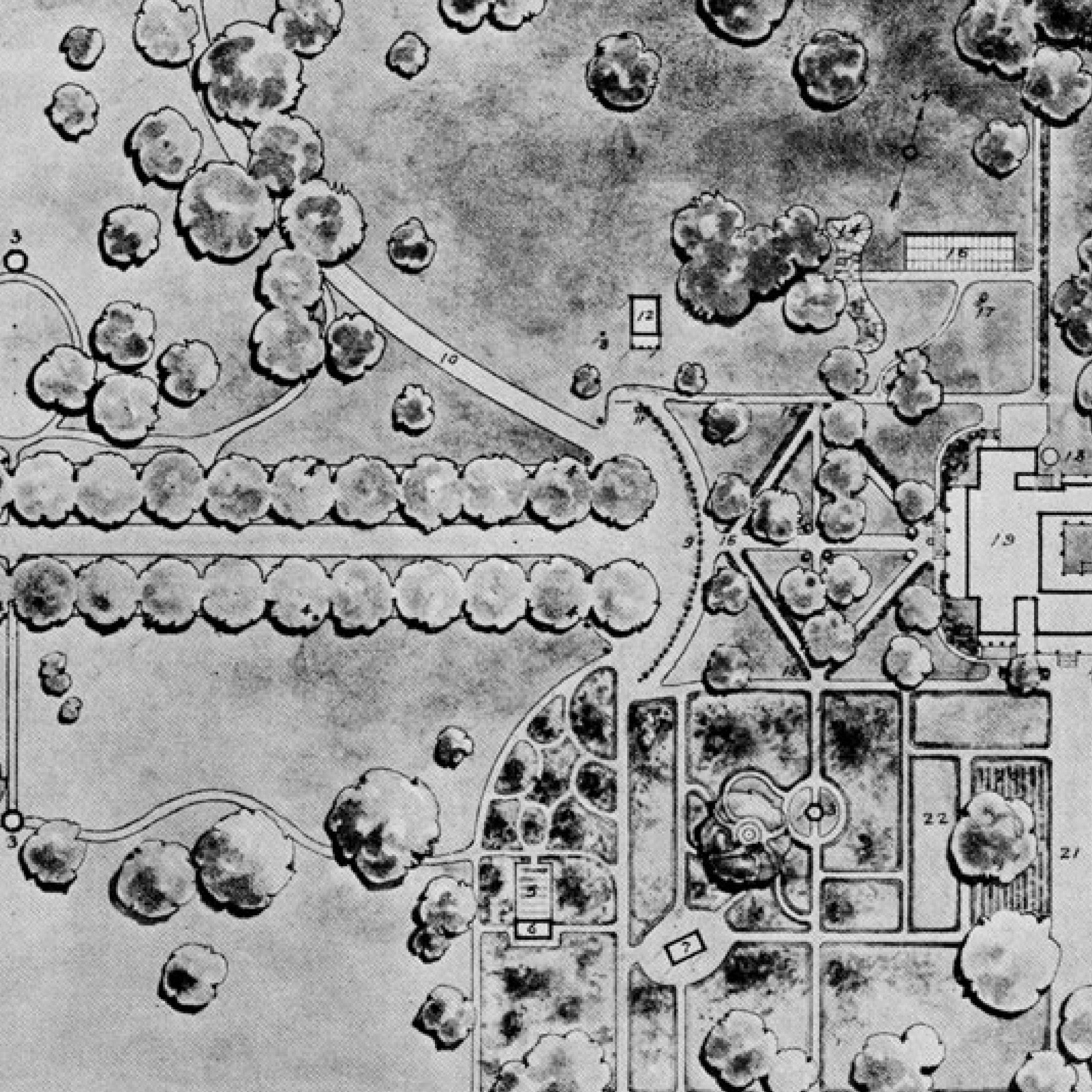
2021 - 2025 Grant Recipients
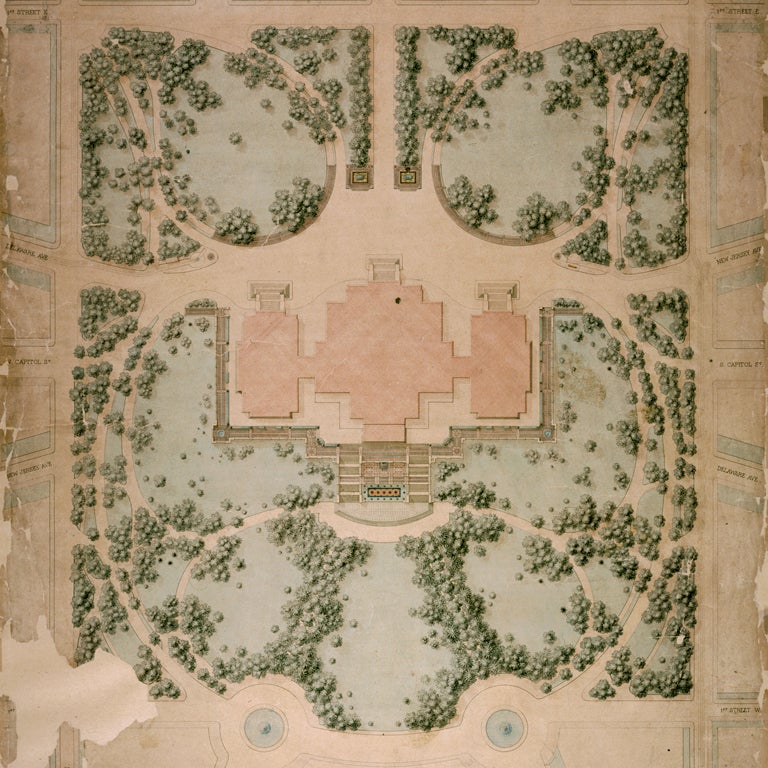
2011 - 2020 Grant Recipients
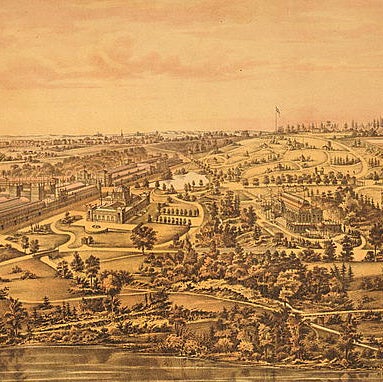
2008 - 2010 Grant Recipients
ELIGIBILITY + APPLICATION PROCESS
ELIGIBILITY
Books published on a landscape-related subject during a three-year period ending in the current calendar year are eligible for consideration by the Awards Committee.
APPLICATION PROCESS
Publishers must send books by mail to each of the appointed jury members before May 1. A cover letter should include a complete mailing address, phone number, and email address of the author(s). To request the mailing addresses for the jury, please email the book prize jury chair, Elizabeth K. Meyer at LSIbookprize@virginia.edu and include "J.B. Jackson Book Prize Application" as the subject line.
2025 Winner & Finalists
2025 J.B. Jackson Book Prize Winner

JAMES MICHAEL BUCKLEY
City of Wood: San Francisco and the Architecture of the Redwood Lumber Industry
University of Texas Press, 2024
California’s 1849 gold rush triggered creation of the “instant city” of San Francisco as a base to exploit the rich natural resources of the American West. City of Wood examines how capitalists and workers logged the state’s vast redwood forests to create the financial capital and construction materials needed to build the regional metropolis of San Francisco. Architectural historian James Michael Buckley investigates the remote forest and its urban core as two poles of a regional “city.” This city consisted of a far-reaching network of spaces, produced as company owners and workers arrayed men and machines to extract resources and create human commodities from the region’s rich natural environment.
Combining labor, urban, industrial, and social history, City of Wood employs a variety of sources—including contemporary newspaper articles, novels, and photographs—to explore the architectural landscape of lumber, from backwoods logging camps and company towns in the woods to busy lumber docks and the homes of workers and owners in San Francisco. By imagining the redwood lumber industry as a single community spread across multiple sites—a “City of Wood”—Buckley demonstrates how capitalist resource extraction links different places along the production value chain. The result is a paradigm shift in architectural history that focuses not just on the evolution of individual building design across time, but also on economic connections that link the center and periphery across space.
James Michael Buckley is an urban planner and historian.
2025 J.B. Jackson Book Prize Finalists

J.T. ROANE
Dark Agoras: Insurgent Black Social Life and Politics of Place
New York University Press, 2023
In this book, author J.T. Roane shows how working-class Black communities cultivated two interdependent modes of insurgent assembly—dark agoras—in twentieth century Philadelphia. He investigates the ways they transposed rural imaginaries about and practices of place as part of their spatial resistances and efforts to contour industrial neighborhoods. In acts that ranged from the mundane acts of refashioning intimate spaces to expressly confrontational and liberatory efforts to transform the city’s social and ecological arrangement, these communities challenged the imposition of Progressive and post-Progressive visions for urban order seeking to enclose or displace them.
Under the rubric of dark agoras Roane brings together two formulations of collectivity and belonging associated with working-class Black life. While on their surface diametrically opposed, the city’s underground—its illicit markets, taverns, pool halls, unlicensed bars, as well as spaces housing illicit sex and informal sites like corners associated with the economically and socially disreputable--constituted a spatial and experiential continuum with the city’s set apart—its house meetings, storefronts, temples, and masjid, as well as the extensive spiritually appropriated architectures of the interwar mass movements that included rural land experiments as well as urban housing, hotels, and recreational facilities. Together these sites incubated Black queer urbanism, or dissident visions for urban life challenging dominant urban reform efforts and their modes of producing race, gender, and ultimately the city itself. Roane shows how Black communities built a significant if underappreciated terrain of geographic struggle shaping Philadelphia between the Great Migration and Black Power. This fascinating book will help readers appreciate the importance of Black spatial imaginaries and worldmaking in shaping matters of urban place and politics.
J.T. Roane is Assistant Professor of Africana Studies and Geography at Rutgers University and Andrew W. Mellon chair in the Institute for the Study of Global Racial Justice.

KOFI BOONE AND M. ELEN DENNING (EDS.)
Empty Pedestals: Countering Confederate Narrative through Public Design
Louisiana State University Press, 2024
Empty Pedestals uses a design perspective to explore how monuments to the Confederacy speak to regionalism, racist political agendas, and residual collective pain. Many designers and artists working in the public realm have created innovative projects to replace Confederate memorials, contextualize those that still stand, and foster new conversations about history, race, and justice in America. By drawing lessons from these initiatives and considering the questions that remain, editors Kofi Boone and M. Elen Deming hope to assist educators and students in combating endemic prejudice and other forms of social division.
For more than a century, the endurance of Confederate monuments, street names, and other memorials in the United States has permitted proponents to establish false and oppressive arguments in defense of so-called historic preservation. The continued presence of these objects maintains symbolic forms of systemic injustice, exclusionary policies and practices, and erasure of the stories, memories, and values of marginalized populations in the American South. While many of these monuments have been taken down since 2017, they account for only a small percentage of the overall number of Confederate relics on public display.
Boone and Deming, along with the volume’s fourteen contributors, strive to elevate novel frameworks and shared solutions for the issues that continue to trouble American cultural landscapes. Above all, Empty Pedestals lifts up the voices of people who have confronted hateful narratives and devised strategies that stand up to, and apart from, old mythologies. If and when oppressive symbols such as Confederate monuments are permanently eliminated, design alternatives such as those presented here may offer healing in shared spaces, healthier social discourse, and stronger community resilience.
Kofi Boone is the Joseph D. Moore Distinguished Professor and University Faculty Scholar in the Department of Landscape Architecture and Environmental Planning at North Carolina State University. He works in the overlap between landscape architecture and environmental justice, with specializations in democratic design and cultural landscapes.
M. Elen Deming is professor of landscape architecture and director of the Doctor of Design program at the College of Design at North Carolina State University. She is an essayist and editor who considers how society shapes, and is in turn shaped by, its cultural landscapes.
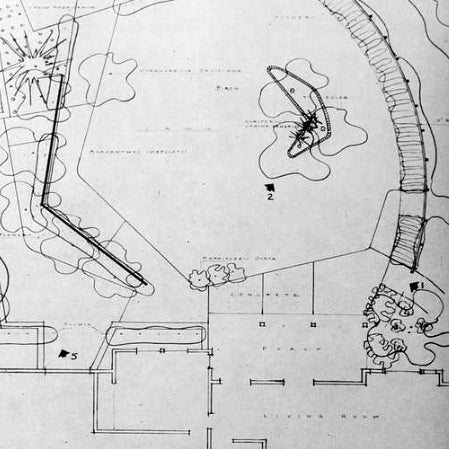
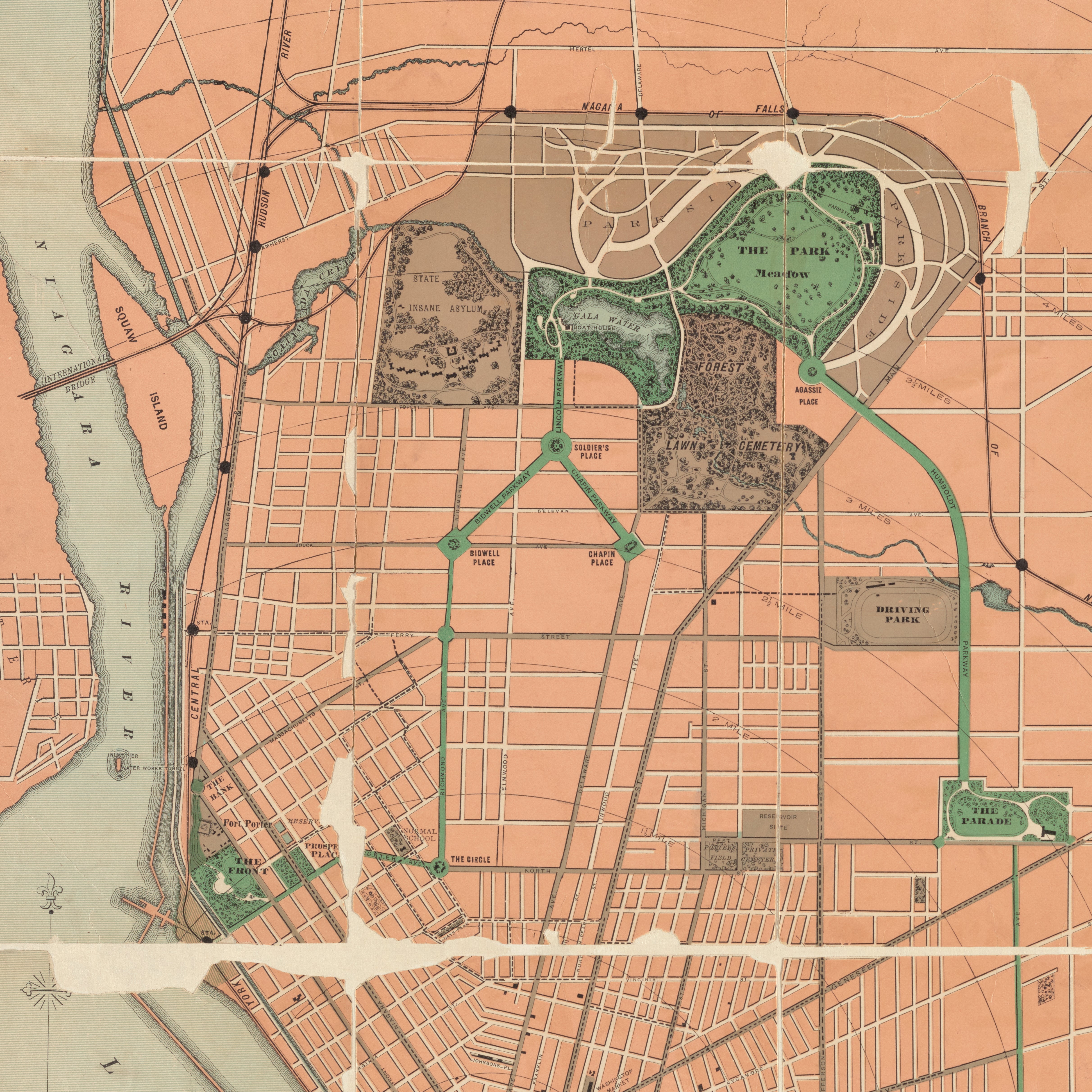
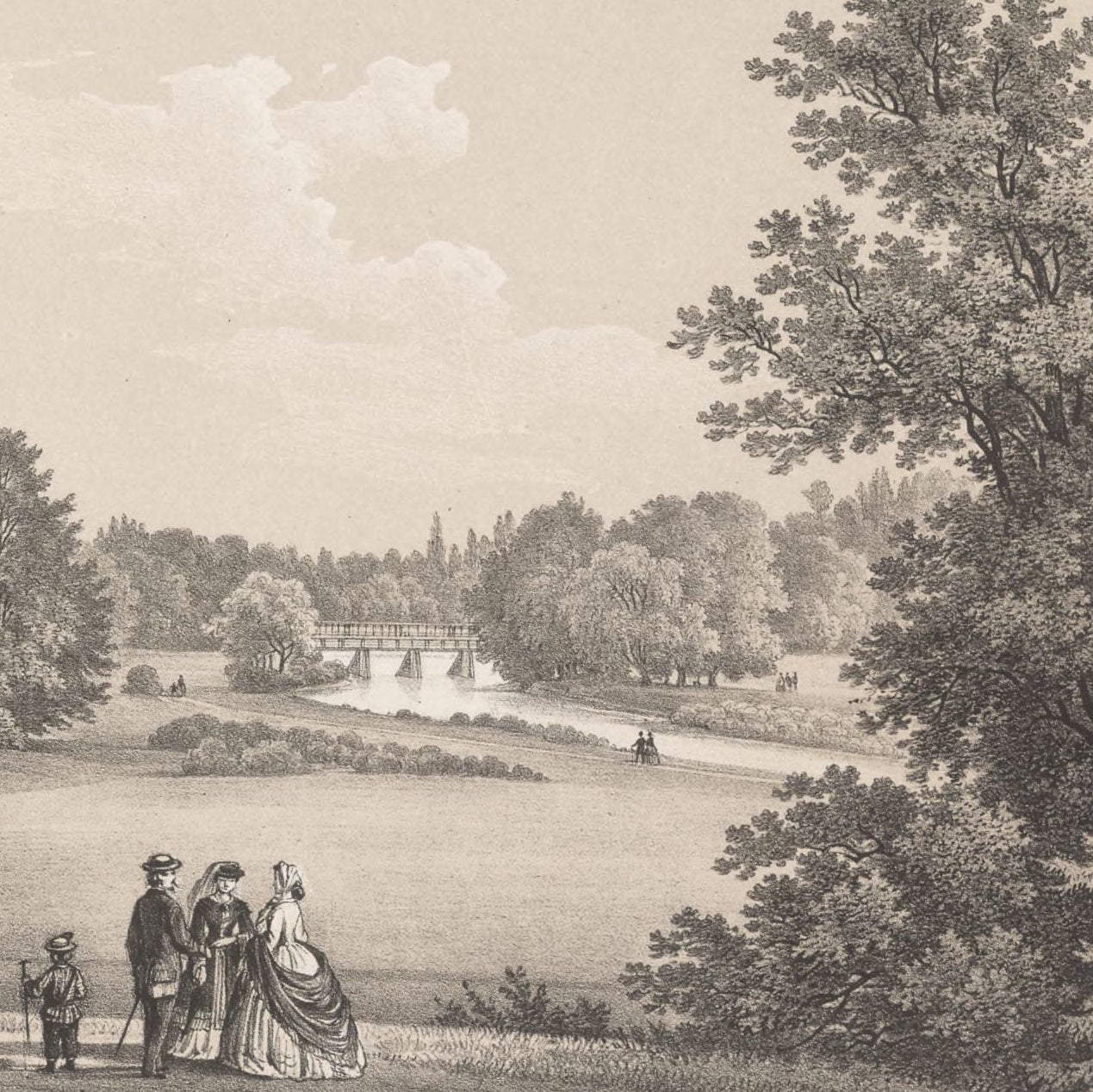
Kenneth Helphand, FASLA, Philip H. Knight Professor Emeritus of Landscape Architecture, retired from the University of Oregon in 2012 after forty years of teaching history, theory, and design. He is a graduate of Brandeis University and Harvard’s Graduate School of Design. Helphand’s books include Defiant Gardens: Making Gardens in Wartime (2006), which won several awards, including the Foundation for Landscape Studies 2007 J. B. Jackson Prize, as well as Colorado: Visions of an American Landscape (1991), Yard Street Park (1996 with Cynthia Girling), Dreaming Gardens: Landscape Architecture and the Making of the Israeli Landscape (2002), Lawrence Halprin (2017) and Hops (2020). Helphand served as editor of Landscape Journal from 1994-2002, and was Chair of Senior Fellows, Dumbarton Oaks Garden and Landscape Studies, Harvard University. In 2013, a symposium, “Landscape Thinking,” was held in Helphand’s honor in Eugene, Oregon. The symposium brought together top scholars of landscape architecture to enlighten, delight, and inspire students, professionals, faculty members, practitioners, alumni, and friends. The speakers included Cynthia Girling, Walter Hood, Ben Helphand, Alisa Braudo, Liska Chan, Tal Alon Mozes, Laurie Olin, Anne Spirn, and Marc Treib.
Dr. Sarah Lopez is a built environment historian and migration scholar and is currently an Associate Professor at the Weitzman School of Design at University of Pennsylvania. Lopez' book, The Remittance Landscape: The Spaces of Migration in Rural Mexico and Urban USA, was published by the University of Chicago Press in 2015 and won the 2017 Spiro Kostof Book Award from the Society of Architectural Historians. Lopez was awarded a Princeton-Mellon fellowship, an Urban Landscape Studies fellowship at Dumbarton Oaks, and a Center for the Study of Visual Arts fellowship.
Lopez is working on two books examining the history of migrant incarceration in the U.S. and tracking the development over the last fifty years of a network of Mexican stonemasons, quarry workers, homebuilders, architects, and businessmen who primarily provide services to Mexican and Mexican-American clientele in the American Southwest.
Jane Wolff (on research leave for 2024 cycle) is a professor at the University of Toronto’s Daniels Faculty of Architecture, Landscape, and Design. Her most recent book, Bay Lexicon, is an exploration in the place-based language around the San Francisco Bay. By diving into the complex meaning of words associated with a specific place, Wolff studies and attempts to classify phenomena throughout the Bay. The book was a winner of the 2022 LSI Book Prize. Previous publications include the edited volume Landscape Citizenships (co-editors: Tim Waterman and Ed Wall); the web resource Gutter to Gulf (co-authors: Elise Shelley and Derek Hoeferlin); and the book and deck of playing cards Delta Primer: a field guide to the California Delta. Wolff has been featured at the 2019 Toronto Biennial of Art, the Exploratorium, and the Center for Land Use Interpretation.
Wolff is a member of the advisory board of the University of Toronto’s Jackman Humanities Institute and served on the Design Review Board of Waterfront Toronto and the advisory board of BEAT (Building Equality in Architecture Toronto). Her current research focuses on developing and decolonizing landscape observation methods throughout Toronto.
Wolff is the 2022 recipient of the Margolese Design for Living Prize. This award celebrates an inspiring Canadian designer whose work in the built environment improves the lives of people and their communities.
Elizabeth Meyer, FASLA, Merrill D. Peterson Professor at the University of Virginia School of Architecture, is the Chair of the UVA Landscape Studies Initiative annual book awards program. Meyer, a landscape architect, has been fascinated by the thick description of landscapes—places replete with cultural memories and biophysical processes—since encountering historic sites along the coast from New England to Puerto Rico during her nomadic childhood. Her graduate degrees in landscape architecture and historic preservation, from the University of Virginia and Cornell University respectively, prepared her for professional opportunities to collaborate on significant projects such as the University of Virginia Academical Village, Bryant Park NYC, the National Zoo in Washington DC, Wellesley College campus in Massachusetts, and the St. Louis Gateway Arch Grounds. In 1988, Meyer left professional practice and began a career as a scholar and educator, first at Harvard Graduate School of Design, and since 1993 at the University of Virginia where she teaches design studios and graduate seminars on cultural landscapes and contemporary design theory. She has published widely in scholar journals and anthologies; in 2018, the European Journal of Landscape Architecture dedicated a special issue to an assessment of Meyer’s influential manifesto Sustaining Beauty, a mediation on the entanglement of landscape aesthetics and environmental ethics. In recognition of Meyer’s accomplishments, she was selected by President Obama to serve on the US Commission of Fine Arts (2012-2020) and received the Vincent Scully Prize from the National Building Museum in 2019.
Meyer founded the UVA Center for Cultural Landscapes in 2016 as a collaborative hub for scholars and practitioners seeking to create new cultural landscape approaches to research, interpretation, preservation and design. Early CCL projects include What’s Out there Richmond, a collaboration with The Cultural Landscape Foundation, the Central Virginia Piedmont Food Heritage Cultural Landscape Atlas, the Race and Public Space. Commemorative Practices in the American South symposium and the Towards a Charlottesville Cultural Landscape Colloquium. In August 2022, Meyer and the LSI team, launched the beta version of an open-source digital landscape history text, Landscape Design. A Cultural and Architectural History, that was funded by the Andrew D. Mellon Foundation, the UVA Alumni Association Jefferson Trust, and the UVA School of Architecture. This project will continue to evolve with the addition of new content and features thanks to a generous legacy gift from the Foundation for Landscape Studies.