
This summer, prospective students and their guests are invited to explore the A-School through a guided visit of Campbell Hall. Tours are led by the Director of Admission and include an overview of our academic programs, studio culture, and student experience, followed by an informal Q&A. Register here!
Need Assistance?
Email us at a-school-admissions@virginia.edu.
VIRTUAL CAMPBELL HALL TOURS
The Urban Design graduate certificate program is designed to equip Master’s candidates from the School of Architecture’s four departments of Architecture, Landscape Architecture, Urban and Environmental Planning, and Architectural History with the expertise and skills to engage with multi-scalar issues facing urban environments, from urban and infrastructural development, to social equity and resilience. The program will provide students with practical spatial design strategies and analytical tools as well as foundational historical and theoretical knowledge supporting urban design and planning strategies. As a cross-disciplinary program of study, the Urban Design certificate effectively complements the school’s other graduate degree programs by preparing graduates that are able to join, and meaningfully contribute to, interdisciplinary teams concerned with the urban realm and urban spaces, whether in government, private practice, or in an institutional context.
Architects pursuing the Urban Design certificate will be prepared to join the making of an urban plan, and deploy their design skills to create synergy between multiple buildings and the spaces between and around them. For landscape architects, the certificate will provide tools and strategies to prepare them to coordinate the needs of local and regional ecosystems with needs of urban development. The Urban Design Certificate will build spatial skills and design thinking for students from Urban and Environmental Planning. Students in History will gain concepts and strategies to help ensure that historic buildings and districts maintain or renew their vitality in a changing urban context.
For official requirements of this certificate, students should consult UVA's Graduate Record.
15 CREDITS
To complete the program requirements of the Urban Design Certificate students will fill their elective classes with Urban Design certificate credits. Students are recommended to start with the core classes as these build a foundation for the certificate. Students without design experience in their undergrad education are further required to participate in the Summer Design Institute prior to enrolling in the Urban Design Certificate program.
Full-time degree-seeking student at UVA School of Architecture taking 12-18 credit hours per semester would complete the certificate in 2-3 years (4-6 semesters). The program is only available to full-time students. All certificate course requirements are to be completed within the time it takes to complete the graduate degree in which they are enrolled, ensuring no additional time is added to the expected length of graduate study.
Current students enrolled in the Urban Design Certificate program must consult UVA's Graduate Record for the official requirements for this certificate.
Students wishing to enter the Urban Design graduate certificate program must be a current graduate student at the School of Architecture. Students must apply to Urban Design graduate certificate program, following the admissions requirements outlined below:
+ An online application
+ A statement of professional goals [approximately 300 words]
+ Curriculum Vitae
+ Successful completion of the Summer Design Institute [for students who do not have an undergraduate degree in a design discipline]
+ Good academic standing in their department, with a GPA of at least 3.0 [B average]
+ Approval of the Urban Design Certificate Program Director
Degree-seeking students may transfer a maximum of 3 credits toward the certificate requirements if earned at the University of Virginia and if they have attained a minimum of a B in the course and have received approval from the Urban Design Certificate Program Director.
The Urban Design graduate certificate is offered through 2 tracks depending on the student’s graduate program. Students in the Architecture, Landscape Architecture, or Planning program will enroll in track 1 with an emphasis on urban analysis and design. Students in the Architecture History program can enroll in track 2 with an emphasis on urban design history, theory, and analysis.
[Note: Students might be able to opt in or out of their track. This however is understood as an exception and needs approval from the Urban Design Certificate Program Director.]
URBAN DESIGN CERTIFICATE: TRACK 1
Students in Track 1 are required to take two urban design core seminars (3 credits each), one urban design research studio (6 credits), and one urban design elective course (3 credits) for the total of 15 credits. There are several classes that fulfill the UDC core seminars and students can choose among these classes (Go to the section below "Urban Design Courses" to view a list of UDC core seminars). One core course should cover urban design history and theory to provide a foundation in the historic, geographic, and cultural diversity of cities worldwide based on a comparative study of exemplary projects. The second core course should concentrate on urban design methods and provide the analytical methods and design strategies required for analyzing urban processes and intervening in urban environments. The urban design research studio is offered in the ARCH/LAR 8010/8020 sequence. Studios are addressing urban problematics through a variety of scales ranging from the neighborhood to the city and larger surrounding regions.
Electives will complement core courses by presenting advanced theoretical positions and practical skills in contemporary urban design. Courses will teach students to: carry out digital and analog analyses of urban areas at multiple scales; create a strategic development plan; analyze how ecological, economic, and policy issues affect the making of urban design plans; and understand how to work with stakeholder groups to build consensus and resilience.
UDC electives can be chosen from the classes listed on this webpage (Go to the section below "Urban Design Courses" to view a list of UDC electives). Required classes in the major degree program cannot count as UDC electives.
URBAN DESIGN CERTIFICATE: TRACK 2
Students in Track 2 are required to take two urban design core seminars (3 credits each), one urban design analysis class (3 credits), and two urban design elective courses (3 credits each) for the total of 15 credits. There are several classes that fulfill the UDC core seminars and students can choose among these classes. (Go to the section below "Urban Design Courses" to view a list of UDC core seminars). One core course should cover urban design history and theory to provide a foundation in the historic, geographic, and cultural diversity of cities worldwide based on a comparative study of exemplary projects. The second core course should concentrate on urban design methods and provide the analytical methods and design strategies required for analyzing urban processes and intervening in urban environments. The urban analysis seminar will introduce students to GIS software technology, mapping techniques, and the ESRI analytical toolbox. Students can choose among multiple urban analysis classes and should contact the program director to discuss this prior to enrollment.
Electives will complement the core courses by presenting advanced theoretical positions and practical skills in contemporary urban design. Courses will teach students to: carry out digital and analog analyses of urban areas at multiple scales; create a strategic development plan; analyze how ecological, economic, and policy issues affect the making of urban design plans; and understand how to work with stakeholder groups to build consensus and resilience.
UDC electives can be chosen from the classes listed on this webpage. (Go to the section below "Urban Design Courses" to view a list of UDC electives). Required classes in the major degree program cannot count as UDC electives.
Specific course numbers and course requirements are posted through UVA's Graduate Record.
Students should review course requirements and seek advice for course planning by meeting with the Urban Design Certificate Program Director.
The following list of course descriptions present the range of course offerings at UVA School of Architecture related to urban design. Not every course will be offered every semester.
Consult with the Urban Design Certificate Program Director to learn more about current and future course offerings that apply to the Urban Design graduate certificate.
UDC CORE SEMINARS:
ARCH 5500 - Technology, Urbanization & Design (3 credits)
[Note: Students who can’t take ARCH 5612 can count PLAN 5500 as a replacement class. Approval by the UDC Director is required.]
This course is premised on two major shifts within the discussion of urbanization and technological development. On one hand, our understandings of urbanization processes and urban forms need to move beyond cities as concentrated sites of urban thought. This expansion of scope allows for the analytic inclusion of the extended productive, infrastructural and extractive landscapes. On the other hand, looking at technologies matter-of-factly is increasingly not sufficient. We also need to investigate the ideologies and biases embedded within technological development that tend to reflect and perpetuate some of the larger sociopolitical inequalities and systemic and structural preconceptions at work in urban environments. Something that becomes more critical as tech companies begin to exert their power and resources within cities and urban environments globally.
ARCH 5612 - Modes of Inscription: Architecture, Landscape, Urbanism (3 credits)
Topical in structure, this lecture course presents a contemporary examination of the role of the designer within the built environment, beyond disciplinary silos inherited from the twentieth century that defined the practices of architecture, landscape architecture, and urban planning as autonomous disciplines with limited transversal dialogue. Key to this argument is the claim that a renewed understanding of the notion of urban design as a bridge practice that can help facilitate a more unified disciplinary body.
ARCH/PLAN 5614 – Urban Strategies (3 credits)
Worldwide urbanization processes will increase in the next years reaching an urbanization rate of 75% by the middle of the century. Shrinkage, stagnation and rapid growth are simultaneous phenomena affecting contemporary cities. Urban sustainability is therefore highly dependent on our ability to generate and implement strategic frameworks for the city that accommodate these transformations. Discussions, lectures, and readings in combination with an urban design group project will introduce students to contemporary urban design methodologies, including temporary tactics and the elaboration of urban scenarios, that lead to the development of comprehensive urban design frameworks and strategies.
LAR 7500 - Water and the City (3 credits)
This seminar examines urban relationships between water infrastructure, rivers, and coasts in the Americas over the last one thousand years. Issues related to climate change, landscape infrastructure, urban form, public space design, and human and ecosystem health are presented and analyzed. Themes such as wilderness, frontiers, and mobility are developed as we investigate cases drawing from academic texts, source documents, and popular culture.
PLAN 5611 - Barcelona Urban History (3 credits)
[Note: Students who join the Barcelona Study abroad semester can count PLAN 5611 as a replacement for ARCH 5612. Approval by the UDC Director is required.]
The students will understand the history of Barcelona from its Roman foundation to the extension of its medieval walls. The development of its urban structural grid, example of Cerdà, as well as its current state of remodeling for the Olympic games, and the ongoing urban transformations will all be studied in this class. This course will consist of lectures, field trips & practical exercises; specifically, we will develop a graphic interpretation.
UD 8612 - Urban Design History and Theory (3 credits)
This course introduces students to the underlying histories and theoretical dimensions of urban design as a creative spatial practice. By exploring a wide range of urban interventions at multiple scales, the course contextualizes contemporary design practice within the social, environmental, and political forces acting on the urban environment.
UDC RESEARCH STUDIOS:
UD Research Studios are offered regularly in the Architecture and Landscape Architecture curriculum. Each year students in these studios work across disciplines. The studio topics are ranging, but urban-focused studios are guaranteed as a commitment by the department chairs and the dean.
The following list features a sample of urban design studios that have been taught in last few years.
ALAR 8010 - Yamuna River Project, India (6 credits)
The University of Virginia’s Yamuna River Project is an inter-disciplinary research program whose objective is to revitalize the ecology of the Yamuna River in New Delhi, thus reconnecting India’s capital city back to the water. Students employ techniques of urban design and landscape remediation for the recovery of the Yamuna and its tributaries.
ALAR 8010 - Urban Design Barcelona (6 credits, Barcelona Program only)
Students design a new relationship between the eastern port area and the city of Barcelona. Working in a complex urban area, students acquire urban, architectural and landscape strategies. Their work incorporates urban relations, public spaces and infrastructure.
ALAR 8010 - The Architecture and Landscape of Infrastructural Urbanism (6 credits)
This studio encourages the rethinking of the processes, structures, and forms of cities, urban landscapes, and architecture in the 21st century. The studio participates in the Schindler Global Award Competition, which is one of the most important ideas competitions that runs every two years. The context for the 2018-19 competition was Mumbai, India, one of the more rapidly developing cities in the world.
ALAR 8010 – Fallow Cities: The Ruhr and the Rust Belt (6 credits)
This studio investigates precedents of urban regeneration in industrial regions to gather fodder for design propositions at multiple scales of urban, landscape and architectural design. Students delve deep into pre-settlement, growth and decline cycles of select cities to imagine the next successional phase of urban form. As opposed to overzealous redevelopment schemes, the premise of this studio is zero or little growth, propositions focused on restructuring the city for existing or displaced residents. Lessons learned in the Ruhr District in Germany are translated for application to North American Rust Belt cities.
UDC ELECTIVES:
Electives are grouped in areas of expertise; Urban Design spatial analysis and transportation systems, history and theory, systems and ecology, as well as economy, policy and community engagement. Students are not allowed to count a required class in their degree program towards a required elective in the Urban Design Certificate. The following course descriptions are examples of urban electives at the UVA School of Architecture.
Urban Design Spatial Analysis and Transportation Systems
ARCH/PLAN 5613 - Networked Cities: Techniques and Theories (3 credits)
This seminar investigates the Northeast Corridor, specifically the region around Washington, DC. Current and recent theories of large urban agglomerations are discussed and critically examined. Students gain analytical techniques developed through maps, infographics, and are introduced to ArcGIS applications.
ARCH 5717 - Mapping as Critical Practice (3 credits)
This course introduces contemporary cartographic and data visualization techniques as design tools for the strategic development of critical, theoretical, and experimental frameworks for architecture, urbanism, and intermedia design practices.
LAR 7415 - Scripting Civic Engagement: Web Technologies (3 credits)
This course introduces various technologies, primarily web-based, that enable designers to promote civic engagement through the analysis and activation of public space. Course format is interactive and interdisciplinary, combining hands-on tutorials (Mapbox, HTML, CSS, dataviz, social media APIs.) with contemporary case studies in placemaking, activism, and civic tech. No prior coding knowledge required.
LAR 7750 - Gaming Landscape Representation: Imaging the Green New Deal (3 credits)
How we image the world directly informs how we see and act in the world. As we face the social and environmental crises of climate change, imaging of the future must be bold and compelling. Within the framework of the Green New Deal and its urgent context, a newly accessible, uniquely versatile, and culturally significant tool will be employed: the Unity game engine. Real-time environments and mixed reality (AR/VR) projects will be produced.
PLAC 5721 - Transportation and Design (3 credits)
This urban-design-oriented class explores the impact of transportation choice on community character. Students learn the skills for place-making and multi-modal transportation planning by: Understanding “Neighborhood” as a physical entity; Rethinking “Corridor” as a critical element of public space; and Learning the rudiments of transport planning.
PLAN 6120 - Digital Technology for Planning and Design II - GIS (3 credits)
Required second semester technology class introducing students to the fundamental applications of geographic information systems central to planning analysis and practice.
SARC 5400 - Data Visualization (3 credits)
This is a course about information and data visualization. We live in a world rich with information. This course teaches visual and spatial thinking coupled with data analysis tools and custom web-enabled programming to construct and envision information. To find and even invent approaches toward seeing into complex problems, we will study, and make, useful, compelling and beautiful tools to see.
SARC 6720 - Design Computation GIS (3 credits)
Geographic Information System (GIS) is a data management, a mapping, and a visualization tool as well as a spatial analysis engine. This course focuses on how urban and environmental planners, and others in the social sciences, can use GIS to address current planning problems. Students work with GPS, Remote Sensing, 3-D analysis and web GIS.
Urban Design History/Theory
ARAH/ARH 9540 - Space & the Politics of Everyday Life (3 credits)
This seminar aims to re-situate the recent interest in avant-garde architectural practices of the 1960s in relation to the contemporaneous history and spatial politics of decolonialization, revolutionary movements, student uprisings, and urban theory. Henri Lefebvre’s formulations of everyday life and the right to the city will be a focus of investigation.
ARCH 5605 - Public Space – Design, History and Construction (3 credits)
Students explore how to use materials to resolve urban design and landscape issues. Using the different urban textures of Barcelona as a laboratory, students confront urban design and landscape techniques with the challenges of climate change, energy and water supply, and urban transportation.
LAR 5210 - Topics in Contemporary Landscape: Public Space (3 credits)
This seminar explores topics in landscape architecture theory through direct readings, discussions & research papers. Topics vary from year to year -- eg public space, representing temporality & process, changing conceptions of nature & ecology (from sustainability to emergence), gender & design, the works of a specific designer or region.
PLAN 6011 - Race and the American City (3 credits)
A seminar exploring how racialized inequalities have shaped American cities North & South, past & present, and the influence of racialized urban structures on the idea & experience of race in America. Topics include the effects of segregation, redlining, urban planning, redevelopment, white flight, ghettoization & neoliberal development on the form & culture of American cities & structures of inequality in the US. Graduate level will have additional requirements.
PLAN/LAR 5452 - Healthy Cities (3 credits)
This course's objective is to understand the theoretical concepts and health models supporting the goal of healthy cities. Classwork will frame health and well being issues relative to sustainability. This course is interdisciplinary and designed for students from the schools of architecture, public health, nursing, sociology, and psychology.
PLAN 6040 - Quantitative Methods of Planning Analysis (3 credits)
This course applies quantitative skills to the planning process: analyzes decision situations and develops precise languages communicating the quantitative dimensions of planning problems. Includes lectures, case studies, and applied assignments addressing statistical methods, survey methods, census data analysis, program and plan evaluation, and emerging methods used by planners.
PLAN 6070 - Planning Theory and Practice (3 credits)
In this course students grapple with the dynamic tensions between planning and democracy, the various responses that have been proposed, and planning failures and successes. They explore the development of theories about how we ought to plan, why, and for whom. This course will have additional course requirements compared to PLAN 6070.
PLAN 7040 - Advanced Metropolis (3 credits)
This lecture course focuses on cities as centers of cultural, social, and artistic activity. It considers how we define cities, the forces that create and sustain them, and what makes them culturally distinctive. Istanbul, London, Paris, New York, and Shanghai are studied at their moments of cultural, political or architectural glory.
Urban Design Systems/Ecologies
ARCH 5150 - Global Sustainability (3 credits)
Earth's ecosystems are unraveling at an unprecedented rate, threatening human wellbeing & posing substantial challenges to contemporary society. Designing sustainable practices, institutions, & technologies for a resource-constrained world is our greatest challenge. This integrated and interdisciplinary course prepares students to understand, innovate & lead the efforts necessary to engage in this task. Graduate course will have additional course requirements.
PLAC 5800 / LAR 5290 - Green Infrastructure: Cities (3 credits)
Green infrastructure includes water, habitats, parks, soils, and forests essential for healthy communities and building community resiliency. Working in teams, students conduct field work and determine community needs and opportunities for a city's urban forests, water, recreation and historic and cultural resources. Students then complete a strategic green infrastructure plan for a city.
PLAC 5860 / LAR 5280 - Green Infrastructure: Sites (3 credits)
Cities have altered natural drainage patterns, vegetation, local climate and habitats. Cities can use natural elements such as plants, trees and wetlands combined with engineered structures as “constructed green infrastructure” to redesign degraded urban sites. Students will utilize “green infrastructure” to create conceptual designs for sites to absorb stormwater, clean the air, or provide food and recreation.
PLAN 5500 - Climate Adaptation Planning (3 credits)
Adaptation refers to actions taken at the individual. Local, regional, and national levels to reduce the risks posed by a changing climate. This course contrasts the theory and academic research of climate adaptation planning with the state of practice in communities around Virginia. Anticipated impacts such as sea level rise, heat waves, and coastal storms will be explored as well as implications for natural ecosystems and urban infrastructures. Topic varies from semester to semester
PLAN 5500 - Informal Urbanism (3 credits)
The growth of the informal sector worldwide has led to a polarization between formal and informal practices. Although informal urban practices and its multifarious related activities contribute significantly to cities' development, it is often stigmatized as an urban mistake, and little is known about them. By exploring the informal city as a site for critical analysis, this course will investigate informal urban practices' economic, social, spatial, and environmental dimensions and their role in the creative production of cities, resilience, and spatial justice. Topic varies from semester to semester
PLAN 5840 - Ethics and Environment (3 credits)
Course materials cover a wide range of topics in environmental and urban ethics, including contrasting views of the market, the rights of animals and nature, and obligations to future generations. Besides extensive readings, students complete an ethics interview, an applied ethics analysis, and a personal ethical statement.
PLAN 6860 - Cities and Nature: Planning for Biophilic Cities (3 credits)
This class studies and discusses the positive effects and pathways by which nature can compliment and enhance urban lives. The concept of Biophilic Cities is reviewed by studying projects, which develop the tools, techniques, and policies of Biophilic Design.
Urban Design Policy/Economics/ Community Engagement
PLAC 5250 - Applied Real Estate Studio (4 credits)
The course emulates the real estate development process in a specific geographic and socio-economic setting. In this studio, students will form small teams assigned to develop a project for a specific site. The students begin with site analysis, develop a proposed "product," conduct all the key financial analyses, and identify and develop the materials that would be necessary to move the project through public approval.
PLAC 5240 - Collaborative Planning for Sustainability (3 credits)
This course proposes that communities can only be sustained by informed participation of citizens actively engaged in self-governance. Public decisions are better when developed by processes that are inclusive, transparent, and inviting, and responsive to community needs.
PLAC 5720 - Transportation and Land Use (3 credits)
This course examines the relationships between transportation, land use, and urban form by developing a transportation-land use plan focused on a major transportation and development issue. The study of history, theory, and current case studies is contrasted by fieldwork, interviews, and remotely sensed data.
PLAN 5200 - Real Estate Develop Process (3 credits)
Foundational course for SARC real estate offerings. Covers fundamentals from basic real estate relationships, land acquisition decisions, "the cash cycle", legal aspects, public processes including entitlements, risk management, ethics, and preliminary feasibility analysis. The emphasis is on the creation of value in real estate (viewed holistically as financial profit informed by equity, sustainability, and design.
PLAN 5220 - Real Estate Finance Fundamentals (3 credits)
Finance is a critical element in determining whether a real estate development project goes forward and whether the project actually looks and performs in accordance with the original design and social/economic objectives. In this course, students will learn the fundamental analyses of real estate finance and develop an understanding of the ways finance impacts upon project completion and architectural and community outcomes.
PLAN 5600 - Land Use and Growth Management (3 credits)
Introduces the theory and practice of land use planning and growth management as they have evolved historically and as expressed in contemporary practice. Addresses the need and rationale for land use planning as well as its tools.
PLAN 5810 - Sustainable Community Design (3 credits)
What are the impacts that development practices have on our globe and its inhabitants? This course considers the history, theory, and practice of sustainability, one of the most powerful ethics-driven concepts ever to take hold in the marketplace, focusing on how the tensions of economy, ecology, and equity play out in sustainable design practice.
PLAN 6020 – Methods of Community Engagement and Research (3 credits)
This course explores the ethics and methods available for practitioners intending to work in/with communities. Traditional methods used in community partnerships are studied along with more recent strategies such as asset mapping, visual preference surveys, games, art-based visioning to build empathic skills.
PLAN 6050 - Law, Land and the Environment (3 credits)
This course examines major legal issues surrounding land use planning and environmental protection. Intended to introduce students to critical legal concepts (e.g., due process, precedent, standing) as well as the parameters set for planning by the US Constitution, key Constitutional amendments, and various statutes including main federal environmental laws. Where appropriate state level laws and cases are reviewed.
PLAN 6070 - Planning Theory and Practice (3 credits)
Planners are often caught between serving the “public interest” and powerful economic and political forces. In this course, students measure the dynamic tensions between planning and democracy by critically reviewing examples that succeeded or failed. Students debate how we ought to plan, why, and for whom.
The Master of Urban Design (MUD) is a new 3-semester, 45-credit hour, post-professional non-accredited degree program at the UVA School of Architecture that addresses contemporary questions of urbanization. Recognizing the urban as a dynamic, evolving construct and a space of collective citizenry, the city for us is a verb — rooted in action and participation, complexity and potential. Defined as a bridge discipline and a critical catalytic link across different professions, Urban Design at UVA draws together and transcends the traditional disciplines of Architecture, Urban Planning, and Landscape Architecture to address current urban challenges, to serve broad community needs, and to participate in the dynamics of the urban condition. The breadth and depth of our interdisciplinary faculty expertise teach students to push disciplinary boundaries while providing a strong mission-focused foundation, across scholarship, design, technology, society, and practice.
ADMISSION NOTIFICATION
*** Admission to the Master of Urban Design Program (1.5 year post-professional degree), including dual degree students, is currently paused. ***
Students who are interested in the program are invited to join our contact list (see below).
INTERESTED IN OUR MUD PROGRAM?
JOIN OUR CONTACT LIST
Why Study Urban Design at UVA?
Urban Design Now
We are living in a critical moment in human history. With most of the world’s population now living in urban areas and an expected substantial increase of the world’s urban population by 2050, urban design is at the center of addressing so many of today’s most pressing spatial, economic, environmental, and social challenges. From rapid population growth and mass urbanization to environmental degradation and the impacts of climate change, from questions of social justice and urban inequities to housing affordability and accessibility to shared public space, urban designers are leaders and change-makers who are envisioning and shaping sustainable, just, and resilient urban environments for our future.
AN INTERDISCIPLINARY APPROACH TO ENACT POSITIVE CHANGE
The post-professional Master of Urban Design program at the UVA School of Architecture embodies an in-depth interdisciplinary and multi-scale approach and takes advantage of the School’s existing expertise to synthesize knowledge and skills drawn from all our disciplines, and grounded in spatial literacy. Our students are part of a collaborative community of internationally recognized faculty and an energetic, talented, and culturally diverse student body. The program prepares graduates as future leaders, critical scholars, innovative urban designers, and mission-focused change-makers who develop advanced skills and knowledge to address the contemporary challenges of our constructed environments.
CATALYZED BY PARTICIPATORY RESEARCH
Linked to the Next Cities Institute, our students are directly engaged with urban design research projects that provide opportunities to apply theory and experimentation in specific conditions and contexts. Our research-focused program gives our students a chance to participate in the dynamic conditions of the urban as active citizens — to work with community members and to learn from their lived experience. Our work is diverse, in scope and geography, with projects in India, Brazil, the Arctic, China, and many other global sites, that address the paradigm shifts of planetary urbanization, environmental degradation, and the digital revolution.
WHO SHOULD APPLY
We welcome students from diverse academic backgrounds and professional experiences with a desire to make a positive impact on the built environment. As a student, you have the opportunity to take advantage of UVA’s strong history as a renowned research university, with nationally and internationally ranked programs, distinguished faculty, and robust resources.
The Master of Urban Design program welcomes applicants with a professional degree in Architecture, Landscape Architecture, and/or Urban Planning. Applicants with a 4-year non-professional degree in Architecture or Landscape Architecture and experience in design practice can be admitted based on portfolio review and by the decision of the Urban Design admission committee.
The diverse scholarly and professional backgrounds of our students and faculty enrich our educational environment in the post-professional MUD program. Applicants with a previous Urban Design Certificate from UVA and a degree in Architecture, Landscape Architecture, or Urban and Environmental Planning from UVA are eligible for advanced placement.
MUD: 45 CREDITS
The 1.5 year, post-professional Master in Urban Design [MUD] is 45 credits. Students complete 15 credits per semester, starting in the fall semester. Graduates with a previous Urban Design Certificate from UVA are accepted with advanced standing and can complete the program in 1 year, completing a curriculum of 30 credits.
FIRST SEMESTER (FALL): 15 CREDITS
The first-semester sequence establishes a common ground for all MUD students who are entering the post-professional program coming from diverse disciplinary backgrounds. In the first semester, students learn to synthesize analytical, theoretical and design skills to address questions of coastal resilience and environmental justice. An open elective allows students to explore individual interests and research agendas.
-
UD 8010 Foundation Studio [6 credits]
-
UD 8611 Urban Analysis and Technology [3 credits]
-
Restricted Elective* [3 credits]
-
Open Elective [3 credits]
*Restricted elective seminars are offered in every semester and have three different focus areas:
-
Urban Climate Ecology and Environment [3 credits]
-
Global Territories and Social Justice [3 credits]
-
Urban Economy and Spatial Policies [3 credits]
Students can choose among multiple seminars listed in these categories that are taught at the School of Architecture and across Grounds in other Departments and Schools. Over the three semesters of the degree program, students must have taken a course in each of the three focus areas. Restricted electives can also count as open electives.
SECOND SEMESTER (SPRING): 15 CREDITS
For the second-semester curriculum students contribute to the Next Cities Research initiative. Embedded into a network of international partners in Europe, Asia, and the Americas, as well as NGOs and governmental organizations, students explore questions of global urbanization processes in their studio project. The studio is linked to travel opportunities and interdisciplinary design workshops with national and international partners. Two core seminars and a restricted elective will help students to further synthesize urban theory and explore a range of urban design strategies.
-
UD 8020 Research Studio Next Cities [6 credits]
-
UD 8614 Urban Strategies and Engagement [3 credits]
-
UD 8612 Urban History and Theory [3 credits]
-
Restricted Elective* [3 credits]
THIRD SEMESTER (FALL): 15 CREDITS
The third, and final, semester is built around individual design research. Students may choose to pursue an independent urban design thesis or take an advanced research studio from a wide range of elective studios offered by the School of Architecture. Open electives allows students to explore urban design classes offered across UVA Grounds and to investigate work related to their thesis interest.
-
UD 8030 Thesis Studio [6 credits] or ALAR 8010 Research Studio [6 credits]
-
Restricted Elective* [3 credits]
-
Open Elective Thesis Research** [3 credits]
-
Open Elective [3 credits]
** Students must dedicate one of the open electives to support their thesis research or research studio.
Some individual adjustments to the degree program curriculum are possible. For example, the semester in which a student takes restricted electives and/or open electives could be adjusted from the curricular path outlined above, but all changes need to be discussed with the MUD Director during the enrollment period.
Students enrolled in the MUD program must consult UVA's Graduate Record for the official requirements.
Students enrolled in one of our graduate programs [M.ARCH, MLA, MUEP] who are interested in also receiving the Master of Urban Design [MUD] degree should first complete the Urban Design Certificate [UDC], a 15-credit curricular sequence. The UDC is taken while pursuing the M.ARCH, MLA or MUEP degree. By continuing for another year [30 credits], students can complete the MUD as a dual degree with our other graduate degrees.
The Master of Urban Design (MUD) degree at UVA is an approved field of study within the U.S. government’s official STEM fields list. The program’s STEM-designation (and associated new CIP code: 30.3301) allows our international MUD graduates to apply for the optional practical training (OPT) extension program for F-1 students with STEM degrees.
The STEM OPT Extension program affords eligible international students holding F-1 visas, upon completion of a STEM-designated degree, the opportunity to extend their stay in the United States by 24 months (allowing for a maximum of 36 months total) to obtain advanced training in their field – enhancing our students’ overall educational experience and helping to bridge their experience between academia and practice.
With a mission-driven interdisciplinary group of faculty rooted in the Departments of Architecture, Landscape Architecture, Urban and Environmental Planning, and Architectural History, our Urban Design curriculum addresses the most pressing social, environmental, and spatial challenges confronting society in the 21st century — challenges such as climate change and environmental degradation, demographic shifts and racial injustices, as well as technological transformations.
Through our collaborations, integrated with the School's Next Cities Institute, these challenges are addressed through radical concepts and transformative methodologies that allow us to not only envision more sustainable future cities, but to shape new practices that constitute the dynamic conditions of the urban. Our work engages the ways in which complex, often competing, forces come together in the spatial structure of the city. Spatial literacy and active participation are critical to recognizing that the spaces of urbanism are spaces of citizenry — where struggles and potentials collide and where we, collectively, enact our capacities to make a better world for all.
Embracing an interdisciplinary and multi-scalar approach, and utilizing applied design research and theoretical investigations, our cross-departmental Urban Design curriculum is committed to the education of the next generation of design leaders and change-makers. In examining a multiplicity of scales and diverse spatial conditions of urbanity, from public space to private development, and from the social to the ecological, we help designers and planners to become critical thinkers and strategic agents in support of urban sustainability, social justice, and environmental resilience.
DEGREE PROGRAMS
MUD (Master of Urban Design)
1.5-year post-professional degree (Master of Urban Design, 45 credits) program with dual degree options for graduate students in the UVA Departments of Architecture, Landscape Architecture, and Urban + Environmental Planning
Admission Notification
***Admission to the Master of Urban Design Program (1.5 year post-professional degree), including dual degree applicants, is currently paused. Students who are interested in the program are invited to join our Contact List. ***
Prospective students applying to any of our four other masters programs (Master of Architectural History, Master of Architecture, Master of Landscape Architecture, or Master of Urban + Environmental Planning) are eligible to pursue the Urban Design Certificate (15 credits) as part of their graduate education at UVA School of Architecture. See more information below and here.
The Master of Urban Design (MUD) degree at UVA is an approved field of study within the U.S. government’s official STEM fields list. The program’s STEM-designation (and associated new CIP code: 30.3301) allows our international MUD graduates to apply for the optional practical training (OPT) extension program for F-1 students with STEM degrees. Learn more about our STEM-designation.
UDC (Urban Design Certificate)
15 credit urban design concentration (Urban Design Certificate) for graduate students in the UVA Departments of Architecture, Landscape Architecture, Urban + Environmental Planning and Architectural History
WHO SHOULD APPLY
The School of Architecture places a strong emphasis on interdisciplinary urban design research and is based on collaboration across all four departments and with a wide range of partners across the University’s Grounds. We welcome students who are interested in studying and exploring the design of our built environment and the dynamics of the urban spatial condition.
Our curriculum offers our students unique opportunities to engage with the city and its citizens through applied research projects and community engagement, learning to work ethically and proactively alongside stakeholders directly effected by urban design. Combining theoretical and applied knowledge with design strategies, our students gain expertise in addressing the complex social, environmental, and spatial issues of our cities. Our graduates find employment with our wide professional network, working for renowned offices that are known for multi-scalar projects, like BIG, SHoP, FXCollaborative, West 8, SCAPE, Nelson Byrd Woltz, and MASS Design; they help cities to become better places by working for planning departments and other civic organizations; they pursue academic careers to become thought-leaders in the field of urban design.
The curriculum is enhanced by an expansive set of travel and study abroad courses and extracurricular research opportunities that allow our students to study and engage with research projects related to the School’s Next Cities Institute.
CURRICULAR FOCUS
Throughout the Urban Design curriculum, we build upon the strengths of our School-wide inherently interdisciplinary community, working both within and across our four departments: Architecture, Landscape Architecture, Urban + Environmental Planning, and Architectural History. Depending on whether students pursue the Urban Design Certificate, the Master of Urban Design, or take urban design classes within their major, the curriculum allows students to develop skills to comprehensively learn about, analyze, and design complex urban environments.
Urban Design Foundation Studios + Courses:
Urban Design foundation studios and courses focus on fundamentals that make up the core of the urban design education and are required classes in the Master of Urban Design program. These foundation studios and courses address questions of coastal resilience, environmental degradation, and social justice in the spatial context of the Northeastern Seaboard and its hinterland.
Urban Design Core Seminars + Restricted Electives:
Students in the Urban Design Certificate and Master of Urban Design programs have the opportunity to enroll in core seminars and restricted electives that specifically address the contents of urban history + theory, urban ecologies + landscapes, urban economy + policy, urban design + engagement strategies, as well urban design analysis + visualization technologies.
Urban Design Elective Research Studios:
Advanced students choose an urban design research studio from a range of spatial topics that are of an interdisciplinary nature and discuss contemporary questions of the urban. The School offers Next Cities Studios with international travel opportunities including the “Yamuna River Project” studios in India, study abroad studios in Barcelona and Venice, or the Arctic Design Group studios focused on mediating extreme environments.
Urban Design Elective Seminars:
Drawing from faculty research and expertise across our departments, urban design elective seminars expose students to a wide range of contemporary theories, analytical methods, design strategies, and urban contents to contextualize and understand our urban environments.
Information provided through the curricular charts linked below are for informational purposes only. Students enrolled in UD programs must consult UVA's Graduate Record for the official requirements for these degree programs. MUD curricular requirements are published in the 2023-24 Graduate Record.
ACADEMIC OPPORTUNITIES
APPLIED RESEARCH PROJECTS + TRAVEL OPPORTUNITIES:
We understand urban design as a bridge discipline that provides students with various possibilities to engage in applied research with significant forms of impact. These include graduate research assistantships in our Next Cities Research Projects and graduate teaching assistantships in urban design seminars or research studios.
We also offer international research and travel opportunities to examine the urban condition across the globe. Direct engagement with the sites and the communities we are studying and designing for is a critical part of our curriculum. Students travel locally, nationally, and internationally to experience design in-situ, engage in fieldwork, and gain a deeper awareness of global urban cultures. More information on the school’s study abroad programs can be found here.
With the challenges that accompany planetary urbanization, racial and ethnic injustices, and environmental degradation, we support independent urban design thesis projects and research agendas that allow our students to identify and develop skills in areas of their interest to promote stewardship, agency, and positive change.
OWNING [UP TO] THE URBAN SPEAKER SERIES
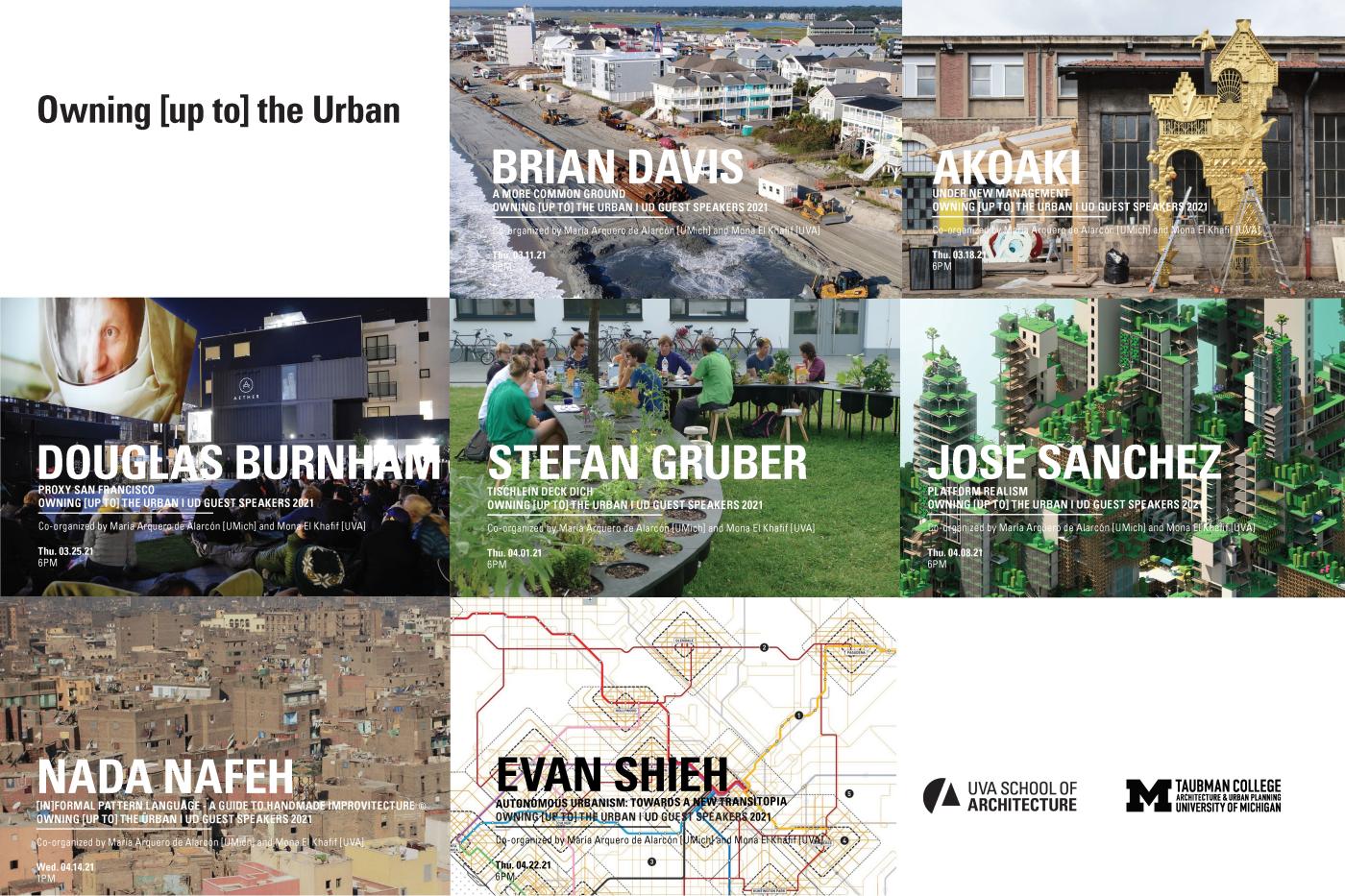
The Owning [up to] the Urban Speaker Series brings together educators, practitioners, and scholars to discuss the elusive nature of contemporary global urban transformations. Co-organized by Maria Arquero de Alarcón, Associate Professor of Architecture & Urban Planning, University of Michigan and Mona El Khafif, Associate Professor of Architecture & Urban + Environmental Planning, University of Virginia.
These opportunities are constructed around the collaborative and inter-connected community that comprises the School of Architecture, allowing students to learn from and gain experience from faculty and curricula across our areas of Architecture, Architectural History, Historic Preservation, Landscape Architecture, Urban + Environmental Planning, Real Estate Design and Development, Urban Design and Global Sustainability.
Each of these opportunities affords additional value to a graduate degree and provides unique trajectories for our students' future career paths.
GRADUATE CERTIFICATE IN HISTORIC PRESERVATION
The interdisciplinary graduate certificate program in Historic Preservation offers master’s degree candidates in all of the School of Architecture’s disciplines (Architecture, Architectural History, Landscape Architecture and Urban + Environmental Planning, as well as many other masters students from the university) the opportunity to expand their professional studies through specialized training in the theory, practice and ethics of historic preservation.
DIRECTOR: ANDY JOHNSTON [asj4w@virginia.edu]
GRADUATE CERTIFICATE IN REAL ESTATE DESIGN + DEVELOPMENT
The Real Estate Design and Development graduate certificate program provides an opportunity for graduate students in all four disciplines (Architecture, Architectural History, Landscape Architecture and Urban + Environmental Planning) in the UVA School of Architecture, and in other affiliated UVA Schools, to expand their professional training to achieve a fundamental understanding of the dynamics and processes of private for-profit and non-profit real estate design and property development.
DIRECTOR: FRED ROWE [ryb6qx@virginia.edu]
GRADUATE CERTIFICATE IN URBAN DESIGN
The Urban Design graduate certificate program is designed to equip master’s candidates from the School of Architecture’s four departments (Architecture, Architectural History, Landscape Architecture and Urban + Environmental Planning) with the expertise and skills to engage with multi-scalar issues facing urban environments, from urban and infrastructural development, to social equity and resilience. The program provides students with practical spatial design strategies and analytical tools as well as foundational historical and theoretical knowledge supporting urban design and planning strategies.
DIRECTOR: MONA EL-KHAFIF [me9gn@virginia.edu]
GRADUATE DUAL DEGREES WITHIN THE SCHOOL OF ARCHITECTURE
The multi-disciplinary ethos of the School of Architecture offers unique opportunities for students to structure and pursue dual graduate degrees. Dual degrees are offered as a combination of two graduate degrees in the following areas: Master of Architecture, Master of Architectural History, Master of Landscape Architecture, Master of Urban and Environmental Planning and Master of Urban Design. Pursuing a dual degree requires admission to each program, and meeting the appropriate requirements. Dual degree students will work closely with the Graduate Program Director of each respective program while pursuing their dual degree in order to ensure they are meeting curricular requirements.
CONTACT DIRECTOR OF STUDENT ADVISING + ACADEMIC SUPPORT: TASHANA STARKS [tdp2m@virginia.edu]
MUEP-JD PROGRAM
The School of Law offers a combined degree program with the Department of Urban + Environmental Planning at UVA School of Architecture. Students may earn both a Master of Urban + Environmental Planning (MUEP) and the Juris Doctor (JD) in four years, instead of the typically required five years to pursue each degree separately.
CONTACT MUEP PROGRAM DIRECTOR: SUZANNE MOOMAW [swm2x@virginia.edu]
MUEP-MPP PROGRAM
The UVA School of Architecture and the Frank Batten School of Leadership and Public Policy offer a combination degree program which leads to the completion of the Master of Urban + Environmental Planning degree (MUEP) and the Master of Public Policy degree (MPP) in three years, instead of the four years that would be required to complete each degree separately. The program is administrated by faculty advisors from the School of Architecture and Batten School.
CONTACT MUEP PROGRAM DIRECTOR: SUZANNE MOOMAW [swm2x@virginia.edu]
Any graduate student at UVA interested in one of the School of Architecture graduate certificates or dual degrees should contact Tashana Starks (Director of Advising and Academic Support) at tdp2m@virginia.edu or Campbell 316.
Specific course requirements for all graduate certificates can be found in the UVA Graduate Record.
MINOR IN ARCHITECTURAL HISTORY
A minor in architectural history requires 15 ARH credits, including ARH 1010 and ARH 1020, and three ARH electives (9 credits). Courses in History of Landscape Architecture, and Art History can count toward the minor with the permission of the Undergraduate Director. No thesis is required.
ADVISOR: LISA REILLY [lar2f@virginia.edu]
MINOR IN PUBLIC HUMANITIES IN PLACE
The pan-university minor in Public Humanities in Place introduces undergraduate students to the importance of place and story in the shaping of the American imagination. This minor offers undergraduate students (of any major) an introduction to strategies that reground, repair, and renew communities and our imagination for localities, and the importance of the humanities in restoring the fabric of everyday life. This is a 5-course (15 credit) minor.
DIRECTOR/ADVISOR: LOUIS NELSON [ln6n@virginia.edu]
MINOR IN ARCHITECTURE
A minor in Architecture provides students with an opportunity to develop a basic understanding of, and appreciation for, architecture as an important component of culture and the built a minor in Architecture provides students with an opportunity to develop a basic understanding of, and appreciation for, architecture as an important component of culture and the built environment. The Minor in Architecture is offered to all students at the University. Students who complete the Minor range from those whose major is in a related field and who wish to expand the boundaries of that endeavor, to those considering graduate study in architecture.
ADVISOR: ELGIN CLECKLEY [elc2n@virginia.edu]
MINOR IN DESIGN
The Design Minor is a distinctive, interdisciplinary minor program that will equip students with foundational skills in spatial and visual thinking, and the material practices of designers from multiple disciplines.
The Design Minor leverages the strengths and unique disciplinary practices of the four departments in the School of Architecture (Architecture, Landscape Architecture, Urban & Environmental Planning, and Architectural History). The curriculum is grounded in the disciplinary practices of design, while incorporating expertise from numerous allied disciplines and fields of study. The main objective is to serve a wide population of undergraduate students throughout the University who are interested in complementing their current course of study with the methodologies of Design Thinking, spatial and material practices, and the strategies of creative problem-solving.
ADVISOR: JOHN COMAZZI [jcomazzi@virginia.edu]
MINOR IN URBAN + ENVIRONMENTAL PLANNING
A minor in Urban and Environmental Planning requires 15 credits of PLAN courses with a minimum grade of C-. Students may choose from among any PLAN courses, with no more than six credits at the 5000-level counted toward the minor. PLAN courses taken as a completed Planning Minor do not count against the limit of credits college students can take outside the College. Students minoring in Urban and Environmental Planning are highly encouraged to take PLAN 1010, Introduction to Planning, and PLAN 3030, Neighborhoods, Communities, and Regions.
Jointly listed courses PLAN/ARCH, PLAN/EVSC, PLAN/SARC, etc. also count toward the minor.
ADVISOR: TIM BEATLEY [tb6d@virginia.edu]
MINOR IN GLOBAL SUSTAINABILITY
A Minor in Global Sustainability is comprised of five courses: a required Foundation Course, Global Sustainability; three electives from a pre-approved list with one course selected from each of three categories: Equity, Environment, and Economy & Policy; and a final Capstone course selected from an approved list of sustainability-focused, upper–level courses in several disciplines. No more than two of the four elective courses may be taken within a student’s own department, in order that each student adds breadth to their major course of study. At least three of the student’s courses must be above the 3000 level.
ADVISOR: PHOEBE CRISMAN [pc4v@virginia.edu]
MINOR IN HISTORIC PRESERVATION
The minor in Historic Preservation requires a total of 15 completed credit hours with a minimum grade of C-. The following distribution is required: 3 credits of theory, 6 credits of history, 3 credits of field methods, 3 credits of "Specialized Component" that is focused on preservation practice. Example Specialized Component classes include design, technology, materials science, planning, law, and curation. An internship is not required for the minor. However, internships are encouraged and many students undertake them.
ADVISOR: ANDY JOHNSTON [asj4w@virginia.edu]
MINOR IN LANDSCAPE ARCHITECTURE
Undergraduates wishing to minor in landscape architecture explore the issues and the future of the natural and built environment as shaped by dynamic ecological processes and human cultural practices. The minor is offered to all undergraduates–from those considering graduate studies in landscape architecture to those who just wish to broaden the scope of their major in a related field that is key to envisioning sustainable planning and design. A minor in landscape architecture requires at least 15 credits in landscape architecture and a minimum GPA of 3.000.
ADVISOR: MATTHEW SEIBERT [ms3sy@virginia.edu]
Any undergraduate student at UVA interested in one of the School of Architecture minors listed above should contact the Advisor specific to the minor of his/her choice listed above for more details.
To apply, contact Tashana Starks (Director of Advising and Academic Support) at tdp2m@virginia.edu or Campbell 316.
Specific course requirements for all minors can be found in the UVA Undergraduate Record.
ABOUT THE YAMUNA RIVER PROJECT —
The Yamuna River Project (YRP) aims to be a catalyst for the urgent recovery of the Yamuna River in India and its tributaries, building a publicly accessible body of information and expertise, and visions of what an alternative future could be. The YRP was founded at the University of Virginia School of Architecture in 2014 and expanded to Tulane University in 2019. The YRP is dependent on the continued research of faculty members at the University of Virginia and elsewhere. Professors, students, and directors from Architecture, Art History, Leadership, Business, Engineering, Science, Politics and Health lead to comprehensive and coordinated research efforts regarding the Yamuna, Delhi, and Jaipur extended. The YRP has facilitated nearly a dozen research trips to India, especially in coordination with advanced research design studios. Projects from these studios have received countless national awards and the YRP studio pedagogy has twice been nationally recognized as one of a handful highlighted as a model for “thoughtful and ethical” studio teaching.
DIRECTORS —
Pankaj Vir Gupta, Professor, Architecture, UVA [pvg2x@virginia.edu]
Iñaki Alday, Dean and Koch Professor, Architecture, Tulane [ialday@tulane.edu]
Brian Owensby, Director, Center for Global Inquiry and Innovation and Professor, History, UVA [bpo@virginia.edu]
STUDIO FACULTY —
María González Aranguren, Assistant Professor, Architecture, UVA [mg5hh@virginia.edu]
YRP SELECT RECENT STUDIOS —

RE-CENTERING NEW DELHI, A PIECE OF THE CITY
In its seventh year, the Re-Centering New Delhi studio at UVA School of Architecture involved 13 students, focused on a 24-kilometer stretch of the Yamuna River, which bisects the city and provides both its drinking water and its sewage drain. The students divided into teams to research different aspects of the river, including its uses, its impact on health, and the housing stock surrounding it.
After several weeks of research, the students traveled to New Delhi, where they met with local political and community leaders. Following the visit, each student chose a particular aspect of the research to develop into a project proposal—for example, one designed a plan to better handle sewage from nearby housing blocks, while another developed a scheme to reintroduce small-scale agriculture to the Yamuna flood plain. Finally, the class combined their projects into a master plan for the river—which is integrated with the previous semesters’ work.
Winner of the 2019 Studio Prize
Instructors: María González Aranguren (Assistant Professor, Architecture); Pankaj Vir Gupta (Professor, Architecture)
Students: Darcy Engle, Katherine Rush, Jing Huang, Hangyu Shi, Christian Kochuba, Cong Nie, Gene Louise Kimberly Corral, Jonathan Chu, Yousef Almana, Yasmin Ben Ltaifa, Andrew Helmbrecht, Kristen Von Bampus, Mennen Middlebrooks (work submitted)
THE RAJASTHAN CITIES: JAIPUR
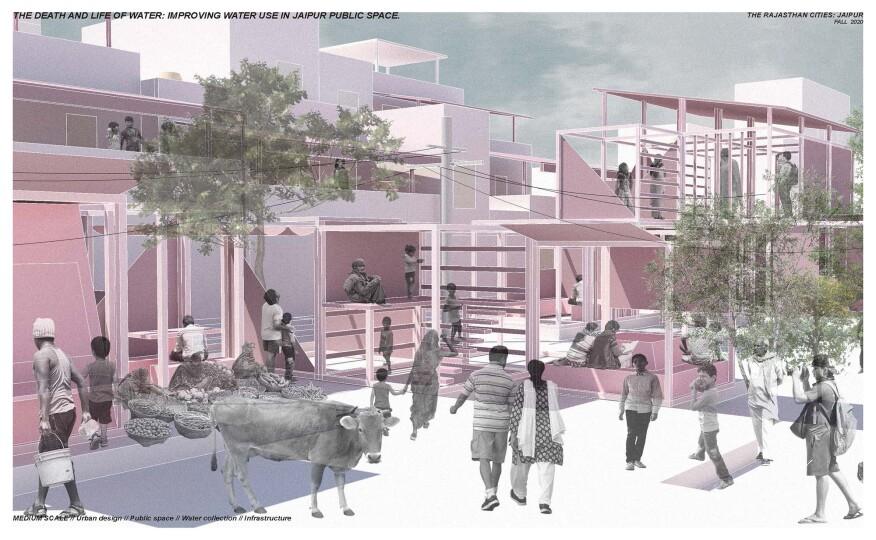
Looking at the specific needs of Jaipur, India, this Fall 2019 advanced research studio explored urban and architectural strategies to address the need to harvest water during the few months of monsoon rain, while also striving to create a more equitable city in terms of natural resource allocation and access to egalitarian public amenities.
This semester-long research studio brought two research professors together with 14 students across architecture, urban planning, and landscape architecture. Following six weeks of initial research, the studio (along with a group from Tulane University investigating a similar program) spent a week in New Delhi and Jaipur. The preliminary research was presented to local officials while the class was in Jaipur.
Students designed their own strategic interventions, informed by their field research and observations. “These students are attentive to the people who remain unrepresented, who never have a voice in requesting architectural help,” Gupta says. This ethic was reinforced by the instructors, who helped them to develop meaningful prototypical solutions that are tailored to the pressing need for obtaining, maintaining, and regulating clean water by Jaipur’s inhabitants.
Winner of the 2020 Studio Prize
Instructors: María González Aranguren (Assistant Professor, Architecture); Pankaj Vir Gupta (Professor, Architecture); Darcy Engle (Yamuna River Project Fellow)
Students: Mary Kate Graeff, Chenjie Xiong, Qinmeng Yu, Allison Ta (submitted work); Gaelle Gourmelon, Nicholas Wittkofski, Huiru Shen, Chloe Nagraj, Wenyan Yu, Audrey Liu, Karim El-Araby, Grace Douthit, Emmett Debree
Learn more about this project.
SUPPORTED COURSES —
The Yamuna River Project supports courses connecting curriculum and research. These courses include:
Advanced Research Studios (graduate and undergraduate) at the University of Virginia and Tulane University as well as research across water economics, environmental sciences, art history and more.
RESEARCH AFFILIATIONS + COLLABORATORS —
YRP affiliated research partners and collaborators include resident and institutional stakeholder groups who work with YRP to develop research as a catalyst for the urgent recovery of the Yamuna and its tributaries, building a publicly accessible body of information and expertise, and visions of what an alternative future could be:
UVA Center for Global Inquiry and Innovation
UVA Institute of the Humanities and Global Cultures
Embassy of Spain in India
Embassy of Switzerland in India
Delhi Jal Board
Aga Khan Trust for Culture
Katz Family Foundation
Yamuna Biodiversity Park
YES Institute
OVERVIEW
The UVA School of Architecture provides its students with opportunities to apply for paid assistantships at the school within specific categories.
There are three types of employment positions for students (“assistantships”) available at the School of Architecture for undergraduate, graduate, and PhD* students:
- Student Instructor Assistantships (SIAs) for support of courses
- Student Research Assistantships (SRAs) for research support
- Student Staff Assistantships (SSAs) for administrative or operational support
There are two types of positions available for PhD students only:
- Graduate Research Assistants (GRAs)
- Graduate Teaching Assistants (GTAs)
*PhD students are advised not to exceed their GTA/GRA requirement; only in exceptional cases when the scope and type of work aligns with the PhD student’s research and teaching foci, PhD students may apply for additional SIA/SRA/SSA positions. (Find more in PhD Positions Section below)
This webpage provides detailed information about each job profiles and pay ranges, eligibility, expectations of student hires and hiring managers, and more, for both students interested in applying for these positions and faculty/staff seeking to hire student assistants. Useful forms and application materials are also shared on this page.
The link below takes you to a landing page with current positions and application details. Open positions are listed at the top, while those that are closed (no longer accepting applications) are archived at the bottom of the page.
LIST OF CURRENT JOB POSITIONS
All School of Architecture student employees and hiring managers should familiarize themselves with the Student Assistantships Policy and Procedures document:
THE FULL SARC POLICY + PROCEDURES DOCUMENT FOR VIEW + DOWNLOAD
The School of Architecture aligns its hiring practices with the Federal Work-Study (FWS) Program. FWS establishes job categories based on scope of work, skill sets, expertise, knowledge, experience, and specialization. The job categories are assigned a pay range. Hiring managers determine the job category and establish an hourly rate within the associated FWS range for that category, in alignment with their budgets.
FWS updates pay ranges on an annual basis. The School’s Student Assistantship Policy uses the current pay ranges established by FWS. These can be found in the FWS Employee Handbook (See Appendix for Job Categories and Hourly Pay Ranges).
To maintain fair wages for student employment, it is important that Hiring managers (for SRAs and SSAs) or Department Chairs (for SIAs) match the job responsibilities and role with the hourly pay range assigned in the FWS handbook.
FWS Employee Handbook — View Appendix for Hourly Pay Ranges
Standard eligibility requirements apply to all student assistantship positions and are described below. Eligibility requirements that are unique to each position are shared as part of the “Call for Applications” announcement and position description.
ELIGIBILITY FOR STUDENT ASSISTANTSHIP (SA) POSITIONS
To be eligible for an SA position (for federal work-study or wage pay) at the A-School, a student must be an effective University of Virginia student and meets the following qualifications:
- The student is enrolled full-time in a University of Virginia degree program; students in their last semester of enrollment prior to graduation who need fewer than 12 credits to graduate are eligible to work in a student wage capacity.
- The student is in Academic Good Standing (Graduate and Undergraduate descriptions found below).
- The student has not completed all the required credits towards their degree.*
- The student is making satisfactory progress toward completing all their degree requirements in a timely manner; this includes approved extensions.
- In cases where an admitted graduate student has been guaranteed an SIA, SRA, or SSA position for their first semester of enrollment, the criteria listed above would go into effect for the start of the student’s second semester of enrollment.
- Eligibility requirements that are unique to each position are shared as part of the “Call for Applications” announcement and position description.
*Please consult the Wage Authorization for information regarding circumstances under which spring graduates may continue to work through the summer after their graduation.
ACADEMIC GOOD STANDING
Undergraduate Students
Undergraduate students in the School of Architecture must meet the following criteria to remain in academic good standing:
- Complete at least 12 credits of coursework.
- Maintain at least a 2.0 cumulative GPA.
- Source: Undergraduate Record
Graduate Students
Graduate students in the School of Architecture must meet the following criteria to remain in academic good standing:
- Complete at least 12 credits of coursework.
- Maintain at least a 3.0 cumulative GPA.
- Source: Graduate Record
APPEALS PROCESS
An appeals process can be implemented to allow for the consideration of a student case where extenuating circumstances have introduced challenges for a student to maintain academic good standing. In such cases, a review panel, comprised of the Associate Dean of Academics, Director of Advising, and the Hiring Manager, will convene to deliberate on the merits of the appeal. They will carefully consider the extenuating circumstances which may have introduced difficulties and interfered with maintaining academic good standing of a student applying to a position. This process will be highly confidential and expedited to not interfere with the typical application cycle and adversely affect a student’s candidacy for said positions.
A student seeking to appeal must contact the Associate Dean of Academics or the Director of Advising to initiate the process.
EXPECTATIONS OF STUDENT ASSISTANTS
All students hired to fulfill responsibilities as part of a Student Assistantships (SAs) are expected to carry out these responsibilities in accordance with the position description and through direct communication with the faculty or staff hiring manager. SAs are expected to:
-
Maintain a regular working schedule and time commitment based on communicated expectations of the position established with the hiring manager.
-
Communicate instances of scheduled adjustments (as needed) with the hiring manager with advanced notice, except for emergencies.
-
Maintain consistency and quality in the execution of job duties.
-
Enter and submit hours worked in Workday in a timely and honest manner.
-
Become familiar with Workday in order to accurately enter time and view pay slips (Netbadge required, see: https://hr.virginia.edu/workday-central/workday-training)
-
Maintain regular and open communication with the hiring manager, sharing concerns about workload, scheduling, inability to carry out responsibilities, request for feedback, etc. in order to assist in resolving work-related issues.*
*For work-related issues that are not resolvable through open communication with the hiring manager, or in circumstances where direct communication is not viable or effective, student employees are asked to communicate their concerns directly with the Office of the Dean:
-
SIAs: Associate Dean of Academics
-
SRAs: Associate Dean of Finance
-
SSAs: Chief of Staff
EXPECTATIONS OF HIRING MANAGERS
All hiring managers (faculty or staff) are expected to carry out manager responsibilities in accordance with the position description and through direct communication with hired student assistants. Hiring managers are expected to:
-
Be familiar with, and abide by, University policies which govern student employment. Specifically, hiring managers should review the Wage Authorization at least annually at the beginning of each academic year.
-
Use the FWS Job Categories and Pay Ranges to establish hourly rates based on job responsibilities, scope of work, required skills and experience. (See Job Profiles — Categories + Pay Ranges Section above with link to FWS Employer Handbook)
-
Utilize best practices when reviewing and interviewing student candidates for a position.
-
Ensure that student workers do not begin work before their assignments have been entered and approved in Workday. This is coordinated centrally at the School of Architecture by Kathy Woodson, Special Assistant. (See Hiring Process Section below for more details). Hiring managers will receive a Workday notification when the student worker’s assignment is complete and when they may begin entering their time in Workday.
-
Allocate and set weekly workload for student workers depending on course/project/ assignment requirements; total hours worked per week for students should be between 5-10 hours/week and should not exceed 20 hours/week (during the typical semester). The 20 hours/week limit includes ALL positions held by a student worker (many students hold more than one position at a time). Summer and J-Term maximum hours may exceed 20 hours/week with stipulations. Please review the Wage Authorization for full details.
-
Monitor and approve student worker timecards in Workday regularly. (Netbadge required: see Manager Workday Training webpage for training resources for managers).
-
Know where to access Workday training resources for employee time entries, corrections, etc. and share the same with student workers (Netbadge required: see Employee Workday Training webpage).
-
Address discrepancies with student worker’s time entries (when not aligned with allocated/scheduled weekly hours).
-
Communicate in a timely manner with Kathy Woodson, Special Assistant, when a student position is complete and should be closed in Workday. This process will be completed by Kathy Woodson who sends reminder emails to all hiring managers to review their Workday Team on a consistent end-of-the-semester basis.
-
Establish open methods of communication* that allow for effective and regular feedback from student workers.
*For work-related issues that are not resolvable through open communication with the hired student, or in circumstances where direct communication is not viable or effective, hiring managers are asked to communicate their concerns directly with the Office of the Dean:
-
SIAs: Associate Dean of Academics
-
SRAs: Associate Dean of Finance
-
SSAs: Chief of Staff
Hiring managers (faculty or staff) are asked to carry out hiring processes that are focused on consistency and equity across the School. While advertising a position is not required, it is strongly recommended to identify the best candidate for the position from the widest applicant pool.
TO HIRE A STUDENT INSTRUCTOR ASSISTANT (SIA)
- Faculty who are seeking a SIA for their course, should contact their Department Chair and Department Administrator for coordination. SIAs are designated by Department Chairs in coordination with Program Directors and the Finance Office based on course enrollments, course needs, and Department budgets. SIA allotments are limited and not every course will be assigned an SIA.
- For courses designated as School-wide (SARC), instructors should contact the Associate Dean of Academics to determine if the course may be eligible for an SIA.
- Department “Calls for SIAs” will be posted on the School of Architecture’s Student Assistantship webpage with detailed instructions for application, along with any course-specific eligibility requirements, preferred or required skills/experience, and required application materials.
- Department Administrators will assist faculty hiring managers during this process by collating application materials and distributing these materials for review. The review of all applicants and final decisions will be made by the hiring manager in consultation with Department Chairs and/or Program Directors. All selections for SIA hires must be communicated to Department Administrators who will work with Kathy Woodson, Special Assistant, to complete the hire process in Workday.
- Hiring managers will need to ensure that the student hire is academically eligible (See Eligibility Section above) in consultation with the Registrar, Sharon McDonald; Hiring managers will also need to determine if the student hire is accepting the position for Federal Work Study (FWS) or wage pay.
- An email to all applicants (for a cycle) will be issued by Department Administrators when SIA positions have been filled to ensure that applicants who did not receive an SIA position are informed of the results of their application.
TO HIRE A STUDENT RESEARCH or STAFF ASSISTANT (SRA or SSA)
There are two approaches to hiring an SRA or SSA:
1) with an online/email posting of the opportunity for students to apply to, or
2) without posting and directly hiring a student who the hiring manager has already identified for the opportunity.
While advertising a position is not required, it is strongly recommended to identify the best candidate for the position from the widest applicant pool.
Hiring managers who would like to post their position, should begin at STEP 1 below.
Hiring managers who do need to post their position, should begin at STEP 4 below.
STEP 1. Developing the Call for SRAs or SSAs
- The Hiring manager submits a completed online SRA/SSA Position Form for Posting (See Hiring Forms Section below) that includes details about the job and is used to post the position.
- SRAs and SSAs are posted on a weekly basis (See Timelines Section below).
STEP 2. Announcing and Advertising SRA or SSA Positions
- The Communications Office will issue a weekly email to all A-School students, faculty and staff with new opportunities and instructions for application.
- They will also be posted on the School of Architecture website.
STEP 3. Applying to SRA or SSA Positions / Reviewing + Interviewing
- If posted, a position must be open for a minimum of one week, prior to review and appointment to allow time for applicants to submit materials.
- Following the application’s priority deadline, the hiring manager is to review all applicants, interview said applicants and determine the appointment of the hire based on the merits of the applicant’s qualifications.
- After reviewing applications, the hiring manager is responsible for communicating their choice with the selected student applicant and engaging in discussion about accepting the position.
- Once both the hiring manager and the selected student agree to the hire, the hiring manager should subsequently communicate to all applicants that the position has been appointed/closed to ensure that they are aware that the review process has concluded.
STEP 4. Completing the Hiring Process
- Hiring managers will need to ensure that the student hire is academically eligible (See Eligibility Section above), in consultation with the Registrar, Sharon McDonald; Hiring managers will also need to determine if the student hire is accepting the position for Federal Work Study (FWS) or wage pay.
- Hiring managers are responsible for filling out the Student Work Hire Form (see Hiring Forms Section below) to complete the hiring in Workday. This form is submitted to Kathy Woodson, Special Assistant, by the hiring manager (not the student hire). This form must be submitted at least four business days prior to the position start date.
REACHING AN APPLICANT POOL BEYOND THE A-SCHOOL
For hiring managers who are seeking an applicant pool of students beyond the ASchool, contact Kathy Woodson, Special Assistant, who will assist in posting the position through Handshake/Workday.
There are two categories of forms to complete for Student Assistantships:
1. SRA / SSA POSITION FORM FOR POSTING
This form is used by hiring managers who want to post their position for applicants from the School of Architecture. For hiring managers who are seeking a broader pool of applicants beyond the School of Architecture, please read through instructions provided in the Hiring Process Section above.
The form requests information to describe the job position for advertisement. The hiring manager should complete the form below to be included in the weekly email distributed by the Communications Office to all A-School students, faculty and staff.
SRA / SSA POSITION FORM FOR POSTING - TO BE COMPLETED BY HIRING MANAGER
See Application Timelines Section below for details on when your position will be posted.
2. STUDENT WORK HIRE FORM
Once a hiring manager is ready to make a student hire, they should use the following online form necessary for completing the hiring process. The same form can be used for both Federal Work Study and Wage Hire students.
STUDENT WORK HIRE FORM
Note—For SRA and SSA Positions:
The completed online "Student Work Hire Form" (see link above) should be filled out by the Hiring Manager to be received by Kathy Woodson, Special Assistant. Kathy will assist student hires and managers in completing the hiring process in UVA's Workday system. The completion of the hire form should occur at least four business days prior to the position start date.
Note—For SIA Positions:
Hiring managers should not fill out this form for SIAs. For SIA Positions (paid through department funds), hiring managers should communicate their hiring appointments to their Department Administrators, who will coordinate with Kathy Woodson, Special Assistant, to complete the hiring process in UVA's WorkDay system for SIA positions.
The following timelines are provided for coordination across the School:
SIA TIMELINE
Departments will typically initiate a “Call for Applications” for SIAs in the spring semester or early summer for the next academic year. In some cases, the Call for spring semester SIAs will be posted in the previous fall semester.
SRA / SSA TIMELINE
To provide students with streamlined communication for SRA and SSA opportunities throughout the year, an email, and updates to this website will be shared advertising any new opportunities on a weekly basis — the weekly email is distributed by the Communications Office. Posting of new SRA and SSA positions will follow this timeline:
- Hiring Managers fill out the SRA/SSA Position Form for Posting (See Hiring Forms Section above) by Thursdays, 9am
- Email issued on Fridays, 9am
- Emails will not be issued over holidays
- All SRA and SSA positions will be advertised for a minimum of one week to allow for the receipt of applications. Hiring managers can not appoint a student to a position prior to the application deadline and review of all applications. If necessary, applications will be accepted following the deadline, until the position is filled.
For students:
Federal Work-Study (FWS) is financial aid that is based on financial need and must be earned through student employment. FWS funds are not credited to the student account up front and so should not be factored into the budgeting process for semester payment plans or how much a student might need to pay out of pocket at the start of a term. Students can view their financial aid offer or accept their Federal Work Study (FWS) award by logging into their SIS account. In SIS, a student must “accept” their work-study award to be able to hold a FWS job.
UNDERGRADUATE STUDENTS
Student Financial Services (SFS) automatically considers work-study for eligible undergraduate students once their completed FAFSA, CSS Profile, and other requested documents are received. Annual offered amounts range from $1,000 - $4,000 for undergraduate students.
GRADUATE STUDENTS
Graduate students who demonstrate financial need may also be considered for Federal Work-Study eligibility (FWS) upon request. To be considered for FWS, choose this option on the FAFSA. Annual award amounts can be up to $5,000 for graduate students. Graduate students can have an FWS award added later in the semester even if they did not indicate interest in FWS on their FAFSA when initially applying. To do so, or if verify your request, contact Student Financial Services (SFS) at sfs@virginia.edu.
For hiring managers:
The link below provides useful information for hiring managers who are employing a Federal Work Study (FWS) student.
GUIDELINES FOR MANAGERS OF FEDERAL WORK-STUDY EMPLOYEES
Distinct from the Student Assistantship positions described in the policy linked on this page (See Student Assistantships: Policy + Procedures for Appointment and Employment Section above), PhD students at the School of Architecture serve as Graduate Research Assistants (GRAs) and/or Graduate Teaching Assistants (GTAs). Full details regarding these appointments are outlined in the PhD Student Handbook (Contact the PhD Program Director for more information).
PhD students are advised not to exceed their GTA/GRA requirement by holding an SA position. In exceptional cases when the scope and type of work aligns with the PhD student’s research and teaching foci, PhD students may apply for additional SIA/SRA/SSA positions. Refer to the approval process described in full in the PhD Student Handbook (contact the PhD Program Director for more information).
Generally, after the first three years and contingent on a successful prospectus defense, PhD candidates will have greater flexibility to pursue Student Assistantship opportunities following the typical approval process.
The UVA Center for Teaching Excellence regularly hosts a Teaching Methods Workshop that is recommended for students accepting an Student Instructor Assistantship (SIA).
The CTE “Teaching as a Graduate Student (TAGS)” workshop is open to undergraduate, graduate and PhD SIAs and is broken into 2 parts – an online, on-demand, self-placed set of modules (3-4 hours) and an in-person or synchronous meeting (1-2 hours). Participation in one or both is highly recommended for new SIAs.
The TAGS workshop provides an overview of inclusive and learning-centered teaching and helps participants apply these ideas in contexts most applicable to instructor assistants. The material is designed primarily to those new to teaching. Topics include: Creating inclusive learning environments; Principles of learning-centered teaching; Supporting students’ success; Teaching the first day of class; Facilitating effective classroom discussions; Approaching feedback and grading effectively and efficiently.