
BACKGROUND
In 2017, the School of Architecture’s Inclusion + Equity Committee began work on a wide-ranging plan of action, motivated by our commitment to the university as a space for cultivating democracy, one dedicated to “the sustained, critical rethinking of our institutional policies, practices, and structures.” In June 2020, over 500 members of the School of Architecture community signed a Call to Action, urging the School of Architecture “to accept the challenge of setting a precedent for an anti-racist design pedagogy,” with a key priority of appointing an Associate Dean of Inclusion + Equity. That same summer, President Jim Ryan appointed a Racial Equity Task Force (RETF), whose final report, “Audacious Future: Commitment Required,” issued in August 2020 and endorsed by UVA’s Board of Visitors, lays out a detailed action plan for the University of Virginia. As a short term exploratory and advisory body, the Racial Equity Task Force (RETF) aligned initiatives with the University's Inclusive Excellence framework and the University's 2030 Strategic Plan to orient and embed the initiatives in our larger institutional operations.
This pivotal moment of institutional transformation presents an unparalleled opportunity to spearhead the continued co-creation and implementation of long-term solutions that are integrated into the A-School's educational mission, daily operations, and culture. The A-School has many leaders in the national conversations about JEDI topics in the field, and we are ready to invest in the institutional infrastructure needed to build on our collective strengths. The A-School aims to be a nexus of thought leadership on Justice, Democracy, and Design— cultivating and disseminating knowledge on architectural empathy, on climate justice, on cultural landscapes, and on community-driven design that help transform our professions and disciplines.
THE JUSTICE, EQUITY, DIVERSITY AND INCLUSION (JEDI) INITIATIVE
In July 2021, Malo A. Hutson joined the University of Virginia School of Architecture as Dean and named the JEDI Initiative as one of his key priorities for the School, building on the ongoing work by the Inclusion + Equity Committee. Through the coordinated efforts of leadership, faculty, staff, students, alumni and allies, the School of Architecture is committed to the long term project of working together to build, promote and sustain a culture of justice, equity, diversity, and inclusion — and to cultivate shared humanity through difference — within and beyond the University.
A-SCHOOL JEDI STRATEGIC GOALS
- Increase faculty, staff, and student diversity through recruitment and retention
- Expand student support and resources
- Enhance social justice-based pedagogy and disciplinary scholarship around issues of race, identity, culture, power, and belonging
- Build meaningful, sustainable, and supportive partnerships with neighborhoods, institutions, communities and organizations who are allies in this work
- Establish guiding metrics and a structure of reporting and communicating progress
Below you can review the status updates on the JEDI Initiative, its key strategic goals, and additional new and ongoing work contributing to achieving justice, equity, diversity and inclusion as integral to our guiding mission as a School.
GOAL 1: Double the number of underrepresented faculty by 2030
ACTIONS:
— Associate Dean JEDI
The School launched a search for an Associate Dean JEDI who will join the A-School faculty. The Associate Dean will be a key member of the Dean's Executive Team and will bring strategic and imaginative thinking to the School-wide shared JEDI project. POSITION DESCRIPTION.
Announcement of the hire: March 2022
— Mellon Postdoctoral Fellows
The School launched a search for up to two Mellon Postdoctoral Fellows in Race, Place & Equity, part of a $5 million grant from the Mellon Foundation that supports a wide-ranging series of racial equity programs across the University (Office of the Executive Vice President and Provost).
Mellon Fellows Olanrewaju Lasisi and Ana Ozaki joined the Department of Architectural History as postdoctoral fellows in AY 23-24.
— Early Career Fellows
The School is a founding member of the national "Deans' Equity and Inclusion Initiative," a partnership of nine (at founding) US schools and colleges of architecture, planning, and design working collectively to nurture a diverse population of emerging scholars focused on teaching and researching the built environment to advance socio-ecological and spatial justice, equity and inclusion. Launched in Summer 2021 with continued growth each year.
The A-School hosted the DEII Summer Institute in summer 2023.
The A-School hires DEII Fellow Isaac Mangual as a Virginia Architecture Fellow for AY 23-24.
— JEDI Emerging Faculty Fellows
Continue to build long-term robust faculty pipelines to increase faculty diversity through JEDI Emerging Faculty Fellowships.
— JEDI Faculty Hires
Seek additional JEDI TOPS hires for both tenured and tenure-track faculty.
— Announcement of Andrea Roberts as Associate Professor of Urban and Environmental Planning and co-director of the Center for Cultural Landscapes, March 2022
— Announcement of Mohamed Ismail as Assistant Professor of Architecture, March 2022
GOAL 2: Review policies regarding faculty and staff hiring, wages, retention, promotion, work load, and procurement, in order to ensure equity
ACTIONS:
— Retention and Support of Faculty + Staff
Examine overall practices including recruitment, promotion, wages and tenure for faculty and staff.
University-wide Staff compensation analysis completed in AY 22-23
University-wide Faculty compensation analysis completed in AY 23-24
— Teaching and Service Loads for Faculty
Examine teaching and service loads across all faculty ranks.
— Service Loads for Staff and Areas in need of Expanded Support
Examine staff work loads across units and increase staff positions to support areas needing expanded support.
GOAL 3: Increase student diversity to better reflect the racial, ethnic and economic demographics of the state of Virginia
ACTIONS:
— NOMA Project Pipeline
First launched in summer 2019 by the A-School's chapter of the NOMA Project Pipeline, this ongoing pre-recruitment program provides an educational experience for low-income youth in the Charlottesville community and provides hands-on exposure to the design and planning disciplines. The Project Pipeline program also has partnered with local co-designers, such as the Public Housing Association of Resident (PHAR) to engage in design-build opportunities and will continue to build community-engaged programming each summer.
Current partner, Starr Hill Pathways: https://communitypartnerships.virginia.edu/starr-hill-pathways
— Robust pipelines for recruitment of underrepresented and low-income students
The A-School established an MOU with the Bonner Foundation and partnerships with the McNair Scholars Program to enhance our recruitment.
The School admitted its first Bonner Scholar in spring 2022. Note: The Bonner MOU is not active as of 2025.
— Application fee waivers and travel stipends for low-income prospective students
To increase access to education for low-income prospective students, we aim to cover application fees and travel to visit the A-School for those in need.
Current MOUs and partnerships include application fee waivers. No current MOUs or partnerships provide application fee waivers (2025).
Currently, the School covers graduate application fees and travel expenses to in-person graduate open house for those with demonstrated financial need.
— JEDI-focused programming for recruitment
First hosted in 2019 by the I+E Committee in coordination with the Admission Office, open houses specifically designed for students interested in JEDI has helped to increase our BIPOC student cohort - a 24.8% increase in 2020.
No longer a stand-alone event (2025).
— JEDI Scholarships
In spring 2020, the A-School established two named scholarships focused on diversity, equity and inclusion - named after Edward Wayne Barnett and Audrey Spencer-Horsley, the School's first African American graduates. Scholars were awarded in 2020 and 2021 and through a collective commitment across the School's faculty, staff, leadership boards, alumni and friends, $540,000 was raised in gifts, pledges, and University match by December 2020.
The School has expanded its goal in order to establish competitive scholarships at the graduate-level to both recruit and retain future JEDI scholars.
GOAL 4: Increase staff diversity to better reflect the racial, ethnic and economic demographics of the state of Virginia
ACTIONS:
— Staff Diversity, Professional Support and Growth
University Human Resources is currently undertaking a long-term project to evaluate the job structures in place at the University to establish more clarity in career pathways. This work includes establishing a process for ensuring consistent evaluation of qualifications and experience that qualify individuals for roles beyond, or in addition to, specific degree programs.
The A-School will work in coordination with University HR to continue to evaluate hiring practices to increase diversity in staff, practices for retention and additional pathways for staff success.
GOAL 1: Provide course material support to any A-School student in need (or in specific cases, those enrolled in A-School gateway courses)
ACTIONS:
— Course Material Support
The true cost of education at the A-School goes well beyond tuition. Many students are not able to afford the cost of materials, software, printing, or other expenses related to successful completion of their coursework. An immediate priority is to offer course material support to any A-School student in need.
Funding was offered on an as-needed basis through application during the Covid-pandemic through the CARES Act and a $100,000 School of Architecture Covid-19 Emergency Relief Fund.
Material and software scholarships to support students in gateway courses such as Arch 2070_3070 (which includes 30+ students from the Meriweather Lewis Institute each year).
The A-School compiled data (Fall 2021) on the additional expenses students face per course in order to better establish a budget for this expense.
The School of Architecture Foundation Board's Parent Committee has established this need as its priority fundraising initiative, and have launched a campaign through the Academic Support Fund.
Students seek to benefit from the ASF through a summer 2022 application cycle for the 22-23 AY.
GOAL 2: Support Student Organizations
ACTIONS:
— Student Organizations Support
Student organizations focused on JEDI (NOMAS - National Organization of Minority Architecture Students and manifestA - SOA's Equity in the Built Environment) continue to be an important venue for community building, promoting a culture of equity and inclusive excellence, and providing leadership opportunities for our students.
— FG/LI Student Support
The development of a new FG/LI student organization was under development (Spring 2022) to support the unique needs of our first generation and low income students. Through allied support from Student Council, AIAS, and other student organizations, net proceeds from the 2022 Beaux Arts Ball (April 2022) will go towards the establishment of this organization and to the Academic Support Fund. A Town Hall to launch this initiative was held April 2022.
GOAL 3: Review policies regarding student hiring, wages, and work culture in order to ensure equity and consistent, fair practices for paid student assistantships
ACTIONS:
— Paid Student Assistantships
Student Assistantship Positions administered by the School offer A-School students paid positions in the areas of instruction, research and staff/administrative support. These serve an important role in experiential content and financial support to our students.
As a joint effort across the Office of the Dean, School-wide policies and processes (focused on consistency and equity) were established in fall 2021 to better communicate all opportunities to all students and better administer opportunities on a regular/anticipated timeline.
The establishment of a comprehensive policy document, a webpage collecting all opportunities, a weekly announcement email, and review of the policy on a yearly basis were included in this process.
GOAL 4: Strengthen Advising, Mentoring, Career Development and Mental Health Support for Students
ACTIONS:
— Student Advising + Mentorship
A dedicated staff position for Student Advising was established in June 2019. The Director of Advising and Academic Support fills an essential role at the School (working with the Associate Dean of Academics) in directing all activities related to students' course enrollment, degree completion, and affairs. Additionally, faculty in all departments provide sustained academic and career mentorship.
A new full time academic advisor position was added and hired in November 2023.
— Student Mentorship by Alumni
A collaborative effort by the School's Director of Alumni Initiatives and Engagement and the Young Alumni Council. the A-School Alumni Mentorship Program provides students with a supportive network of alumni for professional advice and growth.
This program was launched in Spring 2020 and continues to evolve to best support our students.
— Career Development for Students
The School searched for a Director of Career Development who joined the staff in a leadership position and focuses on strategizing and planning for diverse career trajectories across our disciplines and creative/scholarly practices, and offering critical student support in the area of career development.
The Director of Career Development was hired in Spring 2022 semester.
— Student Wellbeing, Mental Health and Counseling
In October 2020, the School finalized an agreement with UVA Counseling and Psychological Services (CAPS) to embed a clinician at the School to provide direct mental health support to our students. Given the need, our dedicated CAPS therapist has increased hours in 2021-2022. Additional student wellbeing support resources.
An embedded CAPS psychotherapist joined the school in April 2024.
— A-School Food Pantry
In response to food insecurity, an A-School Food Pantry was launched in fall 2023 and is part of a larger network of pantries across Grounds.
GOAL 1: Expand and Support Field-Changing JEDI Scholarship and Become a Leading Center for JEDI Research
ACTIONS:
— JEDI Faculty Hires
Seek additional JEDI TOPS hires for both tenured and tenure-track faculty to help develop core and expanded expertise in this area.
Cross-listed with Faculty Recruitment Strategic Goal.
— JEDI Emerging Faculty Fellows
Establish JEDI Emerging Faculty Fellowship Program to support early career scholars in this area.
Cross-listed with Faculty Recruitment Strategic Goal.
— JEDI Research Support - Seed Funding / Lab
Establish JEDI Research Seed Funding for faculty. The School has numerous faculty who are currently engaged in cutting-edge JEDI research and community-engaged design that has been nationally / internationally recognized and made positive impacts. Providing dedicated funding for research to specifically support JEDI initiatives and coalescing this work with a JEDI Research Lab can attract major external funding, establish the School's leadership in this area in a more public and concerted manner, and better establish this as integral to our culture, scholarship and practice.
— JEDI Public Programs
Host an annual JEDI Symposia / Re-think current I+E Dean's Forum Lecture Series
The School has hosted four years of a highly successful Dean's Forum I+E lecture series that have brought critical JEDI perspectives and expertise to the School. Given its success, we seek to consider ways to enhance its profile as part of our curriculum and to help provide a forum for multiple speakers to discuss JEDI issues in dialogue with each other and our faculty/students. This new format also provides an opportunity for focused collaborations with other Schools, Labs, and Offices across Grounds.
In AY 23-24, a JEDI panel was led by Visiting Professor Liz Ogbu.
GOAL 2: Support Anti-Racist Design Pedagogy
ACTIONS:
— Orientation Series
Education is a foundational aspect of engendering racial equity at any University. Understanding race and racism, and structures of power and identity, that have foregrounded design disciplines and identifying productive ways to dismantle harmful practices, is a life-long process that requires ongoing learning. A School-wide orientation series, with shared readings and dynamic speakers, would empower all members of our community with courage, understanding, knowledge and skills to take effective anti-racist actions and to foster a culture of belonging and inclusion. This series would also embed JEDI in our culture in a holistic way.
— Anti-Racism Leadership Program
Faculty and staff at the A-School would benefit from a structured approach to developing understanding and accountability in relationship to all of our JEDI goals and our larger mission towards design justice. Building off of strong peer-institutions' models for leadership training and development, an Anti-Racism Leadership Program would support our faculty and staff to also take on leadership roles in JEDI areas across the broader University. Potential partnership opportunities with the Office of Diversity, Equity and Inclusion (no longer active).
— JEDI Curricular Innovation Grants
It is critical that students at all levels of the curriculum are building the tools to ensure that they will bring a robust understanding of equity, inclusion, and social justice to their endeavors as students and as future professionals. Curricular innovation grants provide capacity for faculty to develop coursework in these areas.
— Community-Engaged Courses
Students across all A-School departments are interested in community-engaged learning and modeling ethical community partnerships. The A- School seeks to develop a school-wide ethic for such teaching, potentially one that links with the UVA President’s Council on Community Partnerships and Equity Center ethics.
Seeking financial resources for partner compensation, student assistants, field trips, events, and programming to support collaborative and co-designed work.
GOAL 1: Support Design Justice Approach, Co-Creating with Communities
ACTIONS:
— Creatives-in-Residence Program
The A-School has much to learn from members of the broader community, and our educational endeavors would greatly be enhanced by opportunity for sustained, reciprocal learning. A Creatives-in-Residence Program is an opportunity to award a fellowship for the academic year to a local practitioner whose creative work, organizing efforts, or expertise would promote educational ties between the School and the surrounding community.
— Community-Engaged Courses
Students across all A-School departments are interested in community-engaged learning and modeling ethical community partnerships. The A-School seeks to develop a school-wide ethic for such teaching.
Seeking financial resources for partner compensation, student assistants, field trips, events, and programming to support collaborative and co-designed work.
Cross-listed with Enhance JEDI Pedagogy and Disciplinary Discourse Strategic Goal.
— The Equity Center
UVA's Equity Center grew out of many years of social justice advocacy in Charlottesville and the surrounding region. Its goal is to tangibly redress racial and economic inequity in universities communities by advancing a transformative approach to the fundamental research mission, and in turn, reform institutional values, pedagogy, and operations. The A-School has many active faculty and student leaders working as part of the Equity Center including Faculty Director Associate Professor Barbara Brown Wilson and Faculty Director of Design Justice Assistant Professor Elgin Cleckley. The A-School aims to continue to support faculty and student involvement and leadership at the Center, to partner in ways with the Center that further its mission, and to use its structure as a model for building ethical community relationships.
The Equity Center is the Center for Community Partnerships.
— NOMA Project Pipeline
The A-School's chapter of the NOMA Project Pipeline is a pre-recruitment program that provides an educational experience for low-income youth in the Charlottesville community and provides hands-on exposure to the design and planning disciplines. As part of its ongoing programming, the A-School aims to continue to create meaningful and sustainable partnerships with local communities and organizations, building co-design opportunities with underserved neighborhoods.
Cross-listed with Increase Student Diversity through Recruitment and Retention Strategic Goal.
GOAL 2: Build Shared JEDI Resources and Knowledge across Peer Institutions and Allies Across Grounds
ACTIONS:
— Annual JEDI Symposia
Given the success of our I+E Dean's Forum Lecture series, we seek to consider ways to enhance the profile of our JEDI public programs by providing a forum for multiple speakers to discuss JEDI issues in dialogue with each other and our faculty/students. This new symposia format also provides an opportunity for focused collaborations with other Schools, Labs, and Offices across Grounds building more sustainable partnerships.
Cross-listed with Enhance JEDI Pedagogy and Disciplinary Discourse Strategic Goal.
— Public Design for Social Justice Consortium
Build a consortium with peer public universities to share student and faculty resources to elevate the role of public institutions in defining socially just design education. Opportunity to host workshops/conference focused on youth, undergraduates.
— Dean's Equity and Inclusion Initiative
The School is a founding member of the national "Deans' Equity and Inclusion Initiative," a partnership of nine US schools and colleges of architecture, planning, and design working collectively to nurture a diverse population of emerging scholars focused on teaching and researching the built environment to advance socio-ecological and spatial justice, equity and inclusion. Launched in Summer 2021.
Cross-listed with Increase Faculty Diversity through Recruitment and Retention Strategic Goal.
GOAL 1: Strategic Priorities — Benchmarking and Developing Implementation Plans
ACTIONS:
— JEDI Benchmarking + Implementation Plans
The Associate Dean of Strategic Initiatives, in collaboration with the Dean's Executive Team, is working to benchmark our goals and successes in relationship to peer institutions. As part of this process, a JEDI Action Plan (with key action items included on this webpage) has been developed.
A faculty "implementation" team has been appointed to begin lay out the a detailed plan for implementation that includes short and long-term measures towards each goal.
Implementation Phase.
Peer Institution Benchmarking Data Collection underway - to continue through 21-22 Academic Year.
JEDI Action Plan outlined.
JEDI Implementation Team to commence by end of fall 2021 semester - to develop actionable steps through mid-Spring 2022 semester.
GOAL 2: Celebrate JEDI through A-School Communications
ACTIONS:
— A-School JEDI News and Outreach
Integrating JEDI into the culture of our School is an integral part of our communications strategy. Utilizing our bi-monthly newsletter, our website and social media platforms, JEDI research, stories, courses and projects are highlighted to ensure that our mission is communicated in an integrated and holistic way.
Implementation Phase.
GOAL #3 Establish a Structure of Reporting
ACTIONS:
— JEDI Reports
Build bi-yearly JEDI reports to coordinate with Action Plans to provide updates on progress.
The University of Virginia has been shaped by a fundamental contradiction between the democratic ideals on which it was founded and the reality that, for well over a century, the educational experience it offered was available only to a restricted and decidedly exclusive population of economically privileged, socially elite, white men. At the same time, our institution was built upon and its daily operation was made possible by the labor of many who were excluded from its classrooms and its privileges, including enslaved laborers, women, and men of lower socio-economic standing.
The School of Architecture has witnessed considerable transformations since its initial founding in 1919 as the McIntire School of Fine Arts. Linda Harris Michael (Class of 1959) was one of a small group of professors' daughters admitted to the College of Arts & Sciences before UVA went co-ed. However, she really wanted to study in the School of Architecture, which required any female students to have two years of academic credit and be at least 20 years of age. Undeterred, the 17-year-old Harris took 60 credits over the course of one academic year and two summers and joined the Architecture School at age 18, the age requirement waived because of her strong academic record. She was the only woman in her class.
In the early 1970s, the first African American were admitted into the School of Architecture’s programs. Women matriculated as first-year students in the university in 1970 when it went co-ed, the same year that three women earned master’s degrees in the School of Architecture: Anne Carter Lee (Master of Architectural History) Virginia B. Overton McLean (Master of Planning), and Patricia Turney Garris (Master of Planning). Two years later, Edward Wayne Barnett became the first African American to earn a degree in School (Bachelor of Science in Architecture, 1972). Audrey Spencer-Horsley was the first female African American to graduate from the School with a bachelor degree in city planning in 1975. Since the early-mid 1970s, the composition of the A-School community has changed dramatically, and our four departments now oversee multiple programs at the undergraduate and graduate levels. As we mark the beginning of the University of Virginia’s third century and the School of Architecture’s centennial, this is a critical moment for action, not least because our institution has been thrust onto the front lines of the most pressing challenges facing our society today, including ethno-nationalism, sexual violence, racism, white supremacy, and religious persecution. In this context, we embrace our institutional privilege as a responsibility.
Are you employing a student through the Federal Work Study program?
When classes are officially in session, students usually work between ten and twenty hours per week—and may not work more than 20 hours per week—in all university jobs combined. Students may sometimes elect to work up to 40 hours a week when class is not in session, during official university breaks. There is no work study during the summer.
Reminder: All hours entered under an FWS position count toward the student’s FWS earnings for the year, so please be aware that working longer hours during breaks can potentially cause a student to exceed his/her FWS award before the end of the academic year, at which point either the student must cease to work OR all additional hours need to be charged 100% to the department.
For 2025-2026, the earliest and latest dates to work in an FWS position are as follows:
- Students enrolled for both the fall and spring semester should begin work no earlier than August 26, 2025 and end no later than May 8, 2026.
- Students enrolled for the fall semester only should begin work no earlier than August 26, 2025 and end no later than December 19, 2025.
- Students enrolled for the spring semester only should begin work no earlier than January 12, 2026 and end no later than May 8, 2026.
- Work-study is not available during the summer.
EMPLOYER HANDBOOK — FEDERAL WORK STUDY (FWS) PROGRAM 2025-2026
The UVA School of Architecture will not be hosting a Dean's Forum Dinner this Fall 2025.
All 2024-2025 Dean’s Forum members will be invited to our special Honor the Future Campaign Celebration and Reception on Friday, October 10th (details below). This will be an opportunity to celebrate the accomplishments of the School and our supporters during this milestone campaign. Zena Howard, this year's A-School Distinguished Alumni Awardee will be presented this recognition at the reception. An invitation and more details are forthcoming.
HONOR THE FUTURE CAMPAIGN CELEBRATION AND RECEPTION
FRIDAY, 10.10.25
6 - 8PM
PAVILION IX GARDEN
CHARLOTTESVILLE, VA
By Invitation only, contact Kim Wong Haggart at kimwong@virginia.edu to register
Cocktail Attire
ACCOMMODATIONS —
Hotel Blocks available to Dean’s Forum members:
Courtyard Charlottesville – University Medical Center
1201 West Main Street, Charlottesville, VA 22903
434-977-1700
$289/night
Last Day to Book: September 9th
Booking Link
Homewood Suites by Hilton
2036 India Road, Charlottesville, VA 22901
434-244-6200
$194/night
Last Day to Book: September 10th
Booking Link
Questions —
Contact Kim Wong Haggart, Director of Engagement and Alumni Initiatives at 434-982-2761 or kimwong@virginia.edu
For more information about Annual Giving and the Dean's Forum, contact Kim Wong Haggart, Director of Engagement and Alumni Initiatives at kimwong@virginia.edu
UNRESTRICTED GIVING TO THE SCHOOL OF ARCHITECTURE ANNUAL FUND
Every unrestricted donation, no matter what the size, significantly helps support the areas of greatest need at the School.
The A-School Annual Fund gifts make a daily impact and have been applied to top priorities such as:
-
Student scholarships
-
Faculty research
-
Travel fellowships
-
New technology
-
Innovation in curricula and studios
-
Student support for materials, supplies, and software
-
Lectures and symposia
-
Alumni and Friends events
THE A-SCHOOL DEAN'S FORUM
The A-School Dean’s Forum is the School’s giving society, which recognizes the philanthropy of individuals who give unrestricted donations to the A-School at a leadership level within a fiscal year.
Leadership annual gifts make the A-School stronger and empower the School to respond quickly to arising needs or opportunities. A-School Dean's Forum contributions have always helped to advance some of the School's most important priorities.
WHAT ARE THE LEADERSHIP LEVELS?
NEW FOR 2025-2026!
The Dean's Forum Leadership Giving Levels are designed to fit your personal philanthropic goals and offer year-round programming and donor engagement for Dean's Forum Members:
Capstone: $10,000+*
Special access to private events and tours, roundtable conversations with the Dean, invitation to the Dean's Forum Dinner (plus below)
Keystone: $5,000 - $9,999*
Access to roundtable conversations with faculty and Chairs, invitation to the Dean's Forum Dinner (plus below)
Pillar: $2,500 - $4,999*
Invitation to the Dean's Forum Dinner (plus below)
Member: $1,000 - $2,499
Access to exclusive communications, virtual and regional events, and insider updates
*Also qualifies for membership in the UVA Rotunda Society.
HOW DO I BECOME A MEMBER?
Join the A-School Dean’s Forum by giving an unrestricted gift to the School within one of the leadership levels listed above in any given fiscal year (July 1st to June 30th, annually)
For more information about Annual Giving and the Dean's Forum, contact Kim Wong Haggart, Director of Engagement and Alumni Initiatives at kimwong@virginia.edu
UPDATES TO THE DEAN'S FORUM STEWARDSHIP PROGRAM
NEW AS OF JULY 1, 2026
THE DEAN'S FORUM = MORE THAN A DINNER
After 35 years, we are updating the Dean’s Forum stewardship program to provide more exclusive opportunities to bring you inside the UVA School of Architecture, connect you to our extensive community, and share more about the impact of your partnership — throughout the whole year.
The A-School Dean’s Forum Dinner in Charlottesville, which celebrates the accomplishments of the School and acknowledges the generosity of our leadership donors, will be just one of the special ways to engage with the School over the year. Going forward, invitations to the Dean’s Forum Dinner will be extended to donors at the Pillar Level — those who contribute $2,500 or more annually to the A-School Annual Fund, as well as student and faculty leaders. The A-School Distinguished Alumni Award is customarily presented during this memorable evening. Past locations include Morven, Barboursville, Blenheim, the Jefferson Theater on the downtown mall, Blue Ridge Farm, Montpelier and Monticello.
As we transition to this new update to the Dean's Forum stewardship program, this fall 2025 the School of Architecture will host a special Honor the Future Campaign Celebration and Reception for Dean’s Forum members and campaign donors at the Pavilion IX Garden on Friday, October 10, 2025. An invitation and more details are forthcoming.
The School will not be hosting a Dean’s Forum Dinner in Charlottesville this Fall 2025 and instead, we will bring some Dean’s Forum regional events to cities near you.

ABOUT THE FABLAB
The Fabrication Lab, or FabLab, is a center for empowering people with tools for making, prototyping, and construction at a range of scales, materials, and techniques. As the staff and students of the FabLab Team, we are dedicated to a creative and inclusive environment through access, training, consultation, and support on a range of analog and digital fabrication tools for UVA students, staff, and faculty. We engage projects and research from all the departments of the School of Architecture, connect to shop and lab partners all over Grounds through the MakerGrounds network, and develop research discovering new materials, tools, and fabrication processes related to the built environment.
The FabLab Team is run by Melissa Goldman, Trevor Kemp, and Andrew Spears — three full-time fabrication experts — and a Crew of undergraduate and graduate teaching assistants, all passionate about making and teaching. The team trains basic and advanced techniques and tools, develops and supports curricula, pushes and publishes research, and maintains a positively enthusiastic environment for investigation and high craft.
Our main FabLab within Campbell Hall was renovated in the summer of 2019 by Pancorbo Arquitectos in which we expanded to over 7500 sq ft of project and shop space housing a number of tools for analog and digital fabrication. This renovation greatly increased our capacity to build full scale prototypes, to push experimental fabrication research, and to expand our fleet of tools. From drop-in spots for model making to academic spaces for fabrication based studios and seminars housed within the Lab each semester, we always have a number of exciting projects happening.
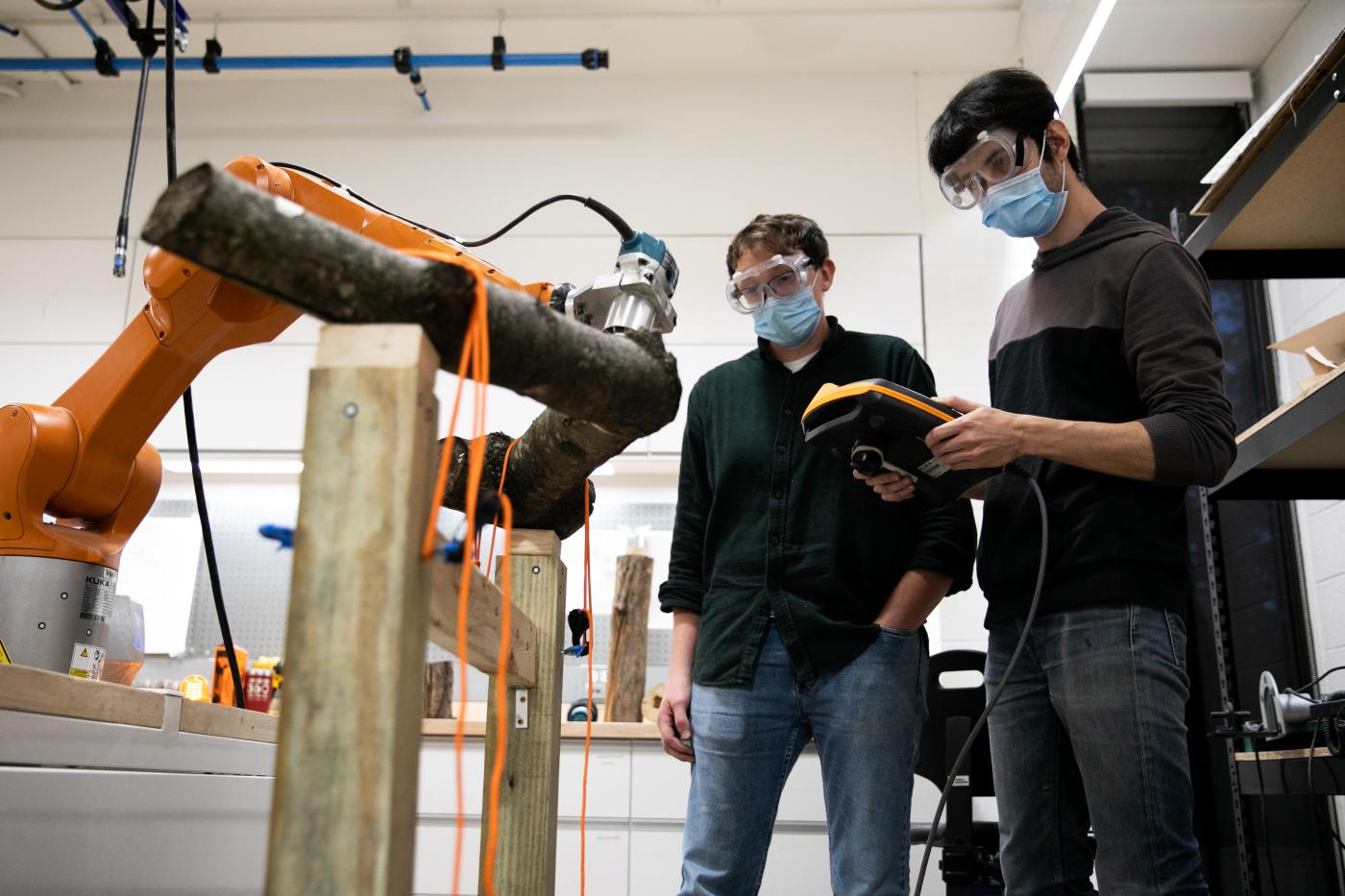
Our spaces and tools are available to UVA students, staff, and faculty through training. Many of our programs within the A School embed these trainings into studios and seminars, and others are through our FabLab Short Courses which we offer each semester. Specialized equipment like our CNC routers, metal 3D printer, clay 3D printer, object and site scanners, CNC embroidery machine, and fleet of Kuka robots are available through consults and Short Courses.
If you would like to gain access in the Lab, want to talk about a project and how to get started, discuss an accommodation for access, or other fabrication related questions, please contact fablab@virginia.edu.
OUR SPACES —
THE OPEN LAB
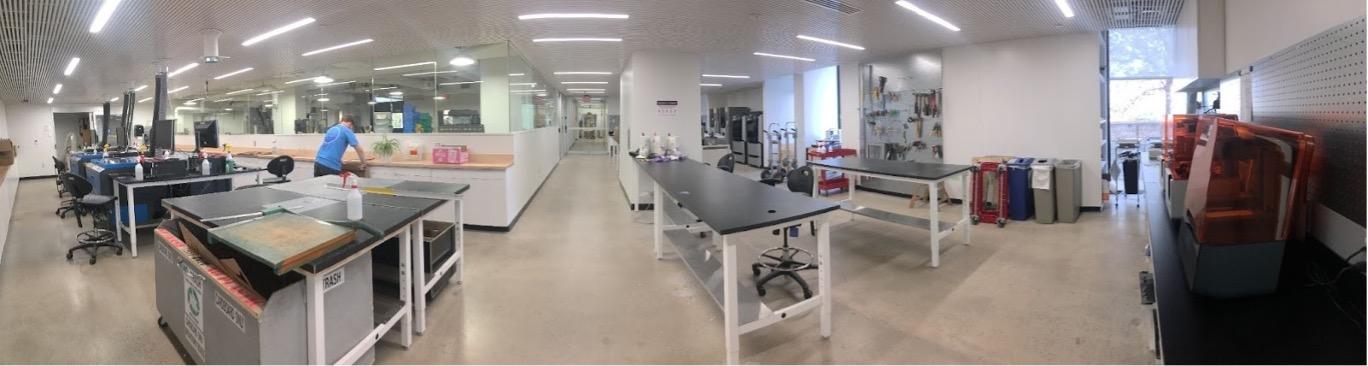
The Open Lab provides 24/7 access to working space for assembly and small gatherings as well as access to our Universal laser cutters, many of our 3D printing fleet (Stratasys FDM and Formlabs SLA printers) and their post-processing equipment, electronics and soldering equipment, Bernina sewing and embroidery machines, a Formech vacuformer, a Wazer water jet, and a tool wall of hand tools. This allows users to make models and test small prototypes and projects on as flexible of a schedule as one can get.
THE WOODSHOP AND THE ELMALEH CNC LAB
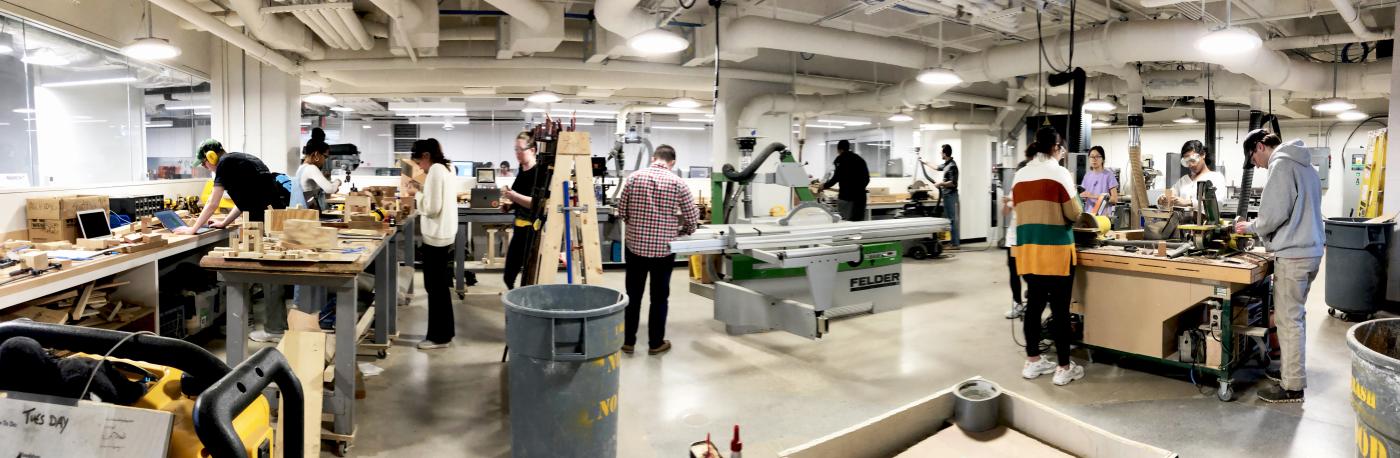
The Woodshop focuses on the analog and digital tools and skills primarily for woodworking processes like cutting, surfacing, jointing, planing, routing, gluing, carving, and other analog techniques. Other materials and techniques, like formwork making and casting are also welcome. The Woodshop is open when staffed with a member of the FabLab Crew and that schedule is updated and posted on the door and on the MakerGrounds website each semester. Within the Woodshop is the Elmaleh CNC Lab, the home of our Onsrud CNC router, a 5’x10’ 3 axis router, perfect for making topographical site models, furniture pieces, formwork, full scale building components, and more. In addition to the indoor space, we open up onto the Workcourt for tools and processes best suited for an outdoor environment.
THE FABLAB STUDIOS
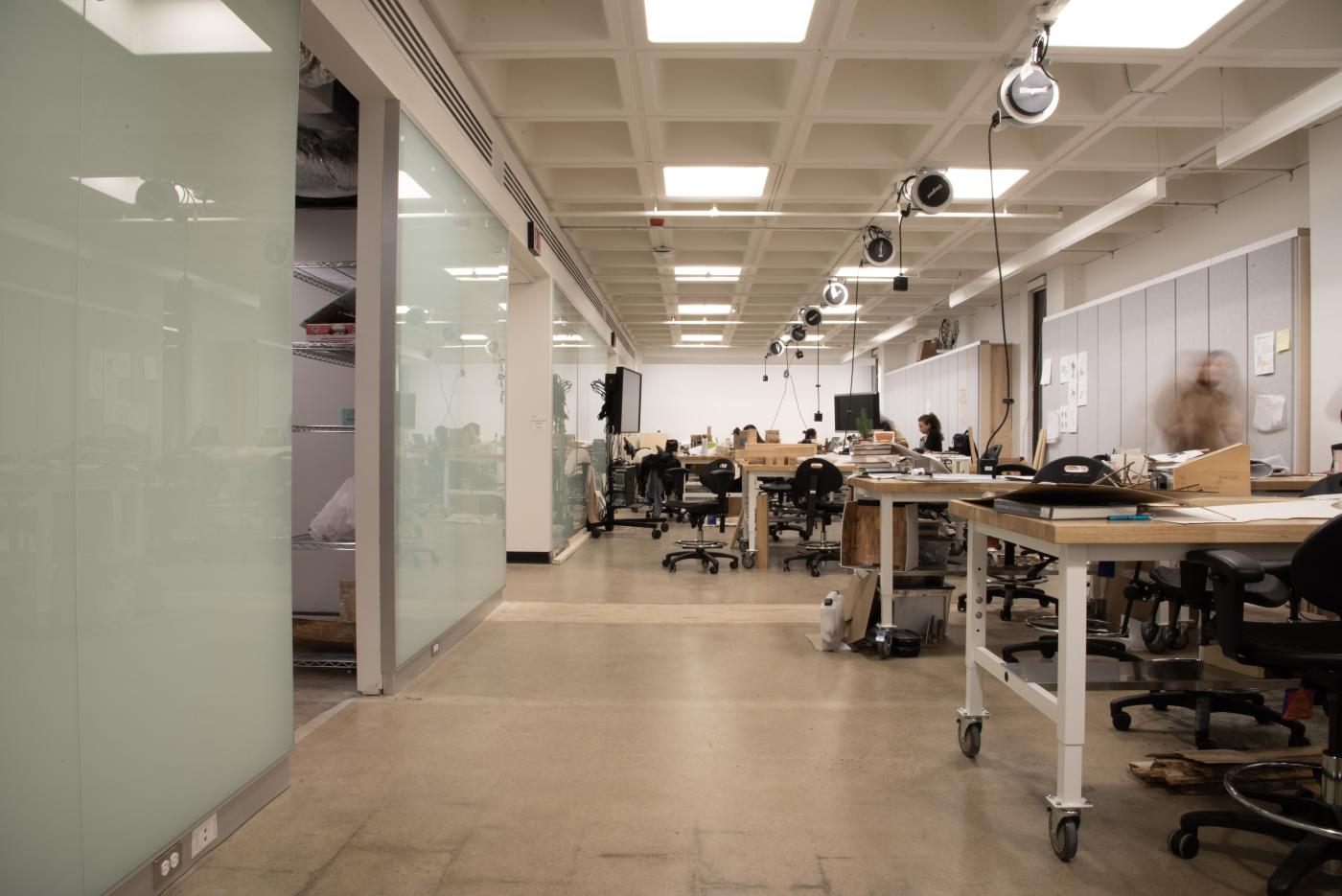
We know that making takes many forms, gets messy, spreads out, and needs to be flexible. Within the FabLab, we have three teaching spaces called the FabLab Studios for classes, projects, and research that are focused on materials and fabrication. Faculty and teaching staff can apply for FabLab Studio space for each semester including the summer. Outfitted with rolling worktables and adjacent to dedicated storage spaces, the Studios can morph throughout the semester as the work needs.
THE GARAGE
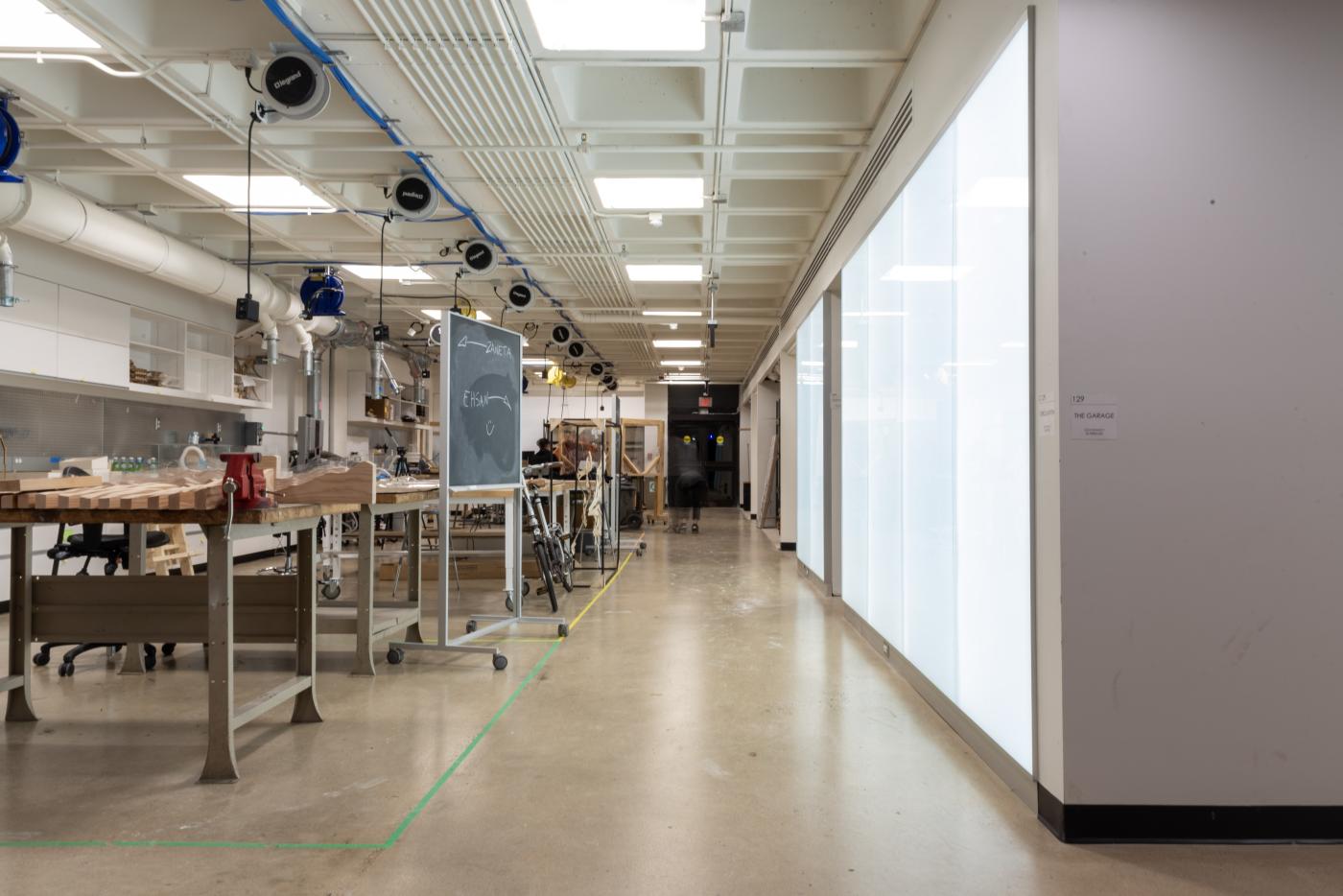
Just outside of the FabLab Studios is a larger, flexible space called the Garage. The Garage is set up with tools for the FabLab Studios, FabLab short courses, and other research work that can expand in size and scope as prototypes get built. It is the home of our fleet of Kuka industrial robotic arms with a 6-10kg payload for teaching and research, a Potterbot clay 3D printer, a Desktop Metal 3D Printer for steel, and other process specific tools.
MILTON AIRFIELD
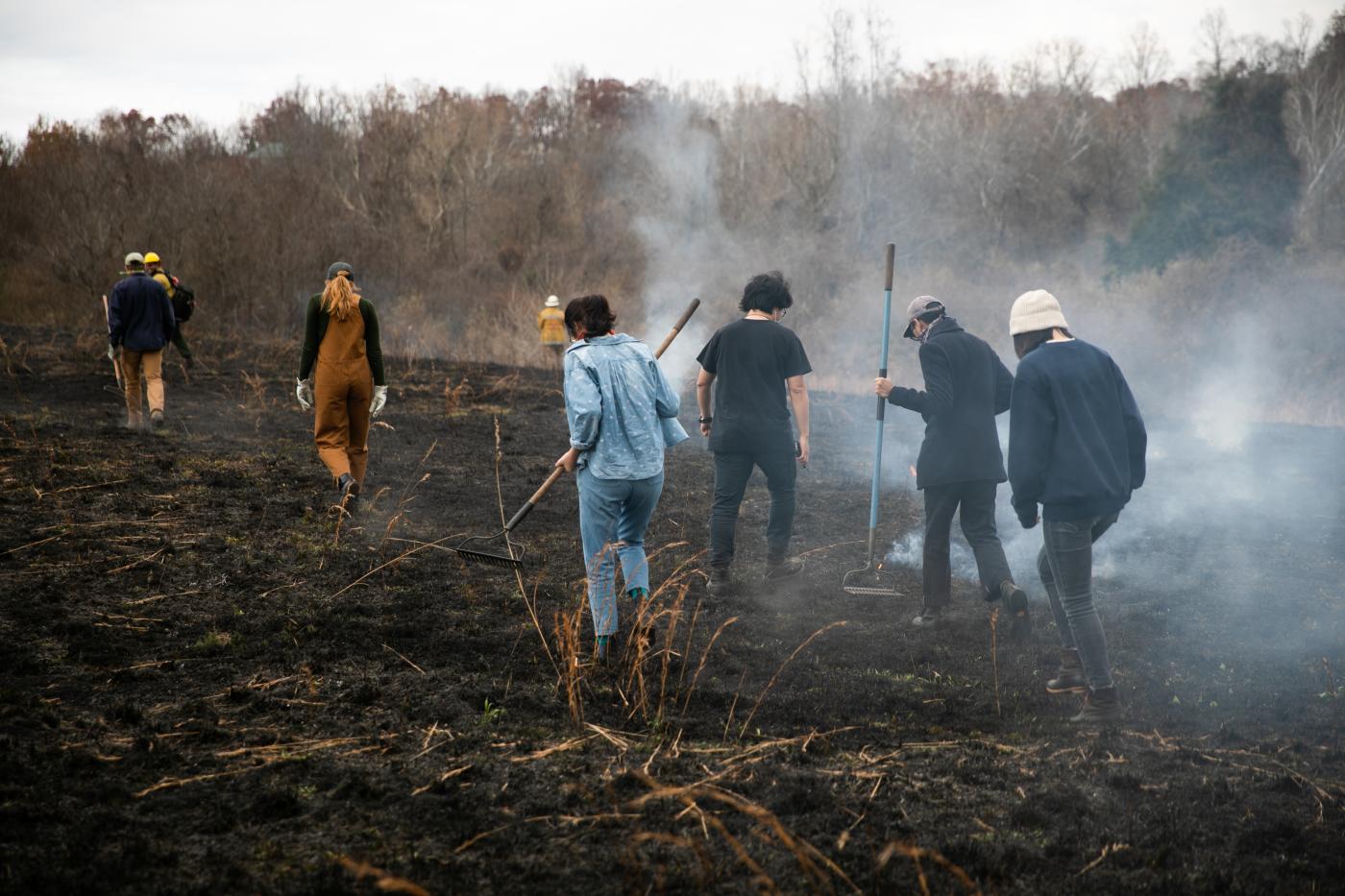
About 20 minutes from Campbell Hall is the Milton Airfield, an interdisciplinary satellite experimentation site for classes to design and test on 172 acres of land with frontage on the Rivanna River. Among many programs, the site has a historic airplane hangar which houses a woodshop, research project labs, and gathering spaces shared by multiple groups on Grounds, including our Department of Landscape Architecture’s Milton LandLab. One of the runways is maintained by the Rivanna Radio Control Club, and is available for model airplane or drone flights. The land is an amazing mix of grassland meadow, forest, and riparian conditions, open for research and experimentation.
If you are interested in starting projects at Milton or going for a visit, contact fablab@virginia.edu and the Milton Operations Team at miltonairfield@virginia.edu for more information about access and support.
The Office of Academic Support at the School of Architecture oversees student records, registration and advising. This office works closely with, and is part of, our Academic Support Team which also includes our Associate Dean of Academics and Associate Dean of Strategic Initiatives.
Sharon McDonald is the Registrar for the School of Architecture.
Tashana Starks is the Director of Advising and Academic Support.
Maya Drake is our Academic Advisor.
The Office of Academic Support offers the following services:
- Grade-related and schedule-related forms and policies
- Course registration assistance and management
- Course Add/Drop instructions and procedures
- Assistance with transcripts
- Assistance with graduation procedures
- Academic advising through appointment
- Major/minor (degree) selection in coordination with faculty program directors
- Planning for study abroad
- Transferring in or out of the School of Architecture
The following forms are among those available through the Office of Academic Support:
- Petition forms
- Approval for summer courses
- Applications for minors and graduate certificates
Note: Many of these forms are online. Please contact the Office of Academic Support (slf7a@virginia.edu / tdp2m@virginia.edu) for assistance.
Do not acquire forms in Garrett Hall, because they are intended for students in the College of Arts and Sciences.
The Related Links on this page provide helpful information for course selection, requirements, and registration.
University-wide Academic Forms for students can be found on the Registrar's webpage. These include Degree Verification Form, Diploma Replacement Request, Transcript Request, and more —
The following curricular forms are for Urban and Environmental Planning majors —
The following curricular forms are for PhD in the Constructed Environment students —
The information below pertains to students enrolled in master’s programs.
PhD funding includes full coverage of tuition, required fees, and single-user health insurance for the duration of the 5-year program. Students also receive direct funding through stipends and/or Graduate Assistantship wages depending on their program year. Learn more about the doctoral student funding process.
TUITION + FEES
University tuition and fees are set annually by the Board of Visitors and are effective only for the academic year noted. For the most up-to-date rates, visit UVA’s tuition and fees information page.
COST OF ATTENDANCE
To estimate the cost of attendance for one academic year (August – May), add the estimated graduate living expenses published annually by Student Financial Services to the tuition and fee costs for your program.
School of Architecture Graduate Cost of Attendance by Program
Graduate students may be eligible for the following types of funding:
INCOMING STUDENT MERIT AID
All graduate applicants are automatically considered for annual merit scholarships by the School of Architecture as part of the application review process. No additional aid applications are required. Admitted students selected to receive merit aid are notified in their offer of admission letters. Scholarships awarded at the time of admission are guaranteed for the duration of the recipient’s period of study provided the student maintains full-time enrollment and good academic standing.
ADMISSION-BASED SCHOLARSHIPS
Interested applicants may apply for additional scholarships and fellowships through the graduate admission application. Please refer to the Graduate Admissions page for detailed information about Admission-Based Scholarships.
CONTINUING STUDENT SCHOLARSHIPS
Continuing students (students who have completed at least one semester of their graduate program) in the School of Architecture may apply for additional scholarships and fellowships that are awarded annually through a competitive application process. Continuing students should visit the Student Financial Support page to learn more.
FEDERAL FINANCIAL AID
U.S. Citizens and Permanent Residents may also apply for federal financial aid by submitting the FAFSA. Federal financial aid is funding from the U.S. Department of Education and is administered at UVA by Student Financial Services. Graduate students are awarded federal aid in the form of Direct Unsubsidized Loans and/or federal work study. Learn more about applying for federal financial aid.
Graduate student loans are not need-based. All graduate students who are eligible for federal aid may accept up to $20,500 each year in Direct Unsubsidized Student Loans. Learn more about Direct Unsubsidized Loans and aggregate loan limits.
Graduate students who demonstrate financial need may also be considered for Federal Work Study (FWS) upon request. Visit the Student Financial Service website for additional details about Federal Work Study.
STUDENT EMPLOYMENT
The UVA School of Architecture provides its students with opportunities to apply for hourly wage employment in the form of student instructor assistantships (SIA), student research assistantships (SRA), and student staff assistantships (SSA). Detailed information about the student hiring process, scope of work, compensation, and more is available on the Student Assistantships + Opportunities webpage.
The Director of Financial Aid oversees the awarding process for Departmental Aid in the School of Architecture, promotes upcoming scholarship and fellowship opportunities, and is available to help students navigate the financial aid process. Prospective, admitted, and continuing students are encouraged to contact the Director of Financial Aid with any questions related to tuition and funding.